
After Hurricane Ian blew through Southwest Florida in 2022, a grower named Mike walked into his backyard to find his three-year-old Glenn mango flat on the ground. Roots ripped halfway out of the sandy soil. Canopy crumpled sideways. He thought it was done.
But the trunk was intact. The roots that were still in the ground looked healthy. So he straightened it, packed soil around the base, drove three stakes into the ground, and tied it up with strips of old t-shirt.
That tree recovered. It took about six months of careful watering and a few nervous storms, but it pushed new growth and stood on its own by the following spring. He removed the stakes and it hasn’t budged since.
Here’s the thing Mike did right that a lot of people get wrong: he staked the tree when it needed it, he used the right materials, and he took the stakes off when the job was done. That last part — knowing when to remove the stakes — is where most people mess up.
Let me walk you through the whole process.
Does Your Mango Tree Actually Need Staking?
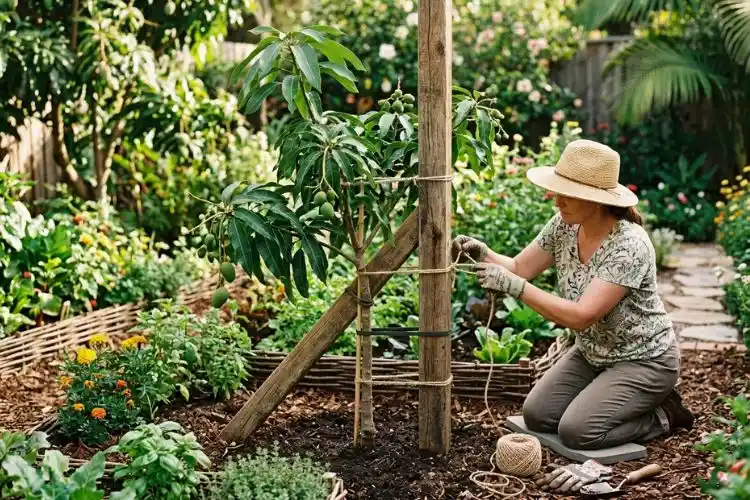
Not every mango tree needs a stake. And staking a tree that doesn’t need one can actually hurt it.
Trees build trunk strength by moving in the wind. That natural swaying triggers the tree to produce denser, thicker wood — reaction wood. A tree that’s locked in place by stakes never gets that signal. It grows a thinner, weaker trunk that depends on the stakes for support. Studies show unstaked trees can develop trunks 20 to 40 percent thicker than unnecessarily staked trees of the same age.
Think of it like a cast on a broken arm. You need it when the bone is healing. But wear it too long on a healthy arm and the muscles waste away.
Stake your mango tree if:
- You just planted it from a nursery pot. The root ball hasn’t anchored yet, and the tree is top-heavy.
- It’s a grafted tree. The graft union is a structural weak point, and the scion canopy sitting on a thin rootstock trunk can snap or bend.
- It’s an air-layered tree. No taproot means much less stability. Plan on staking for two to three years.
- It’s in a windy spot. Coastal areas, open yards, hilltops — persistent wind prevents root establishment if the tree keeps rocking.
- It’s in sandy soil. Sand doesn’t grip roots as well as loam or clay.
- It’s leaning. Whether from wind, light, or bad planting angle, corrective staking can straighten it over time.
Don’t stake if:
- The tree has been in the ground for a year or more and stands upright on its own.
- It’s in a sheltered location with natural wind protection from buildings or other trees.
- It’s a healthy seedling with no lean and a developing root system.
If the tree stands straight, doesn’t wobble when you push the trunk, and isn’t in an exposed spot — leave it alone. Let it build its own strength.
What Materials to Use
Stakes
Wooden stakes are the most common choice. Hardwood like cedar or treated pine, 6 to 8 feet long, about 1.5 to 2 inches thick. They cost $3 to $8 each, they’re available at any garden center, and they look natural. Cedar lasts longest in tropical humidity.
Metal T-posts are stronger and won’t rot or attract termites. They’re great for windy areas and hurricane-prone regions. But they heat up in direct sun and can burn bark, so you need padding between the post and the trunk. They run $5 to $15 each.
Bamboo stakes work for seedlings and very small trees. They’re cheap and lightweight, but they split and rot within a season or two. Fine for temporary duty on a little tree.
Ties — This Is Where People Make the Biggest Mistakes
Use soft, wide, flexible materials. Commercial tree straps are best — they’re designed for this with built-in spacers. Strips of old t-shirt work great too. Nursery tape, pantyhose, rubber tree ties — all good.
Never use wire. Never use zip ties. Never use thin string or twine. These materials cut into the bark as the trunk grows. They create girdling wounds that choke off water and nutrient flow. I’ve seen trees with wire embedded so deep into the trunk that the bark grew over it. The damage is permanent.
Using the wrong tie material is the number one cause of staking-related tree damage, and it’s completely avoidable.
How to Stake a Mango Tree: The Two-Stake Method
This is the standard technique recommended by arborists, and it works for most situations. It gives the tree balanced support while still letting the trunk flex enough to build strength.
- Pick two stakes of equal length and strength.
- Position them on opposite sides of the tree, perpendicular to the direction the wind usually comes from. If wind blows from the west, put stakes on the north and south sides. This lets the tree flex with the wind while the stakes prevent it from tipping.
- Drive stakes into firm ground 12 to 18 inches outside the root ball. Push them 18 to 24 inches deep. If you’re staking at planting time, drive them into the undisturbed soil at the edge of the planting hole — not into the loose backfill. Undisturbed soil holds much better.
- Find the right tie height. Grab the trunk and let go at different heights until you find the lowest point where the tree stands upright on its own. That’s where the tie goes. It’s usually about one-third to one-half of the tree’s total height. Never tie at the very top — that prevents the upper canopy from moving naturally.
- Attach the ties using a figure-8 loop. Loop around the stake, cross in the middle, loop around the trunk. The crossing point acts as a buffer so the stake never touches the bark directly. Leave 1 to 2 inches of slack. The tree should sway slightly but not lean past 45 degrees.
- Test it. Push the tree gently from different directions. It should move a little and return to upright. If it’s completely rigid, loosen the ties. If it leans too far, tighten slightly.
For larger trees or very windy spots, use three stakes spaced evenly around the tree (120 degrees apart) with the same figure-8 tie method on each one. This gives 360-degree protection.
For seedlings and small trees in low-wind areas, a single stake on the windward side is often enough.
For large, recently transplanted trees with trunks over 6 inches, guy wires anchored to the ground at 45-degree angles may be necessary. Always use wide padding where the wire contacts the trunk — never bare wire against bark.
Fixing a Leaning Mango Tree
Trees lean for several reasons: wind, growing toward light, uneven root growth, or just being planted crooked. The fix depends on how old the tree is and how far it’s tilted.
Young trees (under a year): Water deeply to soften the soil. Gently rock the tree upright. Pack soil around the base. Stake it. Done. The root ball shifts easily in loose soil and the tree straightens the same day.
Established trees (1 to 5 years) with a moderate lean: Don’t try to force it straight in one shot. Install a strong stake on the opposite side of the lean. Attach a padded tie and tighten it gradually — about half an inch every one to two weeks. Over a month or two, the tree slowly pulls upright without stressing the trunk or roots.
Mature trees with a severe lean: Honestly, straightening a large tree is often not practical. Many mango trees grow and produce fruit just fine at an angle. You can prune the heavy side to redistribute weight, install a permanent angled brace, or just accept the lean. For a really valuable tree, call an arborist.
When to Remove the Stakes
This is the step most people forget. Over half of homeowners leave tree stakes on way too long, according to arborist surveys. Years, sometimes. And the damage adds up.
Ties that aren’t loosened cut into the bark as the trunk expands. The trunk develops a weak, pinched shape at the tie point. The tree never builds the trunk strength it needs to stand alone.
Check for removal readiness starting at 6 months. Here’s the test: on a calm day, untie the tree from the stakes. Watch it for 24 to 48 hours. If it stands upright and doesn’t wobble when you push the trunk, it’s ready.
Other signs it’s time:
- The trunk is visibly thicker than when you planted it.
- The tree survived a windy period without problems.
- It flexes and bounces back to vertical when pushed.
When you remove, cut the ties first. Don’t unwrap them — the unwinding can scrape bark. Leave the stakes standing for another week or two as a visual backup. If the tree stays straight, pull the stakes and fill the holes with soil.
If the tree starts leaning after removal, re-stake for another two to three months with looser ties that allow more movement. It just needs more time.
Most mango trees should be free of stakes within 6 to 12 months. Air-layered trees might need 12 to 24 months since they lack a taproot. But going beyond 18 to 24 months with stakes is rarely a good idea — at that point, the staking is doing more harm than good.
Staking for Storms and Hurricanes
If you grow mangoes anywhere along the Gulf Coast, in Florida, or in the Caribbean, storms are part of the deal. Mango canopies are dense and heavy — they catch wind like a sail.
Before a storm hits:
- Check all stakes and ties. Tighten loose connections. Replace worn ties.
- If your tree isn’t staked, install three-stake support as fast as you can.
- Prune out dead branches, crossing interior branches, and heavy leaf clusters. This lets wind pass through instead of pushing against a solid wall of leaves.
- Water deeply 24 hours before the storm. Hydrated wood bends better than dry wood.
- Move container trees indoors, into a garage, or flat against a wall on the sheltered side of the house.
After the storm:
If the tree is leaning but roots are still in the ground, straighten and re-stake within 24 to 48 hours. Pack soil around exposed roots. Water deeply. Apply mulch. Be patient — recovery takes 6 to 18 months.
If the tree blew completely over, lift it from the root ball — never pull by the trunk. That tears more roots. Use straps and helpers. Get it upright, backfill, stake firmly with three stakes or guy wires, and keep the water consistent for months.
For long-term wind protection, plant a windbreak on the side the wind comes from. A row of dense shrubs or hedges cuts wind speed by 40 to 60 percent. Prune your mango’s canopy into an open-center shape so wind flows through instead of slamming into it.
The Mistakes That Cause the Most Damage
Leaving stakes on for years. Set a reminder. Check every three months. Test for removal at six months.
Using wire or zip ties. These strangle the trunk. Use soft, wide, flexible ties. Period.
Tying too tight. The tree needs to move a little. No movement means no trunk strength.
Driving stakes through the root ball. That severs the roots you’re trying to protect. Stay 12 to 18 inches outside.
Staking a tree that doesn’t need it. If it’s stable and upright, leave it alone. Let it grow strong on its own.
Final Thought
Mike told me something a while back that stuck with me. He said the hardest part wasn’t staking the tree after the hurricane. The hardest part was trusting it to stand on its own when the time came to pull the stakes.
He took them out the following April. The tree swayed in the breeze and held. It’s been standing on its own ever since — thicker trunk, deeper roots, stronger than it was before the storm hit.
That’s how staking is supposed to work. You hold the tree up until it can hold itself. Then you let go.