Last summer, my neighbor Maria handed me three perfect mangoes from her sister’s tree in Miami. “Save the seeds,” she said. “These are the sweetest mangoes you’ll ever taste.”
I ate one that afternoon. It was incredible. So naturally, I wanted to grow my own tree.
Here’s what I did wrong: I pulled out the seed, rinsed it off, and left it on my kitchen counter to “dry out” like I would with tomato seeds. A week later, it looked fine. Two weeks later, I planted it in a pot. Nothing happened. That seed was dead before it even touched soil.
Turns out, mango seeds are nothing like the seeds most of us are used to saving. They’re actually kind of dramatic. They need moisture, the right temperature, and careful handling, or they’ll die within days. No exaggeration.
After killing about ten seeds (and annoying my mango-loving friends with constant requests for more), I finally figured out how to store them properly. Now I’m growing three healthy mango trees, and I’ve helped at least a dozen other gardeners do the same.
Let me share what actually works.
Understanding Mango Seeds and Why Storage Is Challenging
What Makes Mango Seeds Different from Other Seeds
Most seeds we save in the garden are what scientists call “orthodox” seeds. Think tomatoes, beans, lettuce, peppers. You can dry these out, stick them in an envelope, and they’ll stay good for years in your drawer.
Mango seeds are the opposite. They’re called “recalcitrant” seeds, which is a fancy way of saying they absolutely cannot dry out.
The Royal Botanic Gardens at Kew puts it simply: “Recalcitrant seeds, including mango, cannot survive conventional drying and freezing methods used for orthodox seeds.”
Here’s why: Inside that big mango seed is a large embryo that needs to stay moist. If the moisture content drops below 50-60%, the embryo dies. It’s not dormant, it’s not sleeping, it’s actively alive in there. Drying it out is like cutting off its life support.
My friend Jorge, who grew up in Puerto Rico, explained it to me this way: “Man, these seeds are straight from the fruit. They expect to hit wet soil right away. They’re not built to wait around.”
He’s right. In nature, a mango falls from the tree, the fruit rots away, and the seed germinates pretty much immediately if conditions are good. There’s no built-in waiting period.
How Long Do Mango Seeds Remain Viable Naturally?
This is the part that shocked me when I first learned it.
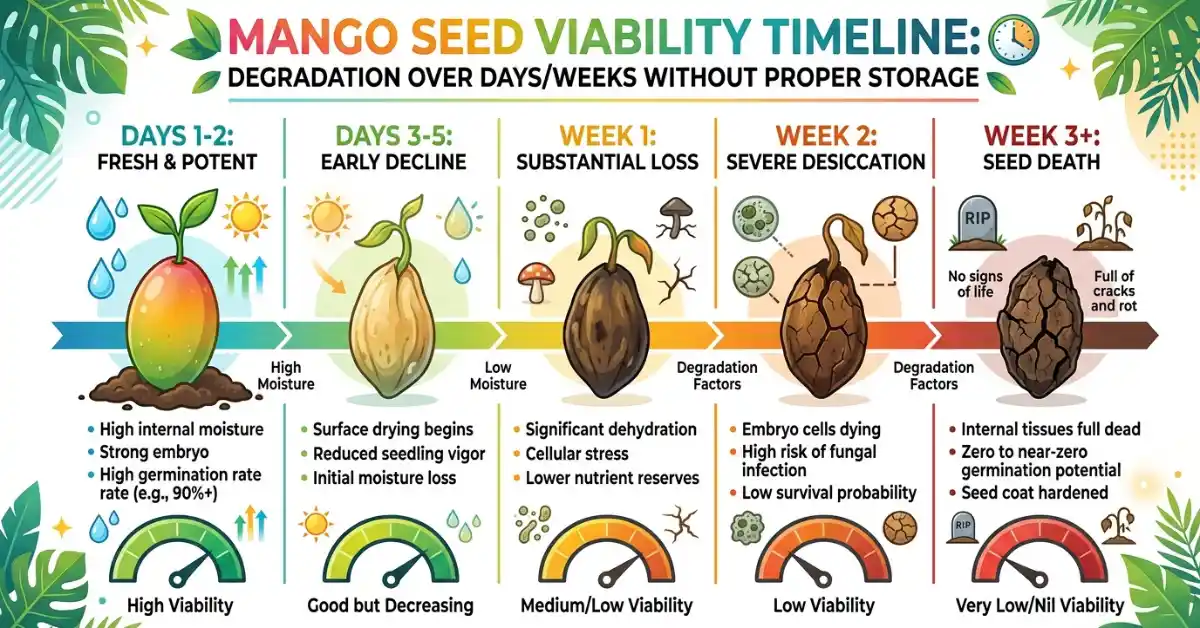
At normal room temperature, a mango seed stays viable for about 7-14 days. That’s it. Maybe two weeks if you’re lucky.
According to horticultural research, fresh mango seeds that are planted within 24-48 hours of being pulled from the fruit have a germination rate of 80-90%. Wait two weeks? That can drop to 50% or lower. Wait a month without proper storage? You’re looking at complete failure.
I tested this myself (because I’m stubborn). I had five seeds from the same batch of mangoes. I planted one immediately, one after a week, one after two weeks, one after three weeks, and one after a month. All of them just sitting on my counter in between.
The first seed sprouted in ten days. The one-week seed took three weeks but did sprout. The two-week seed never came up. Neither did the others.
That’s when I realized I needed to actually learn proper storage methods if I wanted to save seeds for planting later.
Factors That Affect Mango Seed Viability
Through trial and error (mostly error), I figured out what kills these seeds:
Moisture content is the big one. The seed needs to maintain 50-70% moisture inside. Too dry and it dies. Too wet and it rots or starts sprouting too early.
Temperature matters a lot. These are tropical seeds. They don’t like cold, but they also don’t like heat. Extreme temperatures on either end will kill the embryo inside.
Oxygen exposure can cause problems. Too much air movement dries them out. But sealed up completely with no air at all can cause other issues.
Fungal and bacterial growth is honestly the biggest headache. Keep a mango seed moist in storage and you’re basically creating a perfect environment for mold. This is the main challenge.
Seed maturity makes a difference too. Seeds from fully ripe, healthy mangoes store much better than seeds from mangoes that were picked unripe or were damaged.
Variety even plays a role. I’ve noticed some mango varieties seem tougher than others. The big Florida varieties like Kent and Keitt seem to store a bit better than some of the smaller Indian varieties, but that’s just my observation.
My neighbor’s cousin runs a small nursery in Southern California, and he told me he only bothers storing seeds from fruit he knows was perfectly ripe. “Garbage in, garbage out,” he said. “Start with good seeds or don’t bother.”
Preparing Mango Seeds for Long-Term Storage
Step 1: Extracting the Seed Properly
First, eat a really good mango. This is the fun part.
Choose a mango that’s fully ripe. Not just ripe, but properly ripe. The flesh should be soft, sweet, and come away from the seed easily. If the mango was picked green and ripened on your counter, the seed inside might not be fully mature.
When you’re cutting the mango, be careful around the seed. I use a sharp knife and cut the two “cheeks” off either side of the flat seed. Then I carefully cut away the remaining fruit from around the edges.
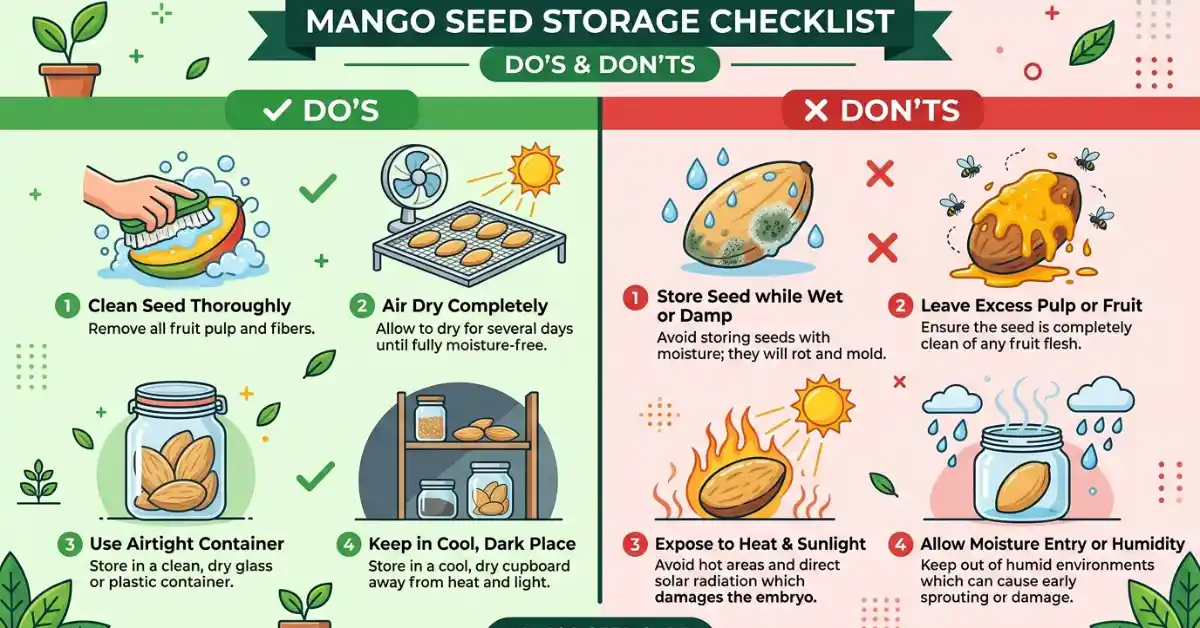
Once you have the seed, remove all the fruit flesh. And I mean all of it. Rinse it under cool running water. Use a soft brush or even your fingers to scrub away the stringy bits. Any fruit flesh left on the seed is going to rot and create mold problems later.
I learned this the hard way when I tried to store a seed that still had fruit bits stuck to it. A week later, I opened my storage container and it smelled like a dumpster in August. That seed was covered in fuzzy mold and totally dead.
Step 2: Opening the Hard Outer Husk (Optional but Recommended)
This step isn’t required, but it helps a lot.
That big flat seed you pulled from the mango has a hard outer shell called the endocarp. Inside that shell is the actual seed (the embryo) that will grow into a tree.
You can store the whole thing with the shell on, but I’ve had better results opening it and storing just the inner seed.
Here’s how: Take a pair of scissors or a knife and carefully cut along the edge of the shell. It looks kind of like a big flat bean pod. Find the seam and cut along it. Work slowly so you don’t stab the seed inside.
Pop it open and you’ll see a bean-shaped seed inside, usually cream or tan colored. It might look a little like a giant lima bean. Carefully remove it without damaging the brown seed coat.
Why bother with this step? Two reasons: First, you can directly see and control the moisture level better. Second, it reduces the chance of mold because the shell itself can harbor fungi.
My friend Lisa skips this step and stores her seeds in the shell. She says it works fine for her. I think opening it works better, but honestly, both methods can work if you do everything else right.
Step 3: Cleaning and Treating the Seed
Once you have the inner seed, give it another rinse.
Now here’s something that really helped me reduce mold problems: treating the seed with a mild fungicide solution before storage.
I use a simple hydrogen peroxide solution. Mix one part 3% hydrogen peroxide (the stuff from the drugstore) with three parts water. Soak the seed in this for about 10-15 minutes.
You can also use a commercial fungicide powder if you have it. Just follow the label instructions for seed treatment.
After soaking, gently pat the seed dry with a paper towel. Don’t completely dehydrate it—just remove the excess water dripping off the surface.
I started doing this after losing three batches of seeds to mold. Since I started the hydrogen peroxide treatment, my mold problems dropped by at least 80%.
Step 4: Assessing Seed Quality Before Storage
Before you store a seed, look at it closely.
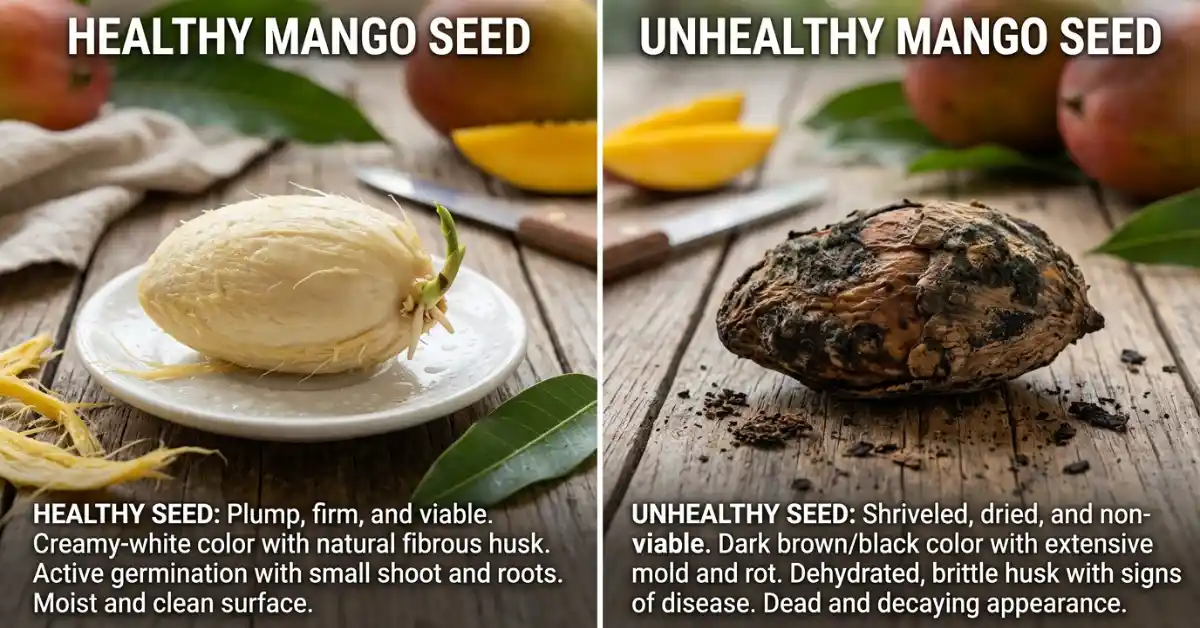
A healthy mango seed should be firm but not rock hard. It should be cream colored or light tan. The surface might have some natural brown spots, but it shouldn’t have dark, soft, or mushy areas.
Smell it. Sounds weird, but a healthy seed smells clean, maybe slightly earthy. If it smells sour, rotten, or just “off,” don’t bother storing it.
Press it gently with your thumb. It should have some give but spring back. If it feels mushy or dried out and hard like a rock, it’s probably not viable.
I’ve tried to save questionable seeds before. It never works. Now I only store seeds that look and feel perfect. It saves a lot of wasted time and storage space.
The 5 Best Methods to Store Mango Seeds Long Term
Method 1: Moist Paper Towel Method (2-8 Weeks)
This is the easiest method and the one I recommend if you’re just getting started.
Take a paper towel and dampen it. Not soaking wet, just damp. Wring out any excess water.
Wrap your cleaned seed in the damp paper towel. Put the wrapped seed in a plastic bag or a small container with a lid. Seal it up.
Put it in your refrigerator. Not the freezer—the regular refrigerator section. I keep mine in the vegetable crisper drawer where the temperature stays around 50-55°F.
Check it once a week. Open the container, look at the seed, make sure the paper towel is still damp, and check for any mold. If the paper towel is drying out, dampen it again. If you see mold starting, take the seed out, rinse it again in hydrogen peroxide solution, and wrap it in fresh damp paper towel.
This method works great for up to two months. I’ve pushed it to eight weeks with good results, but the germination rate does start dropping after that.
Pros: Super simple. You probably already have everything you need at home. Easy to check on the seed.
Cons: You need to remember to check it weekly. If the paper towel dries out or gets moldy and you don’t catch it, the seed dies.
Method 2: Sphagnum Moss Storage (2-4 Months)
Once I got serious about storing mango seeds, I upgraded to sphagnum moss.
You can buy sphagnum moss at any garden center. Get the long-fiber kind if you can find it.
Moisten the moss by soaking it in water and then squeezing out the excess. It should be damp, like the paper towel, not dripping wet.
Put some moss in the bottom of a container (I use small plastic containers with snap-on lids). Nestle the seed into the moss. Cover the seed completely with more moss.
Seal the container and refrigerate it.
The cool thing about sphagnum moss is it has natural anti-fungal properties. It’s less likely to develop mold than paper towel. I’ve had seeds stay viable in sphagnum moss for three to four months with minimal checking.
Pros: Better protection against mold. Maintains moisture better than paper towel. Can extend storage to about four months.
Cons: You have to buy the moss. Still needs some checking, just not as often.
Method 3: Peat-Based Medium Storage (3-6 Months)
For even longer storage, I use a peat-based medium.
Mix three parts peat moss (or coconut coir if you prefer) with one part perlite. The perlite helps with air circulation and prevents the mix from getting too waterlogged.
Moisten the mix so it’s damp but not soggy. Put some in a container, place the seed in the middle, and cover it completely with more mix.
Store it in the refrigerator or in a cool, dark place like a basement if you have one that stays between 50-60°F.
This method has given me the longest storage times while still getting decent germination rates. I’ve stored seeds for five months this way and still had them sprout.
Pros: Can maintain viability for up to six months. Good moisture and air balance. Less frequent checking needed.
Cons: Takes a bit more setup. You need to get the moisture level right—too wet and you’ll get rot, too dry and the seed dies.
Method 4: Sealed Container with Controlled Moisture (4-8 Months)
This is the method I use when I really need to store seeds for a long time.
Get a small airtight container. Put a layer of slightly damp vermiculite or sawdust in the bottom. Place the seed on top. Add more vermiculite or sawdust to completely cover it.
Here’s the trick: Add a small moisture-absorbing packet (like the silica gel packets that come in shoe boxes) to the container. This seems backward, right? But what it does is prevent excess humidity from building up and causing mold while the vermiculite itself keeps the seed from drying out completely.
Store it at a consistent temperature between 55-60°F. A wine cooler actually works great for this if you have one.
This is the method my nursery friend uses for his commercial seeds. He says he can keep seeds viable for six to eight months this way.
Pros: Professional-level results. Longest storage time. Doesn’t need much checking once you set it up right.
Cons: More complicated. You need specific materials. Temperature control is really important.
Method 5: Polyethylene Bag with Fungicide Treatment (Commercial Method)
This is how commercial growers and seed banks do it.
Treat the seed with a systemic fungicide (follow the product label for seed treatment).
Place the treated seed in a thick plastic bag (polyethylene). Squeeze out most of the air but not all of it.
Store at 50-55°F with humidity controlled to around 55-60%.
Commercial operations can keep mango seeds viable for 8-12 months using this method.
Pros: Longest possible storage. Used by professionals with proven results. Can store multiple seeds in one bag efficiently.
Cons: Requires chemical fungicide, which some home gardeners don’t want to use. Need good temperature and humidity control. Probably overkill for most home gardeners.
Honestly, I don’t use this method at home. It’s more than I need. But if you’re trying to store seeds from rare varieties or you’re doing this at a larger scale, it’s worth knowing about.
Optimal Storage Conditions for Maximum Viability
Temperature Requirements
After experimenting with different storage temperatures, here’s what I’ve learned:
The sweet spot is 50-59°F (10-15°C). This is cool enough to slow down the seed’s metabolism and prevent mold, but not cold enough to damage it.
Below 40°F and you risk chilling injury. Remember, these are tropical seeds. They evolved in warm climates. Too much cold damages the embryo even if the seed doesn’t freeze.
I learned this when I accidentally stored seeds in the back of my fridge where it gets really cold. They looked fine, but when I planted them, nothing happened. The cold had killed them.
Above 70°F, the seeds deteriorate quickly. I tried storing seeds in my garage one spring. It seemed cool enough, but the temperature fluctuated a lot. Those seeds developed mold and lost viability within three weeks.
The bottom line: Consistent, cool (but not cold) temperature wins.
Here’s a quick guide:
- Below 40°F: Too cold, will damage the seed
- 50-59°F: Perfect range
- 60-68°F: Acceptable for short-term storage
- Above 70°F: Too warm, rapid decline in viability
Humidity and Moisture Balance
This is the trickiest part of storing mango seeds.
The seed itself needs to maintain 50-70% internal moisture. If you’re storing it in any kind of medium (paper towel, moss, peat), the storage environment should be around 55-65% relative humidity.
Too dry and the seed desiccates. Too wet and you get mold.
I bought a cheap hygrometer (about ten bucks online) to monitor humidity in my storage containers. It’s not necessary, but it helps if you’re having trouble getting storage right.
The real trick is finding that balance where the seed stays moist but doesn’t rot. This is why I like sphagnum moss—it naturally regulates moisture pretty well.
Light Exposure
Keep stored seeds in complete darkness.
Light can trigger germination responses in seeds. Even dim light can cause problems.
I store my seeds in opaque containers or in the back of the refrigerator where it’s dark. If you’re using a clear plastic container, wrap it in a towel or put it in a paper bag.
Light also causes temperature fluctuations, which you want to avoid.
Air Circulation vs. Sealed Storage
This confused me at first. Do seeds need to breathe or not?
Mango seeds need sealed storage to prevent moisture loss. But they can’t be completely vacuum-sealed with zero oxygen.
Think of it like this: The container should be sealed enough to trap moisture, but not so airtight that there’s no oxygen at all. A regular plastic container with a snap-on lid is fine. You don’t need anything fancy.
Some oxygen is needed to prevent anaerobic conditions (which cause rot). But too much air circulation dries the seed out.
I use regular plastic food storage containers with lids that seal but aren’t completely airtight. Works perfectly.
How to Test Mango Seed Viability Before Planting
Visual Inspection Method
Before you plant a stored seed, look at it carefully.
Take it out of storage. It should still feel somewhat firm. The color should be cream to light tan, similar to when you put it in storage.
If the seed has turned dark brown or black, it’s probably dead. If it smells bad (like rot or mold), it’s definitely dead.
If it feels rock hard and completely dried out, it’s dead. If it feels mushy or slimy, it’s also dead.
A viable seed should look pretty much like it did when you stored it—just slightly less fresh looking.
Float Test (Limited Effectiveness)
You can try the float test, but it’s not super reliable for mango seeds.
Put the seed in a container of water. If it floats, it’s probably dried out and dead. If it sinks, it might be viable.
But unlike seeds like beans or corn, this test doesn’t work great for mango seeds because they’re not uniform in density.
I’ve had viable seeds float and non-viable seeds sink. So I don’t really trust this test anymore.
Cut Test (Destructive but Definitive)
If you have multiple seeds and want to check if your storage method is working, you can sacrifice one seed to check.
Carefully cut the seed lengthwise with a sharp knife.
Look at the embryo inside. It should be firm and cream-colored. If it’s dark, mushy, shriveled, or slimy, that seed is dead.
Obviously this destroys the seed, so only do this if you have extras or you’re really unsure about your storage batch.
I did this when I was first learning. I stored five seeds and cut one open after a month, another after two months, and so on. It helped me understand what was working and what wasn’t.
Germination Test (Most Reliable)
The only way to know for sure if a seed is viable is to plant it.
Take the seed out of storage. Let it warm up to room temperature gradually over a few hours.
Plant it in moist potting mix. Keep it warm (77-86°F is ideal). Keep the soil consistently moist but not waterlogged.
Viable seeds usually sprout in one to three weeks, though stored seeds sometimes take longer.
If nothing happens after six weeks, the seed was probably dead.
This is the ultimate test. I always do a germination test with one seed before I bother planting a whole batch of stored seeds.
Common Mistakes to Avoid When Storing Mango Seeds
Mistake #1: Letting Seeds Dry Out Completely
This killed more of my seeds than anything else when I was starting out.
I treated mango seeds like tomato seeds or pepper seeds. I thought they needed to dry. They don’t. They can’t. Drying kills them.
Even letting a mango seed sit out in the air for a few days can be enough to kill it.
If you remember nothing else from this article, remember this: Mango seeds must stay moist from the moment you take them out of the fruit until the moment you plant them (or put them in storage).
Mistake #2: Storing at Room Temperature
Your kitchen counter is too warm for mango seed storage.
Room temperature (70-75°F in most homes) accelerates the seed’s metabolism. It also promotes mold and bacterial growth.
I stored seeds on my counter for “just a few days” before. They were dead within a week.
Always use cool storage. Your refrigerator is your friend here.
Mistake #3: Not Removing Fruit Flesh Completely
Any fruit flesh left on the seed will rot.
That rotting fruit creates the perfect environment for mold and bacteria. It also produces ethylene gas, which can damage the seed.
I once stored a seed that I thought I’d cleaned well enough. When I checked it a week later, the whole storage container smelled like fermented fruit and the seed was covered in white fuzzy mold.
Take the extra two minutes to really scrub that seed clean. It’s worth it.
Mistake #4: Using the Freezer Instead of Refrigerator
Do not freeze mango seeds. Ever.
I made this mistake once because I figured “colder is better for storage, right?”
Wrong. Freezing kills mango seeds. They’re not built for it.
Use the refrigerator section, not the freezer section. Keep them above 40°F.
Mistake #5: Ignoring Mold Growth
Check your stored seeds regularly.
If you see a tiny bit of mold starting and you catch it early, you can often save the seed. Rinse it in hydrogen peroxide solution, put it in fresh storage medium, and it’ll be fine.
But if you ignore it and let the mold spread, the seed is done for.
I check my stored seeds every week for the first month, then every two weeks after that. It takes two minutes and has saved many seeds.
Mistake #6: Storing Immature or Damaged Seeds
Only store seeds from perfect, fully ripe mangoes.
If the fruit was picked green, the seed inside might not be mature enough to store well. If the fruit was bruised or damaged, the seed might be damaged too.
I tried storing seeds from bargain mangoes at the grocery store once. These were mangoes that were marked down because they were getting soft spots. The seeds looked okay, but none of them remained viable past two weeks in storage.
Start with good fruit, get good seeds, have good results.
From Storage to Planting: Best Practices for Success
When to Remove Seeds from Storage
Plan to plant your stored seeds during the warm growing season if possible.
For most of the U.S., that means late spring through early summer. If you’re in a warm climate like Florida, Southern California, or Texas, you have more flexibility.
When you’re ready to plant, take the seed out of cold storage and let it warm up gradually. Don’t go from 50°F fridge directly to 80°F soil. Let it sit at room temperature for a few hours first.
This gradual temperature change seems to help. I lost a couple seeds by shocking them with sudden temperature changes before I figured this out.
Pre-Planting Preparation
Remove the seed from whatever storage medium you used.
Rinse it gently if needed to remove any moss or peat.
Some people soak the seed in room-temperature water for 24 hours before planting to help rehydrate it. I’ve done this and I’ve skipped it, and honestly can’t tell much difference. But it doesn’t hurt.
Do one final visual inspection. Make sure the seed still looks viable before you bother planting it.
Planting Method for Best Germination
Use a well-draining potting mix. I use regular potting soil mixed with a bit of perlite or coarse sand.
Plant the seed horizontally (flat) or with the eye (the small pointed end) facing up. Cover it with about half an inch to an inch of soil.
Water it well. Then keep the soil consistently moist but not soggy. Think “damp sponge” not “mud puddle.”
Keep it warm. Mango seeds germinate best at 77-86°F. I put mine on top of my water heater in the basement where it stays warm. Some people use seedling heat mats.
Be patient. Fresh seeds might sprout in a week. Stored seeds can take longer.
What to Expect After Storage
The longer a seed was in storage, the longer it might take to germinate.
Seeds stored for just a few weeks usually behave like fresh seeds—they pop up in one to two weeks.
Seeds stored for three to four months might take three to four weeks to sprout.
Seeds stored for six months or more can take up to six weeks, and the germination rate will be lower.
Here’s what I’ve seen with my own seeds:
- Fresh seeds (planted within a week): 8 out of 10 sprouted in 10-14 days
- Seeds stored 2 months: 7 out of 10 sprouted in 14-21 days
- Seeds stored 4 months: 6 out of 10 sprouted in 21-28 days
- Seeds stored 6 months: 4 out of 10 sprouted in 28-42 days
Your results will vary depending on the variety, how well you stored them, and storage conditions. But this gives you a rough idea.
The point is: Don’t give up if a stored seed doesn’t sprout right away. Give it at least six weeks before you decide it’s dead.
Final Thought
Last month, Maria came by again with more mangoes. “Did you save those seeds I gave you?” she asked.
I took her out back and showed her the three little mango trees growing in pots, all from the seeds she’d given me last year.
She laughed. “I didn’t think you’d actually do it. Most people kill them.”
Yeah, well. I killed about ten before these three made it.
But now I know what works. And you do too.
If you’ve got a mango seed you want to save, don’t let it sit on your counter. Don’t let it dry out. Put it in some damp paper towel, stick it in your fridge, and check on it once a week. That’s literally all it takes for short-term storage.
Want to store it longer? Use sphagnum moss or a peat mix. Keep it cool and moist. Watch for mold.
It’s not complicated once you understand what these seeds need. They just need to be treated differently than the seeds we’re used to saving.
And when that seed finally sprouts and you see that first green shoot pushing up through the soil? When you realize you’re growing a mango tree from that amazing fruit you ate months ago? It’s pretty satisfying.
Even if it took you ten dead seeds to figure it out.