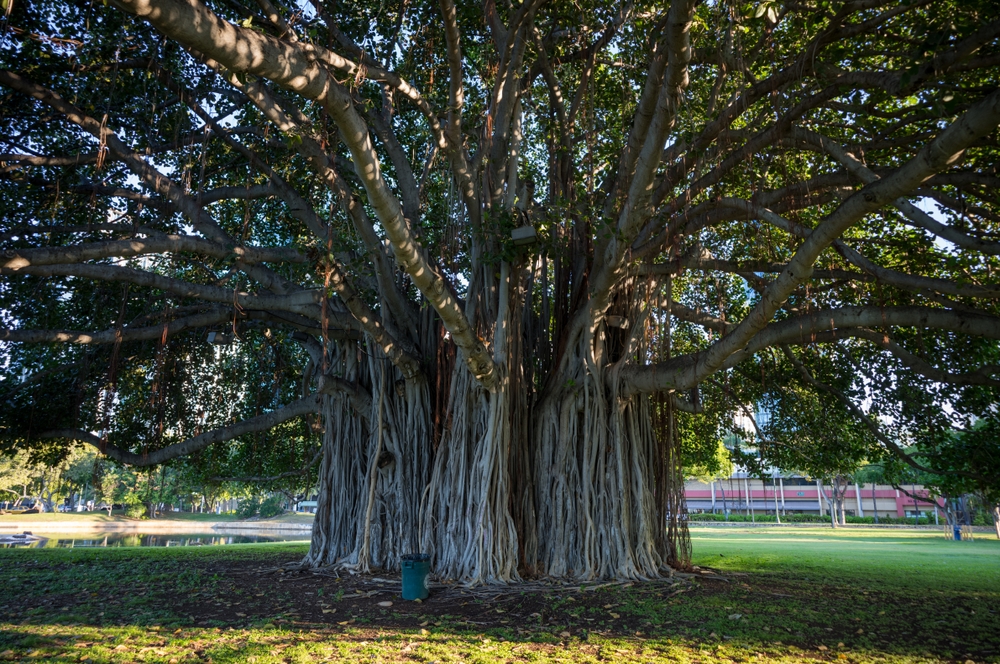
What if a single tree could swallow an entire forest, shelter thousands of people, and hold the secrets of ancient civilizations — all at once? Welcome to the world of the sacred banyan tree, where the roots tell a story far deeper than the soil they grow in
What Makes Banyan Tree Roots Truly Unique?
Most trees have a pretty simple deal going on underground. Roots go down. They grab water and nutrients. They anchor the tree. That’s the whole job.
Banyan trees didn’t get that memo.
The Aerial Root System — Growing Up, Down, and Sideways
The banyan does something no other common tree does at the same scale. It grows roots from its branches — not just from the base of the trunk.
These are called aerial prop roots. They start as thin tendrils hanging down from the limbs, looking almost like vines. Over time, they thicken. They reach the soil. They anchor in. And then they become secondary trunks — full-sized columns of wood that support the expanding canopy above.
The technical name for this is columnar root architecture. In plain language, it means the tree builds new legs for itself as it grows outward. There’s no natural limit to how far it can spread. As long as conditions are right, a banyan tree can just keep going — branch, root, new trunk, repeat.
“The banyan’s aerial root system represents one of the most sophisticated structural engineering solutions in the plant kingdom — each prop root functions simultaneously as a support column, water transport system, and nutrient absorber.” — Dr. P.S. Ramakrishnan, Professor Emeritus of Ecology, Jawaharlal Nehru University
Here’s how big this gets in practice:
- The Great Banyan Tree in Kolkata has over 3,600 recorded aerial roots as of 2022
- A mature banyan canopy can cover up to 5 acres of land
- Aerial roots grow at roughly 1–2 inches per week under good conditions
How Banyan Roots Break the Rules of Normal Tree Biology
Most trees send roots one direction — down. Banyan roots grow in three directions at once: down toward the soil, outward along the surface, and along walls, rocks and structures they encounter along the way.
These roots are strong enough to split concrete. They work their way into stone walls and ancient buildings. If you’ve ever seen photos of temples in Southeast Asia being swallowed by tree roots, that’s a banyan — or a close cousin — slowly winning a centuries-long wrestling match with human construction.
The root system also operates as a unified network. Even when a banyan looks like dozens of separate trees, the whole thing shares water and nutrients across every root and trunk. It functions like one giant interconnected organism — which is exactly what it is.
The roots also produce a milky latex sap. People have been using that sap in medicine for over 3,000 years. We’ll get to that shortly.
And in drought conditions? Banyan roots dig down until they find water — reaching deep underground water tables that shallower-rooted trees can’t access. This is a big part of why banyan trees outlast almost everything around them.
15 Fascinating Facts About Sacred Banyan Tree Roots
Let’s get into the facts. Some of these I knew going in. A few of them genuinely surprised me when I first read them.
Fact 1: A Single Banyan Tree Can Become an Entire Forest
This is the one that stopped me at the botanical garden in Homestead.
The Great Banyan Tree (Ficus benghalensis) in Kolkata, India is technically one organism. It covers 3.5 acres of land. It holds the Guinness World Record for the world’s largest tree by canopy area. It has been growing for an estimated 250+ years.
What looks like a grove of trees is one root system, one genetic identity, one living thing that has simply been building new trunks for itself over two and a half centuries.
When people first hear this, they usually think it’s an exaggeration. It’s not. The original main trunk of the Great Banyan was destroyed by fungal infection in 1925. And the tree didn’t die. The root network was already so established that it just kept growing without its original trunk. It has no main trunk anymore — just thousands of prop roots doing the structural job the original trunk used to do.
Fact 2: Banyan Roots Can Outlive Entire Civilizations
The Thimmamma Marrimanu banyan tree in Andhra Pradesh, India has a documented canopy spread of 19,107 square meters. Records suggest it is over 550 years old.
Some banyan trees are estimated — through carbon dating of root systems and historical records — to be over 3,000 years old.
Here’s what makes this stranger than it sounds: banyan trees show almost no biological aging markers. Scientists call this negligible senescence. Most living things accumulate cellular damage over time. Banyan trees seem to not do this — or at least to do it so slowly that we haven’t caught it yet.
A banyan root that started growing when Rome was still an empire might still be growing right now.
Fact 3: Banyan Roots Actually Breathe Air
Banyan aerial roots have tiny pores called lenticels scattered across their surface. These are gas exchange cells — they pull oxygen in and push carbon dioxide out. The roots are breathing air while they hang above the ground before they even reach the soil.
In waterlogged or flood conditions, banyans go a step further. They produce pneumatophores — vertical root extensions that push upward out of the soil like snorkels, keeping the root system oxygenated even when the ground is flooded.
This is why banyan trees can survive both severe drought and flooding — conditions that kill most other trees. They’ve evolved a root system that handles both extremes.
Fact 4: Banyan Roots Create Their Own Ecosystem
A large, established banyan root system doesn’t just support the tree. It builds a habitat.
The spaces between prop roots create sheltered micro-environments for reptiles, small mammals and insects. The canopy above attracts birds. The roots support soil microbiology that attracts more insects, which attract more birds.
Researchers have documented over 230 species of birds, insects and mammals living within the root systems of large banyan trees.
The banyan also has one of the most exclusive pollination relationships in nature. Fig wasps (Eupristina masoni) are the only insects that can pollinate banyan trees. And the banyan tree is the only place those wasps can complete their life cycle. Neither species can exist without the other. This relationship is estimated to be 90 million years old — which means these two organisms co-evolved together before most modern animals existed.
Banyan root systems have also been found to increase local soil biodiversity by up to 40% in surrounding areas — a measurable ecological benefit just from the tree being there.
Fact 5: The Roots Produce Natural Medicine
My friend in Homestead grows a small banyan in a large container on his property — more as a curiosity than anything else. He knew it had traditional medicinal uses but wasn’t sure of the specifics.
The specifics are pretty remarkable.
Banyan root bark contains flavonoids, tannins, and a compound called bengalenoside. These have been studied in laboratory settings for anti-inflammatory properties. Root extracts have shown antibacterial activity against Staphylococcus aureus and E. coli in controlled studies (Journal of Ethnopharmacology, 2019).
A 2021 study in the Asian Pacific Journal of Tropical Biomedicine found banyan root extract inhibited bacterial growth in 87% of tested strains.
Traditional Ayurvedic practitioners have been using root bark decoctions for 3,000+ years to treat skin conditions, manage diabetes symptoms, and reduce joint inflammation. Modern pharmaceutical researchers are now studying banyan root compounds for potential anti-diabetic drug development.
Three thousand years of traditional use pointing scientists toward the same compounds they’re now testing in labs is not a coincidence.
Fact 6: Ancient Hindu Scriptures Described Banyan Roots with Scientific Accuracy
The Bhagavad Gita, Chapter 15, Verse 1, describes an “eternal banyan tree with roots above and branches below.” Scholars interpret this as a cosmic metaphor. But botanists reading it notice something else — it’s an accurate description of how aerial roots work. They originate above ground and grow downward.
The Atharva Veda uses banyan roots as a symbol of unbreakable family lineage. The Skanda Purana lists banyan roots as one of the five most sacred plant materials in Vedic ritual.
Ancient Sanskrit texts describe the aerial root growth pattern with enough botanical accuracy that researchers have noted it predates modern plant science by approximately 2,000 years. People were observing these roots carefully and writing about them long before there was a scientific framework to explain what they were seeing.
Fact 7: Banyan Roots Have Been Used as Living Bridges for 500 Years
This is one of the most remarkable things I’ve encountered in any plant research.
In Meghalaya, Northeast India, the indigenous Khasi and Jaintia tribes learned centuries ago that banyan and rubber fig aerial roots could be trained across rivers and gaps. Over decades, guided by split bamboo channels and careful tending, the roots would grow into the opposite bank and thicken into load-bearing structures.
These are called living root bridges. There are approximately 75 known examples still in use in Meghalaya today. Some are over 500 years old and can support 50+ people walking simultaneously.
The Double Decker Root Bridge in Cherrapunji is a UNESCO-recognized cultural heritage site. It’s a two-story root bridge — upper and lower spans — built across the same river at different heights.
Here’s what makes them different from conventional engineering: these bridges get stronger with age. Normal bridges deteriorate. Living root bridges grow more robust every year as the root system continues to develop. A 500-year-old root bridge is stronger today than it was 200 years ago.
The practice of training aerial roots this way is called pleaching — an ancient horticultural technique.
Fact 8: The Word “Banyan” Comes from Merchants, Not Botany
The name “banyan” has nothing to do with the tree’s biology. It comes from the Gujarati word “bania” — meaning merchant or trader.
Portuguese traders arriving in India in the 16th century saw Indian merchants (banias) conducting business under the shade of large fig trees. They started calling the trees “banyan trees” — and the name stuck in European botanical records.
This practice of using banyan trees as outdoor marketplaces and community gathering spaces is documented across South and Southeast Asia for centuries. The shade from the canopy was reliable. The prop roots created natural seating and boundary markers. The tree essentially functioned as a village commons.
Village panchayats — local governing bodies — across India still hold official community meetings beneath banyan trees today. The tradition hasn’t fully broken.
The British East India Company also adopted the banyan tree as a symbol of commercial expansion, noting that like the tree, their trading network spread outward from a central point and put down new roots wherever it landed.
Fact 9: Sacred Banyan Trees Have Legal Protection in Multiple Countries
In India, banyan trees are protected under the Indian Forest Act and various state-level tree preservation laws. Cutting a banyan without government permission can result in fines up to ₹10,000 and potential imprisonment.
The Great Banyan Tree in Kolkata has its own dedicated conservation team and receives official government funding for ongoing preservation.
In Sri Lanka, cutting a bodhi or banyan tree near a temple is simultaneously a legal offense and a religious violation — treated seriously on both counts.
Thailand and Myanmar have specific Buddhist temple laws protecting banyan trees on sacred grounds.
These aren’t symbolic protections. They’re actively enforced laws built around the cultural and ecological value of trees that in some cases have been growing in their locations for centuries.
Fact 10: Young Banyan Aerial Roots Can Photosynthesize
This one surprised me more than almost anything else in this list.
The roots of most trees don’t contain chlorophyll. They don’t need to — they live underground where there’s no light anyway. But young banyan aerial roots contain chlorophyll. For a brief developmental period before they reach the soil and mature into prop roots, they are actively producing energy from sunlight.
They are simultaneously roots and photosynthetic tissue. For a plant.
This biological phenomenon is called root chloroplast activity and is rarely documented outside of aquatic and certain epiphytic plant species. The early energy production from this brief photosynthetic phase is thought to help accelerate root growth during the tree’s most vulnerable developmental period.
“The photosynthetic capacity observed in juvenile banyan aerial roots challenges our fundamental assumptions about root function. It suggests the banyan evolved a remarkably efficient energy strategy during its most vulnerable growth stages.” — Dr. Suzanne Simard, Professor of Forest Ecology, University of British Columbia
Fact 11: The World’s Largest Living Tree by Canopy Is a Banyan
Numbers are useful here:
- Canopy circumference: approximately 1 kilometer
- Number of prop roots: 3,600+
- Estimated age: 250+ years
- Canopy area: 3.5 acres
- Main trunk: doesn’t exist — destroyed by fungal infection in 1925
The Great Banyan Tree in Kolkata is not the tallest tree in the world. It’s not the oldest. But it covers more ground than any other single tree on Earth — and it’s been doing it without its original trunk for nearly 100 years.
That last part is the thing that really sticks with me. The tree lost its center and just kept growing.
Fact 12: Engineers Are Studying Banyan Roots to Build Better Structures
Civil engineers at IIT Bombay are studying banyan root growth patterns to develop self-healing concrete structures. The way a banyan root system repairs itself, routes around damage, and distributes structural load across multiple columns is a model for redundant engineering design.
The banyan’s modular root architecture — where any single root failure doesn’t compromise the whole system — is being used as a design template for earthquake-resistant building foundations.
NASA’s bio-architecture division has cited banyan root systems as inspiration for potential extraterrestrial habitat structures. The idea of a habitat that grows stronger over time, repairs itself, and expands organically is attractive for long-term space applications.
In Singapore and Hong Kong, urban planners are studying banyan root integration for sustainable urban forest design. Singapore has planted over 500 banyan trees in the past decade as part of its “City in a Garden” initiative.
Fact 13: Banyan Roots Communicate Underground
This is the part of the story that feels most like science fiction and is most clearly real.
Like other trees studied in “Wood Wide Web” research, banyan trees use mycorrhizal fungal networks connecting their root systems to neighboring plants. Through these networks, banyan trees can send chemical signals when under pest attack — and neighboring vegetation responds by producing defensive compounds before the pest even reaches them.
The banyan’s massive root network makes it what researchers call a “hub tree” or “mother tree” in its ecosystem. It actively shares nutrients with younger and weaker plants through the fungal network, supporting their growth and survival.
This underground communication system was first theorized by Dr. Suzanne Simard and has since been documented in banyan-specific ecosystems. The tree that looks like a solitary giant is actually operating as a community support system for everything around it.
Fact 14: Banyan Trees Have Survived Events That Destroyed Everything Around Them
The Lahaina Banyan Tree in Maui, Hawaii survived the catastrophic 2023 Maui wildfires that destroyed most of the surrounding town. In the days after the fire, images of that tree standing — scorched but alive — became a symbol of resilience for the community. Recovery efforts for the tree were covered internationally.
Several ancient banyan trees along coastal India survived the 2004 Indian Ocean tsunami. Their root systems were credited with stabilizing soil and reducing wave energy in their immediate areas.
In cyclone-prone regions of Odisha, India, banyan trees are deliberately planted as natural windbreakers. Root tensile strength studies show banyan prop roots can withstand wind speeds of up to 150 mph before structural failure.
Historians also record that banyan trees in Hiroshima, Japan were among the first living things to show new growth after the 1945 atomic bombing.
That’s not mythology. These trees just have root systems deep and resilient enough to survive conditions that erase most other life in the area.
Fact 15: Banyan Roots May Help Fight Climate Change
Banyan trees are highly efficient carbon sequestrators. Their massive biomass — all those trunks, all those roots, all that wood — stores significantly more carbon than an equivalent area of conventional forest.
The deep root systems reduce soil erosion and help maintain groundwater levels in drought-prone regions — both serious issues in tropical areas facing increasing climate stress.
Research published in Global Change Biology (2022) suggests large banyan groves could function as “carbon islands” in urban heat environments — pockets of carbon storage and temperature regulation in cities that are otherwise dominated by concrete and asphalt.
Climate scientists at the World Agroforestry Centre are studying banyan root architecture for reforestation strategies in degraded tropical soils. The banyan’s ability to establish and grow in poor, rocky, and degraded soil conditions makes it a strong candidate for climate restoration work in areas where other trees struggle to survive.
One tree that builds its own forest, feeds its neighbors underground, breathes through aerial roots, survives cyclones and wildfires, and pulls carbon out of the atmosphere while it does all of this.
It’s a hard thing to look at and not feel a little amazed.