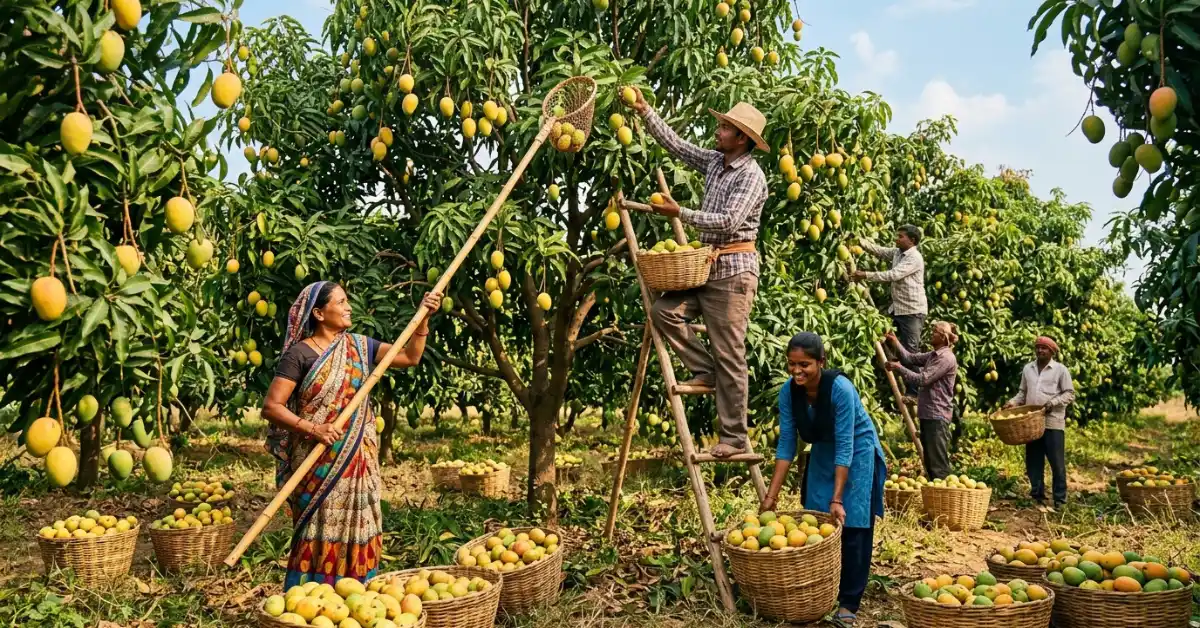
My neighbor Ray grew a beautiful Kent mango tree in his backyard in South Florida. Big canopy, healthy leaves, loaded with fruit every July. But for two years straight, he’d wait until the mangoes turned soft and golden on the tree before picking them. By the time he got to them, half were on the ground bruised and splitting open, birds had pecked holes in a dozen more, and fruit flies had moved into the rest. He was losing most of his crop to patience.
Then a grower at the Redland fruit stand told him the secret: you don’t wait for mangoes to ripen on the tree. You pick them when they’re mature but still firm and green, then let them ripen indoors. That single piece of advice changed everything. Ray’s harvest went from maybe 20 usable mangoes to well over 100 that same season.
If you’ve got a mango tree — in the ground or in a container — knowing when and how to harvest makes the difference between a great crop and a wasted one. Let me walk you through it.
The Science of Mango Maturity — How Mangoes Ripen on the Tree
Here’s the thing most new mango growers don’t realize: mangoes are climacteric fruits. That means they keep ripening after you pick them. You do NOT need to let them turn yellow and soft on the tree.
Most experienced growers — commercial and backyard alike — harvest at the “mature green” stage. The fruit is full-sized and fully developed, but still firm and green. Once picked, it ripens beautifully on its own in 3 to 10 days.
The key concept is this: maturity and ripeness are not the same thing.
- Maturity means the fruit has finished developing. The seed is hard. The flesh has enough starch to convert to sugar. It WILL ripen properly off the tree.
- Ripeness means the fruit is soft, sweet, and ready to eat.
Pick a mature mango and you’ll get great flavor after it ripens indoors. Pick an immature mango — one that hasn’t finished developing — and it’ll never taste right. It’ll shrivel, stay sour, and disappoint you.
The Role of Ethylene
Once a mango hits maturity, it starts producing ethylene gas — the natural ripening hormone. Ethylene does the heavy lifting:
- Converts starch to sugar (that’s where the sweetness comes from)
- Breaks down chlorophyll (green fades to yellow or orange)
- Softens the flesh
- Develops those aromatic compounds that make a ripe mango smell incredible
This happens whether the fruit is hanging on the tree or sitting on your kitchen counter. That’s why picking at mature green works so well.
How Long From Flower to Fruit?
| Climate | Days From Bloom to Harvest |
|---|---|
| Tropical lowlands (India, Philippines) | 100–130 days |
| Subtropical (Florida, parts of Australia) | 120–150 days |
| Cooler subtropical zones | 130–160 days |
Exact timing depends on your variety, weather, and tree health.
“The single most important concept for mango harvesters to understand is the difference between maturity and ripeness. A mature mango picked green will ripen beautifully. An immature mango picked green will never develop acceptable eating quality — no matter how long you wait.” — Dr. Jeffrey Brecht, Postharvest Physiologist, University of Florida
7 Proven Signs Your Mango Is Ready to Harvest
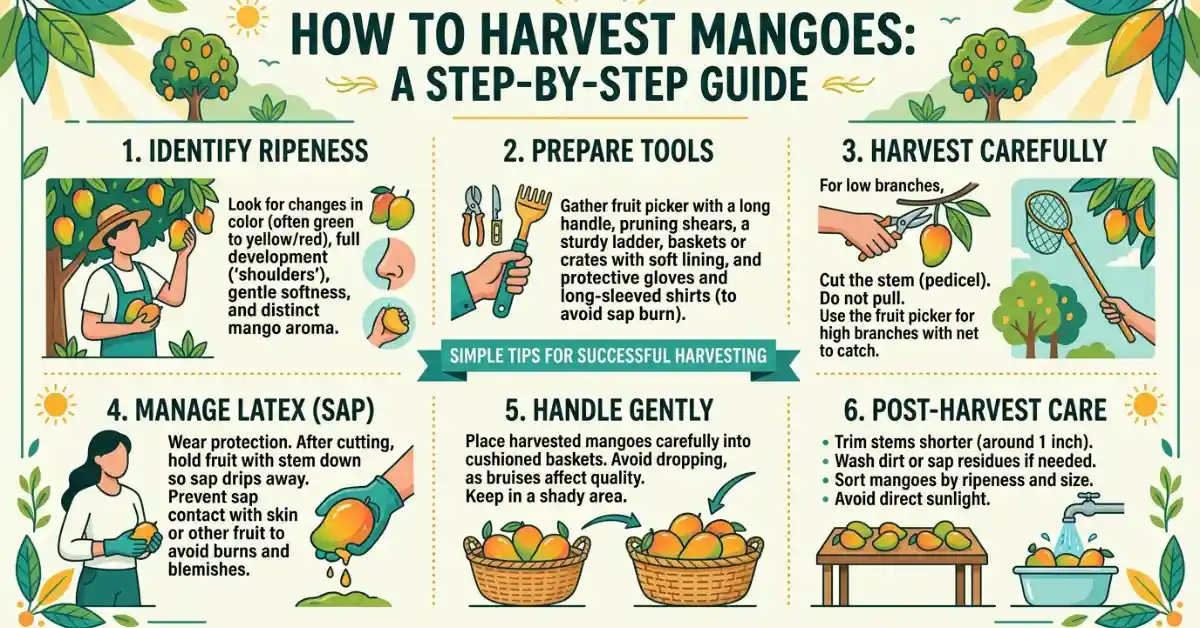
Don’t rely on just one sign. Cross-check at least three of these before you start picking.
Sign #1 — Shoulder Development
This is the most reliable visual clue. Look at the area near the stem. When the mango is mature, the shoulders fill out and rise above the stem attachment point. You’ll see a rounded, plump look — almost like the fruit is bulging upward. Immature fruit has flat or sunken shoulders.
Sign #2 — Color Break
Most varieties show a subtle shift in skin color at maturity. This isn’t the full ripe color — it’s a slight change. Green might lighten to a yellowish-green. Some varieties like Kent and Tommy Atkins develop a reddish blush on the sun-exposed side.
A tricky one: Keitt mangoes stay green even when fully mature. If you’re growing Keitt, lean on the other signs instead.
Sign #3 — The Sap Test
Cut a small stem near a fruit. Immature mangoes squirt sap out hard and fast — watery and abundant. Mature mangoes ooze sap slowly. It’s thicker and stickier. This is one of the most reliable indicators used by growers in India and Southeast Asia.
Sign #4 — Natural Fruit Drop
When the first healthy, full-sized mangoes start falling from the tree on their own, that’s nature telling you the rest of the crop is ready or close to it. The connection between fruit and branch naturally weakens at maturity.
Fruit that drops because of wind, pests, or disease doesn’t count — only healthy fruit.
Sign #5 — Flesh Color (Sacrifice One Fruit)
This is the most definitive test, but you have to cut one open. Slice into a mature-looking mango and check the flesh near the seed. Immature flesh is white or very pale. Mature flesh is deep yellow to orange. Commercial growers routinely sacrifice 2 to 3 fruits to test before harvesting the rest.
Sign #6 — The Float Test
Drop a mango in a bucket of water. Immature mangoes sink. Mature mangoes float or hover near the surface. As the fruit matures, starch converts to sugar and internal air spaces increase, making it more buoyant. This method is about 80% accurate.
Sign #7 — Aroma at the Stem End
Sniff the area where the stem meets the fruit. Mature mangoes give off a mild sweet, fruity smell. No aroma usually means it’s not ready yet. This sign is strongest in aromatic varieties like Alphonso and Kesar and less obvious in Tommy Atkins or Keitt.
🥭 Pro Tip: The most reliable combination for home growers is shoulder development + color break + sap test. Use these three together and you’ll rarely pick too early or too late.
Mango Harvest Season — When to Pick by Region
Harvest Calendar
| Region | Primary Season | Peak Months |
|---|---|---|
| South India (AP, TN, Karnataka) | April–July | May–June |
| North India (UP, Bihar) | May–August | June–July |
| Florida, USA | June–September | July–August |
| Mexico | March–September | May–July |
| Australia | September–March | November–January |
| Philippines / Thailand | March–June | April–May |
| Caribbean | May–September | June–August |
Best Time of Day to Pick
Harvest in the early morning — between 7 AM and 11 AM. Three reasons:
- Cooler temperatures mean less field heat in the fruit
- Sap pressure is lowest in the morning, which means less sap burn
- The fruit is firmest and handles without bruising
Avoid picking in the afternoon heat, during rain, or right after rain. Wet fruit picks up fungal problems faster, and rain increases sap pressure inside the stems.
“Harvesting mangoes in the early morning, before the heat of the day builds sap pressure in the stems, can reduce latex burn damage by up to 70%.” — Dr. Sisir Mitra, Former President, ISHS Mango Working Group
How to Harvest Mangoes — Tools, Techniques & Step-by-Step
Pick Your Method
| Method | Best For | Cost |
|---|---|---|
| Hand picking | Low trees, container trees | Free |
| Pole harvester with basket | Medium to tall trees (most common for home growers) | $20–60 |
| Clippers on extension pole | Any height, cleanest cuts | $40–100 |
Hand Picking (Trees Under 8–10 Feet)
- Wear long sleeves and gloves — mango sap irritates skin
- Grasp the fruit gently
- Cut the stem 1 to 2 inches above the fruit with sharp shears
- Never pull or twist — that tears the skin and invites sap burn
- Place the fruit stem-side down right away so sap drains away from the skin
Pole Harvester (The Go-To for Home Growers)
- Extend the telescoping pole and position the basket under the fruit
- Guide the cutting blade around the stem
- Apply gentle downward pressure to cut the stem clean
- The fruit drops into the cushioned basket — not onto the ground
- Lower the pole and remove the fruit
What NOT to Do
Never shake branches to knock fruit loose. It causes bruising, stem tears, sap damage, and broken branches. Shaken mangoes have a dramatically shorter shelf life. I’ve seen people do this and end up with a pile of brown, leaking fruit within two days. Just don’t.
The Harvesting Workflow
- Harvest in early morning
- Confirm maturity with at least 3 of the 7 signs
- Cut — don’t pull — and leave a 1 to 3 inch stem stub
- Place stem-side down immediately
- Move fruit to shade within 30 minutes
- De-sap before storing
How to Prevent Sap Burn During Harvest
Sap burn is the #1 cosmetic problem with harvested mangoes. That caustic latex in the stems causes permanent dark brown or black marks on the skin. It happens fast — within minutes of contact.
Here’s how to prevent it:
- Pick in the morning when sap pressure is lowest
- Leave a long stem stub (2 to 3 inches) so sap drains from the stem, not onto the fruit
- Place fruit stem-side down on a wire rack and let sap drain for 30 minutes to 2 hours
- Wash with a lime solution — mix a 1% calcium hydroxide solution or warm water with a few drops of dish soap. Dip each fruit for 30 to 60 seconds, wipe dry
- Don’t harvest after rain — rain increases sap flow
And protect yourself. Mango sap contains compounds related to urushiol — the same stuff in poison ivy. Some people get an itchy rash from it. Wear gloves, long sleeves, and keep your hands away from your face. Wash with soap and cold water immediately if sap hits your skin.
Post-Harvest: Ripening and Storing Your Mangoes
How to Ripen Mangoes After Picking
Newspaper wrap method — my favorite for home growers. Wrap each mango in newspaper and place in a warm, dark spot. The trapped ethylene speeds ripening. Most fruit will be ready in 2 to 4 days. Toss a ripe banana in the bag to boost the ethylene even more.
Rice bin method — traditional across India. Bury the mangoes in a container of dry rice. The rice traps ethylene while absorbing excess moisture. Ripens in 2 to 3 days with great results.
Room temperature — just set them out in a single layer. Takes 3 to 7 days. Simple but slower.
Never refrigerate unripe mangoes. Cold kills the ripening process and damages the flavor. Only refrigerate after the fruit is fully ripe — then it’ll keep for 4 to 7 days.
Storage Quick Reference
| Stage | How to Store | How Long |
|---|---|---|
| Unripe | Room temperature | Until ripe (3–7 days) |
| Ripe | Refrigerator | 4–7 days |
| Cut | Airtight container, fridge | 2–3 days |
| Frozen pulp | Freezer bags | 6–12 months |
According to the Indian Council of Agricultural Research (ICAR), proper post-harvest handling can reduce mango losses from 25–40% down to less than 10%.
How to Get More Fruit From Your Mango Tree
A grower I know in Homestead, Florida, went from 50 mangoes to over 200 in one season by making three changes: he adjusted his fertilizer, thinned his fruit, and stopped watering before flowering. Here’s what works.
Fertilizer Timing
| When | What to Apply |
|---|---|
| After harvest | High nitrogen (20-10-10) — pushes new growth |
| Before flowering | High potassium/phosphorus (0-10-20) — promotes blooms |
| During fruit development | Balanced with extra potassium (10-10-20) |
The biggest mistake? Feeding nitrogen year-round. Mango trees need a stress period to trigger flowering. If the tree is too comfortable, it grows leaves instead of fruit.
Fruit Thinning
This sounds backwards, but removing 30 to 40% of developing fruitlets when they’re marble-sized results in bigger, sweeter, better fruit from the ones that remain. It also reduces stress on the tree and helps prevent alternate bearing (heavy crop one year, light the next).
Water Stress Before Flowering
Cut back watering 2 to 3 months before you expect flowers. This mild drought stress signals the tree to switch from vegetative growth to reproductive mode. Once you see fruit set, resume regular watering.
Don’t Spray During Flowering
Mango flowers are pollinated by flies and wasps — not bees. Spraying insecticides during bloom wipes out your pollinators and kills your fruit set. If you have a hopper problem, spray neem oil before the flowers open, not after.
Harvesting From Container Mango Trees
Container trees produce fewer mangoes, but they’re often really good quality. And harvesting is easy — no ladders, no poles. Just sharp shears and a steady hand.
| Container Size | Expected Yield |
|---|---|
| 15–20 gallons | 5–15 fruits |
| 25–30 gallons | 15–40 fruits |
| 40+ gallons | 30–75+ fruits |
Thin aggressively on container trees. They have limited root space and limited resources. Keep 1 fruit per flower cluster for the best size and sweetness. If it’s your tree’s first season producing fruit, let it keep only 2 to 3 mangoes total. That lets the young tree build a stronger root system and canopy for bigger harvests down the road.
🌱 Pro Tip: After harvesting from a container tree, give it a light balanced fertilizer and a deep watering. The tree just spent a lot of energy making fruit — help it recover.
Final Thought
Harvesting mangoes isn’t complicated once you understand the basics. Pick at mature green, not tree-ripe. Cut the stem — don’t pull. Work in the morning. Manage the sap. Ripen indoors. Do these things and you’ll get more usable fruit with better quality from the same tree. Ray figured it out, and so can you.