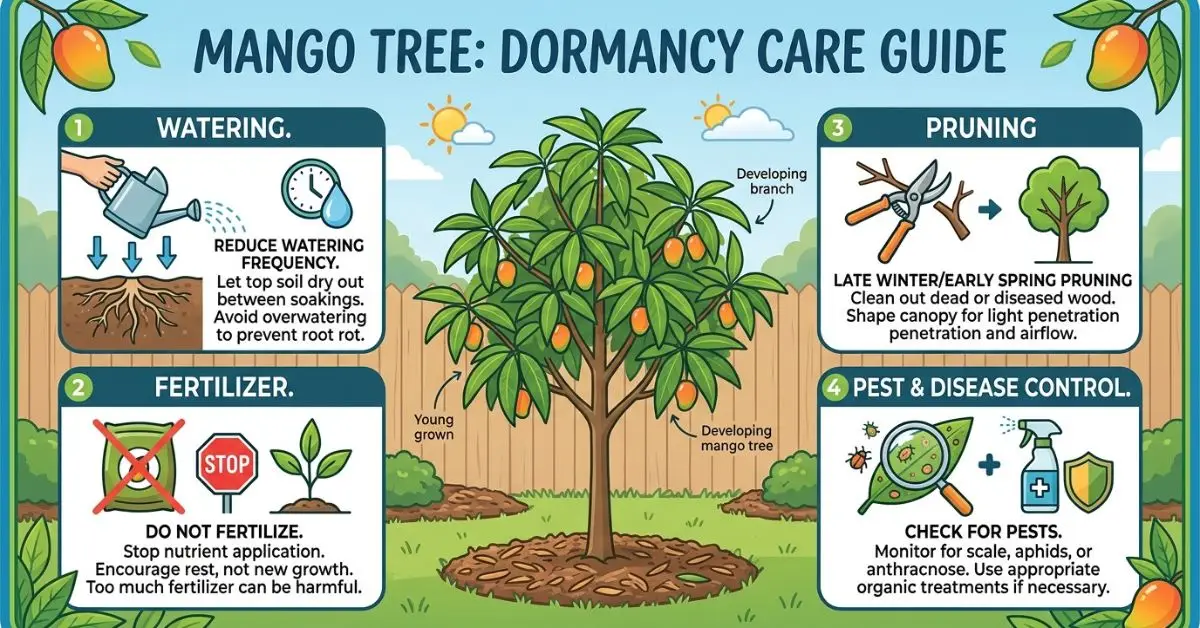
A grower named Beth in a Tampa-area gardening group did everything right for her mango tree during the growing season. She watered it on a solid schedule, fed it balanced fertilizer, gave it full sun, and kept pests away. The tree grew beautifully — thick canopy, healthy green leaves, strong trunk.
Then winter came. The tree stopped growing. A few leaves turned yellow and dropped. Beth got worried. So she kept watering like it was still July. She gave it a round of fertilizer in November to “boost” it. She even tip-pruned a few branches that looked messy.
Spring arrived. Her tree pushed out a flush of gorgeous new leaves. Not a single flower. Not one panicle. She got zero fruit that year from a perfectly healthy tree.
Beth made three of the most common dormancy care mistakes at the same time. And every one of them told her tree the same thing: “Keep growing leaves. Don’t bother with flowers.”
The frustrating part? If she’d done nothing — literally nothing — the tree would have flowered on its own.
Mango tree dormancy care is mostly about what you don’t do. But these mistakes are so common, and so tempting, that growers make them year after year without realizing why their tree never fruits. Let me walk through each one so you can avoid them.
Mistake #1 — Watering on the Regular Summer Schedule
This is the single most common and most damaging dormancy mistake. It’s also the most natural one to make. You’ve been watering your mango tree all summer. Why would you stop?
Here’s why: mango trees need a dry period during the cooler months to trigger flower bud development. Inside those terminal buds at the branch tips, a biological switch happens during dormancy. The buds go from being programmed to make leaves to being programmed to make flowers. But that switch only flips when the tree experiences dry stress combined with cool nighttime temperatures.
When you keep watering on your summer schedule through November, December, and January, the soil stays moist. The tree reads that as a signal to keep growing. It stays in vegetative mode. When spring arrives, those terminal buds produce leaves instead of flower panicles.
The result is what Beth got: a beautiful green tree with no fruit.
How to fix: Reduce watering to minimal or zero from November through January. For in-ground trees, let natural rainfall do the work. If it hasn’t rained in three to four weeks, give one light watering — not a deep soak. For container trees, a very light watering every two to three weeks is enough to keep roots alive. Resume normal watering only after you see flower panicles emerging in late winter or early spring.
Mistake #2 — Fertilizing During Dormancy
This one is right behind overwatering in terms of damage. Any fertilizer containing nitrogen stimulates vegetative growth. During dormancy, the tree’s terminal buds are trying to convert from leaf mode to flower mode. A dose of nitrogen tells them to stay in leaf mode.
Even a “small” application can disrupt the process. The flower bud differentiation happening inside those buds is sensitive to nutrient signals. ICAR research found that nitrogen applied during the pre-flowering rest period reduced flower panicle production by 40 to 70 percent.
I’ve seen growers throw down fertilizer in December because the tree “looks hungry.” The tree isn’t hungry. It’s resting. It’s running on stored energy from the growing season. It doesn’t need — and can’t properly use — fertilizer right now.
How to fix: Make your last fertilizer application in September. Don’t apply anything again until you see panicles emerging in spring. Set a calendar reminder if you have to. Compost or mulch sitting on the soil surface is fine — it breaks down slowly and won’t trigger a growth response the way synthetic fertilizer or fresh manure will. But anything nitrogen-heavy should stay in the shed until March.
Mistake #3 — Keeping the Indoor Environment Too Warm
This one hits container growers who bring their mango trees inside for winter. Your instinct says: it’s a tropical tree, keep it warm. So you park it in the living room next to the heater where it’s 72°F all day and night.
That’s the exact opposite of what the tree needs.
Flower bud formation in mango trees is triggered by cool nighttime temperatures — ideally 50 to 62°F for several weeks. A tree sitting in a heated room at 68 to 75°F around the clock never gets that cool-night signal. It stays comfortable, keeps its metabolism up, and often pushes new leaf growth right through December and January.
Come spring, that tree produces another flush of leaves. No flowers. The grower is confused because the tree “seemed fine” all winter. It was fine — too fine. It never went dormant.
How to fix: Move your container mango to the coolest bright room in your house. An unheated sunroom or enclosed porch is ideal. A spare bedroom with the heat turned off works. Even a bright attached garage can work if you add a grow light. The target is nighttime temperatures between 50 and 62°F. It feels counterintuitive to put a tropical tree in a cool room, but that cool period is exactly what drives flowering.
Mistake #4 — Pruning During Dormancy
Winter is when a lot of people get the urge to clean up their trees. The mango looks a bit scraggly. A few branches are sticking out at weird angles. You grab the pruning shears and tidy things up.
Every branch tip you cut removes a terminal bud. And during dormancy, those terminal buds are actively converting into flower buds. Each one has the potential to produce a panicle with hundreds to thousands of flowers.
Even light tip-pruning during this window directly subtracts from your spring flower count. One snip, one fewer panicle, potentially dozens fewer mangoes.
How to fix: All pruning should be finished by late September at the latest. From October through spring, don’t touch the tree with pruning tools unless you’re removing something clearly dead, broken, or diseased. Rootstock suckers growing below the graft union on grafted trees can also be removed year-round. But healthy living branch tips? Leave them alone. If the shape bothers you, make a note and handle it next August after harvest.
Mistake #5 — Panicking and “Rescuing” a Dormant Tree
This is the root cause behind most of the other mistakes on this list. The tree stops growing. Leaves look dull. Some turn yellow and drop. Branch tips seem lifeless. The whole tree looks like it’s in trouble.
So you do what any caring grower would do: you water it, fertilize it, prune off the sad-looking parts, and maybe move it to a warmer spot. You’re trying to help.
But every one of those actions disrupts the dormancy triggers the tree needs. The watering prevents the dry-period signal. The fertilizer pushes vegetative growth. The pruning removes flower buds. The warm room blocks the cool-night trigger.
The tree was doing exactly what it was supposed to. And the well-intentioned rescue effort just undid all of it.
A dormant mango tree looks like a struggling mango tree. They share a lot of the same visual symptoms — slow growth, leaf drop, dull appearance. But there’s a simple test to tell them apart. Scratch a small patch of bark on a branch with your thumbnail. Green underneath means alive and dormant. Brown and dry means that branch is dead.
If you see green, the tree is fine. Walk away.
How to fix: Perform the bark scratch test for peace of mind. If the tree is alive, practice intentional restraint. Dormancy care is about what you choose NOT to do. The urge to intervene is strong. Resist it. The rest period is not a problem to solve — it’s the preparation for fruit.
Mistake #6 — Moving Indoor Trees to the Warmest Room
This is a specific version of Mistake #3, but it comes up so often it deserves its own callout. People instinctively put their mango tree wherever they’d want to be in winter — next to the cozy heater, in the warm living room, by the fireplace.
Every one of those spots is wrong. A mango tree next to a heating vent gets blasted with hot dry air. The temperature stays consistently warm. The tree never experiences the cool nights it needs for flower bud development.
How to fix: Put the tree in the coolest bright room. Not the warmest, coziest room. An unheated porch with big windows. A spare bedroom where you keep the door closed and the heat off. A bright corner of the garage. Somewhere the temperature drops into the low 50s or upper 40s at night but stays above freezing and gets decent natural light or a grow light.
This is one of those pieces of advice that feels wrong until you see the results. The growers who get flowers from their indoor trees are almost always the ones keeping them cool.
Mistake #7 — Assuming Dormancy Means Frost-Proof
Some growers hear “dormancy” and think the tree is toughened up for winter. They leave it unprotected, figuring a sleeping tree can handle whatever comes.
Dormant mango trees can handle cool weather. They actually need it. But they are still tropical plants. They cannot survive freezing temperatures.
Below 32°F, leaves burn and young branches die. Below 25°F, you’re looking at trunk damage that can kill the tree. A single hard freeze on an unprotected dormant mango — even one that looked perfectly fine the day before — can be fatal.
How to fix: Keep frost protection ready all winter long. Frost cloth, incandescent Christmas lights (they generate heat, LEDs don’t), extra mulch for root insulation — have everything staged and ready to go on 24-hour notice. Water the soil the day before a predicted freeze — moist soil radiates more heat than dry. If you’re in Zone 9b or 10a, late freezes in February are especially dangerous because they hit right when flower panicles are starting to emerge.
Dormancy means resting. It doesn’t mean invincible.
Mistake #8 — Running Grow Lights Too Many Hours
This one catches indoor growers who think more light is always better. They set their grow lights on 14- to 16-hour timers, mimicking summer day length, thinking it’ll keep their tree healthy through winter.
The problem is that long photoperiods — those long, bright days — are a summer signal. They tell the tree it’s growing season. That conflicts directly with the dormancy signal the tree needs from cool temperatures and short days. The mixed signals can delay or prevent proper dormancy altogether.
How to fix: During dormancy, limit grow lights to 8 to 10 hours per day. Set a timer: 8 to 10 hours on, 14 to 16 hours off. The long dark period supports the rest signal. You’re providing enough light to keep the leaves healthy and prevent excessive drop — not enough to trick the tree into thinking it’s June.
The Pattern Behind All These Mistakes
If you look at this list, there’s one thread running through every mistake: doing too much.
Too much water. Too much fertilizer. Too much warmth. Too much light. Too much pruning. Too much worry.
Mango tree dormancy care is the opposite of growing-season care. During summer, your tree rewards effort. More water, more food, more sun — more fruit. During winter, the tree rewards restraint. Less water, no food, cooler temperatures, shorter days — more flowers in spring.
Beth figured this out the following year. She stopped watering in November. Didn’t fertilize. Didn’t prune. Let her tree sit quietly in the cool air through December and January. In February, panicle tips appeared on nearly every branch. She got over 40 mangoes that season.
Same tree. Same yard. The only difference was what she didn’t do.