
A couple of years ago, a friend of mine from Hyderabad sent me a box of mangoes in May. No note, no explanation—just a cardboard box packed with golden yellow fruits wrapped in newspaper. I bit into one, and it was like eating mango-flavored butter. No stringy fibers getting stuck in my teeth. No sharp tang. Just pure, smooth, ridiculous sweetness. That was my first Banganapalli mango, and I finally understood why people in Andhra Pradesh treat mango season like a holiday.
If you’ve never tried one—or if you want to grow your own—here’s everything you need to know about this variety.
What Is Banganapalli Mango? Origin, History & GI Tag
The Birthplace — Banganapalle Town, Kurnool District
The Banganapalli mango gets its name from the small town of Banganapalle in Kurnool district, Andhra Pradesh. You’ll also see it called Benishan, Bangalora, Baneshan, or Safeda depending on where you are in India.
The town sits in the Rayalaseema region — a hot, semi-arid area that happens to be perfect for growing mangoes. This variety has been cultivated here for over 100 years. The Nawabs of Banganapalle are credited with growing it in their royal orchards during the 18th and 19th centuries and distributing grafted saplings to local farmers.
From Royal Gardens to Everyday Fruit
What started in the Nawabs’ orchards spread across all of Andhra Pradesh by the mid-1900s. Today, Banganapalli is grown across Telangana, Karnataka, Tamil Nadu, and Kerala. It’s one of the top 5 most commercially traded mango varieties in India — a long way from its royal garden roots.
The GI Tag
The Banganapalli mango holds a Geographical Indication (GI) tag from the Government of India. This means only mangoes from the specific Banganapalle region and surrounding areas can officially carry the name. It puts this mango in the same protected category as Darjeeling Tea, Alphonso Mango, and Basmati Rice.
The GI tag also protects buyers from fake labeling. If it says Banganapalli and carries the GI certification, you know where it came from.
Names Across Different Regions
| Region | Local Name |
| Andhra Pradesh & Telangana | Banganapalli, Benishan |
| Karnataka | Bangalora, Benesha |
| Tamil Nadu | Bangalora |
| North India | Safeda (“white/pale”) |
| Maharashtra | Benishan |
“The Banganapalli mango is not just a fruit — it is a heritage crop that represents centuries of horticultural knowledge passed down through generations in the Rayalaseema region.” — Dr. V. Prabhakar Rao, Former Director, Dr. YSR Horticultural University.
Banganapalli Mango Appearance, Taste & Flavor Profile
How to Identify a Banganapalli
These are large mangoes — typically 200 to 350 grams each. The shape is oblong, slightly flattened. When ripe, the skin turns a uniform golden yellow with very little blushing. The skin is thin, smooth, and easy to peel.
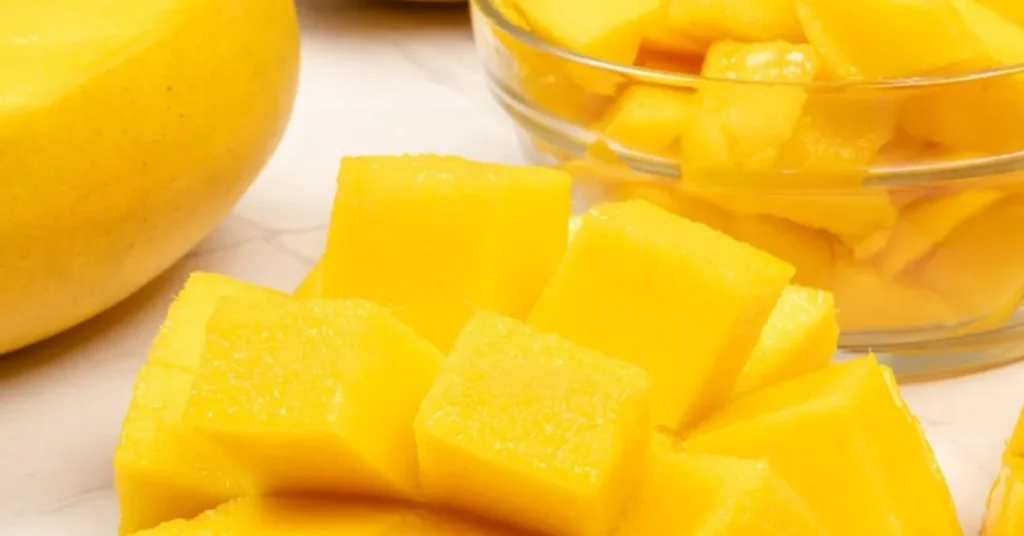
Cut one open and the flesh is deep golden yellow to orange. The seed is flat and thin, which means you get a great flesh-to-seed ratio.
What Does It Taste Like?
This is where the Banganapalli really shines. The Brix rating (a measure of sugar content) typically hits 18 to 22 degrees — that’s very sweet. The acidity is low, so there’s no sharp tang at the end. The texture is smooth and buttery. It practically melts.
And the fiber situation? Almost nonexistent. This is one of the most fiberless mangoes you’ll find. No strings. No chewy bits. Just clean, smooth mango flesh.
People call it “the everyday eating mango” because it delivers consistent sweetness without the premium price tag of an Alphonso.
How to Tell When It’s Perfectly Ripe
- Color: Uniform golden yellow with no green patches
- Touch: Gives slightly when pressed, like a ripe avocado
- Aroma: Sweet smell at the stem end
- Weight: Heavy for its size
- Wrinkles: Slight wrinkling near the stem means fully ripe
🥭 Pro Tip: To ripen Banganapalli mangoes at home, wrap them in newspaper and place in a warm, dark spot — a rice bin or cardboard box works great. They’ll ripen in 2 to 4 days. Don’t refrigerate unripe mangoes. Cold stops the ripening process and hurts the flavor.
Banganapalli Mango Nutrition Facts & Health Benefits
Nutrition Profile (Per 100g of Ripe Flesh)
| Nutrient | Amount |
| Calories | 60–70 kcal |
| Carbohydrates | 15–17 g |
| Fiber | 1.6–1.8 g |
| Vitamin C | 36–40 mg (~44% daily value) |
| Vitamin A | 1082 IU (~12% daily value) |
| Folate | 43 mcg (~11% daily value) |
| Potassium | 168 mg |
Sources: Indian Food Composition Tables (NIN, Hyderabad); USDA FoodData Central
Key Health Benefits
A single Banganapalli mango (around 250g of flesh) gives you close to 100% of your daily Vitamin C. The deep golden color comes from beta-carotene, which supports eye health and skin health.
Mangoes contain digestive enzymes called amylases that help break down carbohydrates. They also have a compound called mangiferin — an antioxidant studied for its anti-inflammatory properties. Research in the BioFactors journal highlights mangiferin’s potential health benefits.
The natural sugars make it a solid pre-workout snack or afternoon energy boost. And because it’s high in fiber with moderate calories, it satisfies sweet cravings without going overboard.
A word of caution: If you have diabetes, eat in moderation and pair with protein or fat to slow sugar absorption. People with latex allergies should be careful — mango skin contains urushiol, which can cause a reaction. Have someone else peel it for you if that’s a concern.
Banganapalli Mango Season — When Is It Available?
Peak Season Timeline
| Phase | Months |
| Flowering | January–February |
| Fruit development | February–April |
| Early harvest | Mid-April to May |
| Peak season | May–June |
| Late season | Early July |
| Off-season | August–March |
The best time to buy is May through June. That’s when you get the highest quality at the lowest prices. Early-season mangoes (mid-April) cost more. Late-season fruit in July can be affected by monsoon rains.
Where the Season Hits First
Andhra Pradesh gets the longest window — mid-April to early July. Hyderabad and Bangalore markets see good supply from late April through June. Mumbai gets them in May and June at premium prices. North Indian cities like Delhi have a shorter window — late May to June — since the fruit travels a longer distance.
Naturally Ripened vs. Artificially Ripened
This is a real issue in Indian mango markets. Some sellers use calcium carbide to ripen mangoes faster. This chemical is banned by FSSAI because of health risks.
Here’s how to spot the difference:
| Factor | Natural | Artificial (Carbide) |
| Color | Uneven yellow-green | Uniformly bright yellow |
| Aroma | Sweet, fruity at stem end | No smell or chemical odor |
| Taste | Rich, complex sweetness | Flat, sometimes bitter |
| Appearance | Minor natural blemishes | Suspiciously perfect |
Always buy from trusted sellers. If the mango looks too perfect and has no aroma at the stem end, think twice.
Banganapalli vs. Other Popular Indian Mango Varieties
The comparison everyone asks about — how does it stack up against the Alphonso?
| Factor | Banganapalli | Alphonso |
| Size | Large (200–350g) | Medium (150–250g) |
| Sweetness (Brix) | 18–22° | 16–20° |
| Fiber | Almost none | None |
| Aroma | Mild | Strong, distinctive |
| Price | ₹60–120/kg retail | ₹300–800/kg retail |
| Best for | Daily eating, juices | Premium eating, desserts |
Here’s my honest take: the Alphonso is a fancier mango. It has a richer, more complex flavor and a stronger aroma. But the Banganapalli is often sweeter by the numbers and costs a fraction of the price. If you want great mangoes every day during summer without breaking the bank, Banganapalli is the smart pick.
Against Totapuri, the Banganapalli is much sweeter and smoother. Totapuri is better for pickles and processing. Against Kesar from Gujarat, the Banganapalli is larger and milder, while Kesar brings a saffron-like aroma that’s pretty unique.
How to Grow a Banganapalli Mango Tree at Home
This is where things get fun for home growers. I’ve talked to gardeners in South Florida, Southern California, and of course all across South India who grow Banganapalli successfully. One grower in the Kurnool area told me his grandfather planted a Banganapalli tree 40 years ago, and it still produces hundreds of mangoes every season. That kind of longevity is common with mango trees — plant one now and your grandkids could be eating from it.
Climate and Growing Needs
Banganapalli trees love heat. They do best at 24°C to 30°C (75°F to 86°F) and can handle temperatures up to 45°C. But they don’t survive frost — anything below 5°C causes damage. In the US, you’re looking at USDA zones 10b through 12 for outdoor growing.
They need full sun — at least 8 hours a day — and dry weather during flowering. High humidity when the flowers are out leads to fungal problems.
Soil
The single most important thing: good drainage. Mango roots rot in waterlogged soil. Sandy loam with a pH between 5.5 and 7.5 is ideal. Heavy clay needs serious amending with sand and organic matter before planting.
Seed vs. Grafted Sapling
| Method | Time to Fruit | True to Type? |
| Seed | 6–10 years | Maybe not |
| Grafted sapling | 3–5 years | Yes — guaranteed Banganapalli |
My advice: always go with a grafted sapling from a certified nursery. Seeds are a fun project, but you might wait a decade and end up with fruit that tastes nothing like the parent tree.
Planting Steps
- Get a grafted Banganapalli sapling (1 to 2 years old)
- Pick a spot with full sun and draining soil
- Dig a pit about 3 feet × 3 feet × 3 feet
- Fill with a 50/50 mix of topsoil and well-rotted compost
- Plant at the same depth as the nursery bag
- Water well, stake if needed, and mulch around the base (keep mulch 6 inches from the trunk)
- Space trees 8 to 10 meters apart for full-sized trees
Growing in Containers
Yes, you can grow Banganapalli in a pot. Use a minimum 25 to 30-gallon container with drainage holes. Mix your soil: 40% potting soil, 30% perlite, 20% compost, 10% sand. Prune hard to keep it between 5 and 7 feet. You’ll need to repot every 2 to 3 years as the root system expands.
Container trees can fruit in 3 to 5 years from a grafted sapling, but expect smaller yields than in-ground trees.
Common Problems
| Problem | What to Look For | Fix |
| Mango hopper | Tiny insects on flowers, flower drop | Neem oil or imidacloprid spray |
| Anthracnose | Black spots on leaves and fruit | Copper fungicide, avoid overhead watering |
| Powdery mildew | White coating on flowers and young leaves | Sulfur spray or potassium bicarbonate |
| Fruit fly | Puncture marks on fruit, larvae inside | Fruit fly traps, harvest at right time |
| Root rot | Yellowing, wilting, mushy roots | Improve drainage, cut watering, fungicide drench |
“The Banganapalli variety is remarkably hardy and well-adapted to hot, dry conditions — making it one of the easiest commercial mango varieties to grow for home gardeners in tropical and subtropical climates.” — Dr. T. Nagalakshmi, Senior Scientist, ICAR-Indian Institute of Horticultural Research
Where to Buy Banganapalli Mangoes & Current Prices
2024–2025 Price Guide
| Source | Price |
| Farm gate (Kurnool) | ₹30–50/kg |
| Retail (Hyderabad, Bangalore) | ₹60–120/kg |
| Organic/GI-tagged | ₹100–180/kg |
| Online delivery (India) | ₹150–300/kg |
| International export | $3–6/kg |
Peak season (May–June) gives you the best prices. Early-season fruit in April costs more.
Where to buy online in India: BigBasket, FreshToHome, Amazon India, and a growing number of direct-from-farm sellers on Instagram and WhatsApp.
International buyers: Check Indian grocery stores in the Middle East, UK, USA, Singapore, and Malaysia during May and June. Online platforms like iShopIndian and Quicklly also carry them seasonally.
The Cultural Significance of Banganapalli Mango
In Andhra Pradesh, mango season isn’t just about fruit — it’s about family. Sending a box of Banganapalli mangoes to relatives in other cities is a summer tradition that goes back generations. The Ugadi festival (Telugu New Year) overlaps with early mango season, and mango pachadi — a dish made with raw mango — is a staple of the celebration.
Mango cultivation is the primary livelihood for thousands of farming families across Kurnool, Chittoor, Krishna, and Prakasam districts. Andhra Pradesh is India’s number one mango-producing state, and the Banganapalli is its flagship variety. During harvest season, the entire supply chain lights up — pickers, sorters, packers, truck drivers, and market vendors all depend on these mangoes.
Mango festivals organized by state horticulture departments draw big crowds every year. There are eating contests, exhibitions of different grades, and export promotion events run by APEDA.
The Banganapalli is to Andhra Pradesh what the Alphonso is to Maharashtra. It’s woven into the food, the economy, the poetry, and the identity of the region.
Final Thought
Whether you’re trying one for the first time, hunting for the best box during peak season, or planting a grafted sapling in your backyard — the Banganapalli mango is one of those varieties that earns its reputation honestly. Sweet, smooth, fiberless, affordable, and easy to grow in the right climate. Hard to ask for much more from a mango.