Last July, my friend Priya’s backyard Kent mango tree in Homestead, Florida, went absolutely wild. Over 200 mangoes in about three weeks. She was handing them out to neighbors, bringing bags to work, eating them for breakfast and dinner. And still — dozens were ripening faster than she could keep up. By the end of the month, she had a pile of soft, overripe fruit on her counter and felt terrible watching them go to waste.
That’s when she called me. “How do I save these?”
We spent one Saturday afternoon turning her surplus into frozen chunks, mango leather, and two batches of chutney. Six months later, she was still pulling mango cubes out of the freezer for smoothies in January. That’s the power of knowing how to store and preserve mango properly.
Whether you grew them yourself or bought a case at the market during peak season, here’s how to make every single mango count.
How to store mango — Ripeness Stages and Shelf Life
How you store a mango depends completely on how ripe it is right now. Treating an unripe mango the same way you’d treat a ripe one is a fast track to waste.
The 4 Ripeness Stages
| Stage | What It Looks/Feels Like | How to Store |
|---|---|---|
| Unripe (hard green) | Firm, solid green, no smell | Room temperature — ripen it first |
| Semi-ripe (turning) | Slight color change, beginning to soften | Room temp 1–2 days OR fridge to slow it down |
| Ripe (ready to eat) | Gives when pressed, sweet smell, full color | Refrigerate right away |
| Overripe (past peak) | Very soft, wrinkled, fermented smell starting | Use immediately or preserve (freeze, jam, puree) |
How Long Mangoes Last
| Stage | On the Counter | In the Fridge |
|---|---|---|
| Unripe | 3–7 days (until ripe) | Don’t refrigerate — it stops ripening |
| Ripe | 1–2 days | 5–7 days |
| Cut/sliced | 2–4 hours max | 2–3 days in an airtight container |
The Ethylene Factor
Mangoes produce ethylene gas — a natural ripening hormone. This speeds up ripening in the mango and in any fruit sitting nearby. Use this to your advantage:
- Want to ripen faster? Put the mango in a paper bag with a banana.
- Want to slow things down? Separate it from other fruit and refrigerate.
- Never store mangoes in a sealed plastic bag at room temperature. Trapped ethylene plus moisture equals mold and fermentation.
“The number one mistake people make with mango storage is treating all mangoes the same regardless of ripeness. An unripe mango needs warmth and ethylene to develop flavor. A ripe mango needs cold to preserve it.” — Dr. Adel Kader, Postharvest Biology Pioneer, UC Davis
How to Store Fresh Whole Mangoes
Ripening Unripe Mangoes
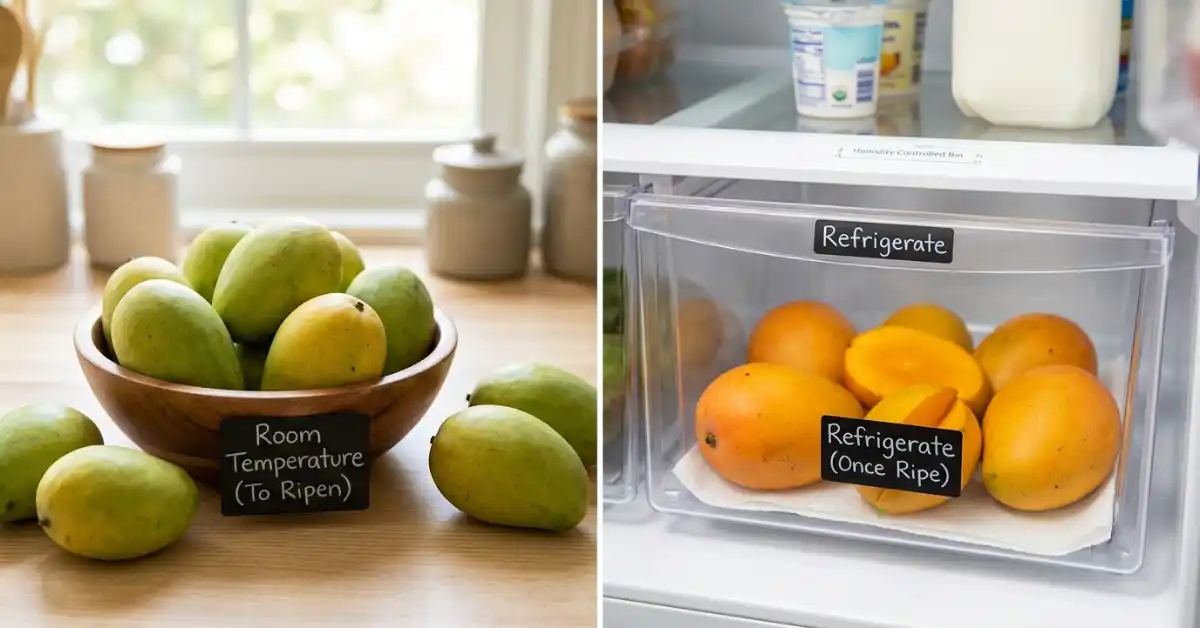
Set them on the counter at room temperature. Keep them in a spot with airflow, away from direct sun. To speed things up:
- Newspaper wrap — wrap each mango individually. This traps ethylene around the fruit.
- Paper bag with a banana — the banana pumps out extra ethylene.
- Rice bin method — bury them in a container of dry rice. Traditional across India, and it works beautifully. Ripens in 2 to 3 days.
Check daily. Smell the stem end — when it smells sweet, it’s ready.
Storing Ripe Mangoes
Once ripe, move them to the fridge immediately. Put them in the crisper drawer or on a shelf — not in a sealed plastic bag. A perforated bag or loose paper bag works. You’ll get 5 to 7 days of good eating.
Pull them out 30 minutes before eating. Cold dulls the sweetness, and room-temperature mango tastes better.
Quick tips for extra shelf life:
- Wrap the stem end in plastic wrap — slows ethylene release (+1–2 days)
- Don’t wash until you’re ready to eat — moisture on the skin promotes mold
- Store in a single layer — stacking causes bruising
🥭 The best way to “store” a perfectly ripe mango for more than a week is to stop thinking about fresh storage and shift to preservation. Fresh storage buys you days. Preservation buys you months.
How to Store Cut Mango
Put cut mango in an airtight container. Squeeze fresh lemon or lime juice over the pieces — the citric acid prevents browning. Refrigerator shelf life is 2 to 3 days.
For puree, blend ripe mango until smooth. Add 1 tablespoon of lemon juice per cup. Store in a jar in the fridge for 3 to 5 days, or move it to the freezer for months.
⚠️ Food safety reminder: Cut mango left at room temperature for more than 2 hours should be tossed, according to USDA guidelines. Bacteria multiply fast on cut fruit in warm conditions.
How to Freeze Mango — The Best Long-Term Method
Freezing is the easiest way to preserve mangoes at home. It keeps 90 to 95% of the nutrition, the flavor stays great, and you don’t need any special equipment. Frozen mango lasts up to 12 months.
Flash-Freezing Chunks (My Go-To Method)
- Peel and cut ripe mangoes into 1-inch cubes
- Toss with a tablespoon of lemon juice
- Spread on a parchment-lined baking sheet in a single layer — pieces should not touch
- Freeze for 2 to 4 hours until completely solid
- Transfer to freezer-safe zip-lock bags. Squeeze out as much air as possible.
- Label with the date
Flash freezing is the key step. Without it, you end up with one solid frozen block and have to thaw the whole thing every time. With flash freezing, you can grab exactly what you need.
Freezing Puree
Blend ripe mango with a tablespoon of lemon juice per cup. Pour into ice cube trays. Freeze. Pop the cubes out and transfer to a zip-lock bag. Each cube is about 2 tablespoons — perfect for dropping into smoothies or sauces.
Smoothie Packs
Divide mango chunks into single-serving portions (about 1 cup each). Add other frozen fruit if you want — banana, pineapple, berries. Bag them up flat. When you’re ready, dump the whole bag in the blender with some liquid. Two-minute breakfast.
Thawing Frozen Mango
| Method | Time | Best For |
|---|---|---|
| Fridge (overnight) | 6–8 hours | Eating fresh, desserts |
| Straight into blender | Immediate | Smoothies |
| Room temperature | 1–2 hours | Recipes |
Never refreeze thawed mango. The texture goes mushy and there’s a food safety concern.
“Freezing is the gold standard for home mango preservation. The key is the flash-freeze step — it’s the difference between beautiful individual chunks and an unusable frozen block.” — Dr. Elizabeth Andress, National Center for Home Food Preservation
How to Dry and Dehydrate Mango at Home
Dried mango is lightweight, shelf-stable, and addictive. It lasts 6 to 12 months stored properly, and you don’t need a fridge or freezer.
Using a Food Dehydrator
- Peel and slice ripe (but firm) mangoes into uniform pieces — 1/8 to 1/4 inch thick
- Optional: dip in lemon water for 5 minutes to prevent browning
- Arrange on dehydrator trays in a single layer
- Set to 135°F (57°C)
- Dehydrate for 8 to 14 hours
- Done when pliable but not sticky — no moisture when you tear a piece
Oven Method (No Dehydrator Needed)
Set your oven to its lowest temperature — ideally around 170°F. Lay slices on parchment-lined baking sheets. Prop the door open an inch with a wooden spoon so moisture can escape. Check every hour or so after the 3-hour mark. Takes 3 to 6 hours total.
Mango Leather (Aam Papad)
Blend 2 cups of ripe mango until smooth. Add 2 tablespoons of sugar or honey and a tablespoon of lemon juice. Spread it onto a parchment-lined baking sheet about 1/8 inch thick. Dehydrate at 135°F for 6 to 10 hours (or in the oven at 170°F for 3 to 6 hours). It’s done when it peels cleanly and isn’t sticky in the center. Roll it up with parchment paper and cut into strips.
Store dried mango and leather in airtight containers in a cool, dark place. Vacuum sealing extends the life to a year or more.
Research in the Journal of Food Science and Technology found that mango dehydrated at 135°F kept 78% of its Vitamin C and 85% of its beta-carotene.
How to Make Mango Jam and Chutney
Quick Mango Jam
Combine 4 cups diced ripe mango, 2 cups sugar, and 3 tablespoons lemon juice in a heavy pot. Let it sit 30 minutes so the sugar pulls out the juices. Bring to a rolling boil, stirring constantly. Reduce heat and simmer 20 to 30 minutes. Test by dropping a spoonful on a cold plate — if it wrinkles when pushed, it’s set. Ladle into sterilized jars.
For shelf-stable storage, process in a boiling water bath for 10 minutes. For fridge jam, just seal and refrigerate — it’ll keep 3 to 4 weeks.
Mango Chutney
Mix 4 cups diced mango, 1 cup apple cider vinegar, 1 cup brown sugar, a diced onion, minced garlic, grated ginger, cumin, red pepper flakes, and salt. Simmer 45 to 60 minutes until thick and jammy. Can it or refrigerate.
Chutney is the ultimate use for semi-ripe mangoes that aren’t sweet enough to eat fresh but too good to waste.
⚠️ Mango is a low-acid fruit. For safe water bath canning, you must add enough lemon juice or citric acid per a tested recipe. Follow USDA-approved canning guidelines from the National Center for Home Food Preservation (nchfp.uga.edu).
Traditional Mango Pickle — Preservation That Lasts a Year
This one is close to my heart. A grower I know from the Kurnool region in Andhra Pradesh makes avakaya every season using raw green mangoes straight off the tree. Her family has used the same recipe for three generations. The pickle lasts 12 to 24 months without refrigeration — just salt, oil, spices, and technique.
Basic Andhra-Style Avakaya
- Wash and completely dry raw green mangoes (any moisture means mold)
- Cut into pieces and mix with salt. Let sit 24 hours to draw out moisture.
- Drain the liquid
- Toss the mango pieces in red chili powder, mustard powder, and fenugreek powder
- Heat sesame oil until it just smokes, then let it cool completely
- Pour the cooled oil over the mango-spice mix — everything should be submerged
- Pack into a clean, dry glass or ceramic jar
- Top with extra oil so nothing is exposed to air
- Stir every couple days for the first two weeks
It’s ready to eat after about two weeks and gets better with age.
Key rules: Use only dry utensils. Never stick a wet spoon in the jar. Use non-iodized salt. Store in glass or ceramic — never metal.
More Preservation Methods Worth Knowing
Mango butter: Cook blended mango with a little sugar, lemon juice, and cinnamon on low heat for 45 to 60 minutes until thick and spreadable. Like apple butter, but tropical.
Fermented mango: Submerge mango chunks in a 2% salt brine in a mason jar. Cover loosely. Ferment at room temperature for 3 to 5 days. You get a tangy, probiotic-rich condiment that lasts 1 to 2 months in the fridge.
Freeze-drying: Produces crispy mango chips with 95 to 97% nutrient retention and a shelf life measured in years. But it requires a home freeze dryer ($2,000+), so it’s really for serious preservers.
Common Mango Storage Mistakes
Refrigerating unripe mangoes. Cold permanently halts ripening. The mango will never develop full sweetness. Always ripen at room temperature first.
Sealed plastic bags at room temp. Moisture and ethylene build up. Mold follows fast.
Stacking. Pressure bruises spread and rot quickly. Store in a single layer.
Throwing away overripe fruit. If it smells sweet (not sour or alcoholic) and the flesh is still orange, it’s still good. Blend it. Freeze it. Cook it. Just don’t waste it.
Priya hasn’t thrown away a single mango since that Saturday we spent in her kitchen. She freezes the surplus in chunks, makes a batch of chutney every season, and keeps dried mango strips in her pantry for snacking. Her tree still goes wild every July. But now, none of it goes to waste.