My friend Megan called me in a panic last winter. Her favorite Monstera — the one she’d had for three years — was dropping leaves like crazy. She’d been watering it more because “it looked thirsty.” Wilting leaves, yellowing edges, the whole deal. When I came over and we pulled it out of the pot, the smell hit us first. Swampy. Rotten. The roots were brown mush. That plant wasn’t thirsty. It was drowning.
Root rot is the most common way people lose houseplants and container plants. The frustrating part? It usually starts with good intentions. You see your plant looking sad, so you water it. But the problem was already too much water. And just like that, you’re caught in a cycle that kills plants fast.
Here’s everything you need to know to spot root rot early, save a plant that’s already affected, and make sure it never happens again.
What Is Root Rot? Understanding the Science Behind the Problem
Root Rot Defined — A Simple Explanation
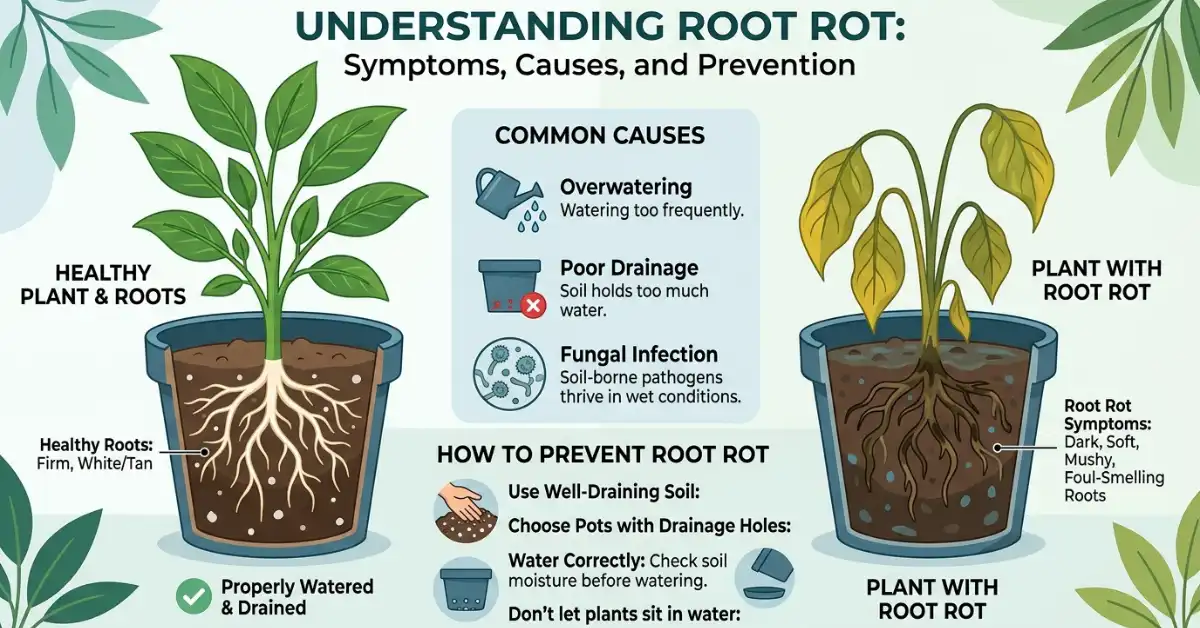
Root rot is exactly what it sounds like — the roots of your plant decay and die. Healthy roots are white or tan, firm to the touch, and smell like fresh soil. Rotting roots turn brown or black, feel mushy and slimy, and give off a foul odor.
Here’s the catch: once roots rot, they can’t absorb water or nutrients anymore. So your plant actually starves and dehydrates while sitting in soaking wet soil. That’s why a plant with root rot looks wilted even though the soil is damp.
The Two Main Causes of Root Rot
Cause #1 — Overwatering (the most common by far)
When you water too much or too often, the extra water fills up all the tiny air spaces in the soil. Roots need oxygen just like we do. When water pushes all the air out, the roots suffocate. The cells break down. Dead root tissue then becomes a perfect home for fungal pathogens that make things worse fast.
Cause #2 — Fungal Pathogens
Several types of fungi attack waterlogged roots:
| Fungal Pathogen | Common Hosts | What It Does |
|---|---|---|
| Pythium | Most houseplants | Spreads fast in wet soil |
| Phytophthora | Tropicals, citrus, avocado | Extremely destructive “water mold” |
| Fusarium | Vegetables, ornamentals | Causes wilt and root decay |
| Rhizoctonia | Seedlings, potted plants | Causes “damping off” in young plants |
The Overwatering → Root Rot Cycle
It follows a pattern every time. The soil stays wet too long. Oxygen levels around the roots drop. Root cells start dying. Dead tissue gives fungi an entry point. The fungi spread through the weakened root system. By the time you see yellowing leaves above ground, the damage below has been going on for a while.
“Root rot is not simply a watering problem — it’s a soil oxygen problem. When water displaces all the air in the root zone, the roots literally suffocate before fungi even enter the picture.” — Dr. Linda Chalker-Scott, Extension Horticulturist, Washington State University
Signs of Root Rot — How to Identify It Before It’s Too Late
Above-Ground Warning Signs
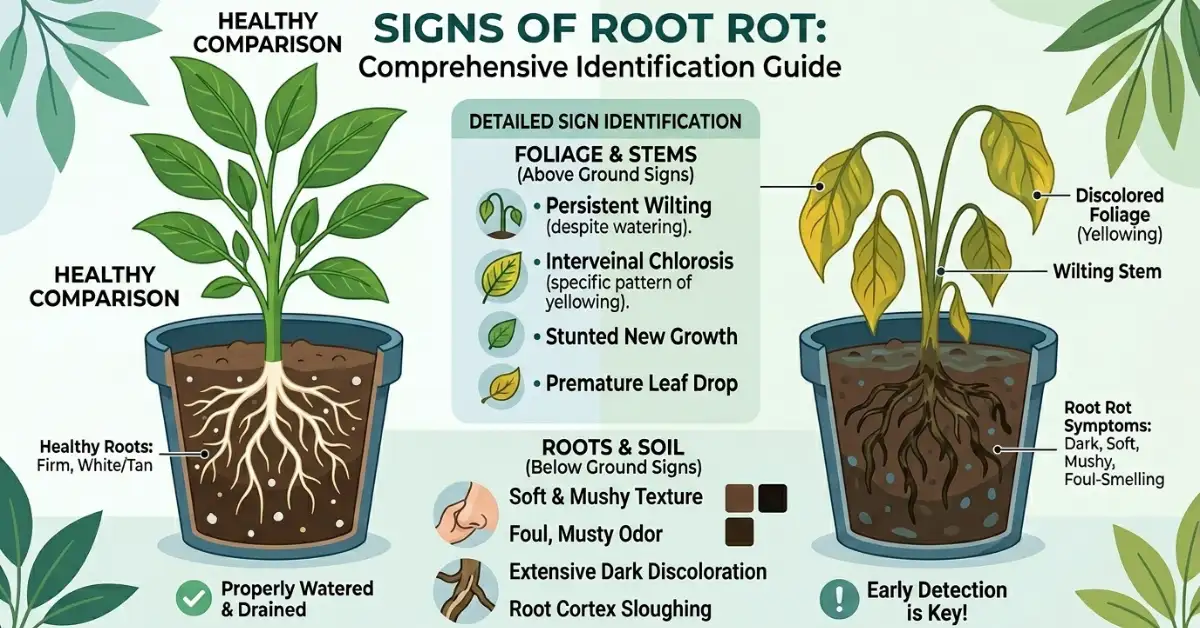
Early signs (your plant can still be saved):
- Lower leaves turning yellow first
- Wilting that doesn’t get better after watering
- Soft, mushy stems near the soil line
- Growth has slowed down or stopped
- Soil stays wet for 7+ days
Advanced signs (act right now):
- Foul, swampy smell from the soil
- Dark brown or black spots on stems
- Leaves dropping everywhere — old and new
- Mold growing on the soil surface
- Plant slides out of the pot with barely any resistance
Below-Ground Signs
| Healthy Roots | Rotting Roots |
|---|---|
| White, cream, or light tan | Dark brown or black |
| Firm and bendable | Mushy and slimy |
| Fresh, earthy smell | Rotten, foul smell |
| Hold together when touched | Fall apart or slide off |
The “Tug Test”
This one takes five seconds. Gently tug the base of your plant. A healthy plant resists — the roots hold it in place. A plant with root rot wobbles or slides right out. This quick check can catch the problem weeks before the leaves tell you something’s wrong.
Root Rot vs. Other Issues
The tricky part is that root rot looks a lot like other problems. Here’s how to tell the difference:
| Symptom | Root Rot | Underwatering | Nutrient Deficiency |
|---|---|---|---|
| Yellow leaves | Starts at bottom | Starts at tips/edges | Patterned along veins |
| Wilting | Doesn’t recover after watering | Bounces back fast after watering | Rarely causes wilting |
| Soil | Wet, soggy, may smell | Bone dry | Normal moisture |
| Roots | Brown, mushy | Dry but alive | Normal |
The Missouri Botanical Garden says overwatering symptoms are the most commonly misdiagnosed issue in houseplant care. People see wilting, assume the plant needs water, add more water, and make root rot worse. I’ve done it myself.
Overwatering vs. Underwatering — How to Tell the Difference
Why They Look So Similar
Both cause wilting. Both cause yellowing. The plant’s stress response looks almost the same either way. This confusion creates what I call the “overwatering death spiral.” Your plant wilts. You water it. It gets worse. You water more. The roots rot further. And round it goes.
The 5 Key Differences
| Factor | Overwatering | Underwatering |
|---|---|---|
| Soil moisture | Still damp days later | Completely dry, pulling from pot edges |
| Leaf texture | Soft, limp, sometimes see-through | Dry, crispy, papery |
| Leaf color | Yellow-green with mushy brown spots | Yellow-brown with dry, crispy tips |
| Wilting recovery | Does NOT improve after watering | Recovers within hours |
| Pot weight | Heavy | Very light |
The “Finger Test”
Stick your finger 2 inches into the soil. If it feels moist or wet — don’t water. If it feels dry — go ahead and water. For deeper pots, push a wooden chopstick down to the bottom. Pull it out and check if soil clings to it. Simple, free, and more reliable than most gadgets.
If you want a tool, the XLUX Soil Moisture Meter (about $13) or Sustee Aquameter (about $10 per sensor) are solid picks. Use them alongside the finger test, not instead of it.
🌿 Pro Tip: Lift your pot before and after watering. Over time, you’ll get a feel for how heavy a wet pot is versus a dry one. A heavy pot means wet soil. A light pot means it’s time to water. This is what most professional growers rely on.
What Causes Root Rot? The Full List of Risk Factors
Root rot rarely comes from just one mistake. It’s usually a combination of things working against you.
Primary Causes
1. Watering too often. This is the big one. Watering on a fixed schedule — like every Monday — without checking whether the soil is actually dry is a recipe for trouble. Plants also need less water in winter when growth slows down.
2. Heavy, dense soil. Garden soil, pure peat, or old compacted potting mix holds too much water and chokes out air. Roots can’t breathe.
3. Pots without drainage holes. Water has to go somewhere. If there are no holes, it sits at the bottom and rots the roots. Decorative pots without drainage are a common trap.
4. Pots that are too big. A small plant in a huge pot means lots of wet soil the roots can’t use. That extra moisture just sits there.
Environmental Factors
5. Low light. Less light means less growth and less water use. Soil stays damp way longer. This hits hard in winter when indoor light drops.
6. Cold temperatures. Cold slows evaporation and the plant’s metabolism. Water hangs around in the soil much longer.
7. Poor air movement. Stagnant air around your pots slows drying. A small fan can make a big difference.
8. Contaminated soil or tools. Reusing soil from a plant that had root rot spreads the fungal spores right to the next victim.
“Nine times out of ten, root rot isn’t caused by a single mistake — it’s a combination of factors. An oversized pot with heavy soil in a low-light corner creates the perfect storm, even with careful watering.” — Darryl Cheng, Author of “The New Plant Parent”
How to Save a Plant With Root Rot — Step-by-Step Treatment
Going back to Megan’s Monstera — we were able to save it because we caught things before the damage hit 100%. Here’s the process we followed, and it’s the same one I’d recommend to anyone.
First: Can It Be Saved?
| Condition | Outlook | What to Do |
|---|---|---|
| Less than 50% of roots affected | Good | Follow treatment steps below |
| 50–75% affected | Uncertain | Treat the plant AND take backup cuttings |
| More than 75% gone | Not great | Take any healthy cuttings to propagate; treat as a long shot |
Step 1 — Take It Out of the Pot
Gently slide the plant out. Don’t yank it by the stem. If it’s stuck, run a knife around the inside edge of the pot.
Step 2 — Wash Off All the Old Soil
Rinse the entire root system under lukewarm water. Get rid of every bit of old soil. It’s full of fungal spores. Leaving any behind brings the problem right back.
Step 3 — Cut Away the Dead Roots
Using sterilized pruning shears, cut off every brown, mushy, slimy root. Cut back until you hit firm, white tissue. Dip your shears in rubbing alcohol between cuts so you don’t spread spores from sick roots to healthy ones.
If you had to remove more than half the roots, prune some of the top growth too. The plant can’t support all those leaves with a tiny root system.
Step 4 — Treat What’s Left
Hydrogen peroxide soak (my go-to): Mix 1 part 3% hydrogen peroxide with 2 parts water. Soak the remaining roots for 15 to 20 minutes. This kills fungal spores and adds oxygen to the root tissue. Rinse after.
Cinnamon powder: Dust all the cut ends with ground cinnamon. It’s a mild natural antifungal and easy to find.
Chemical fungicide: For bad cases, products like Bonide Fung-onil or Southern Ag Thiomyl work well. Follow the label directions.
Step 5 — Let the Roots Dry
Set the plant on paper towels in a shaded spot. Let the roots air dry for 2 to 6 hours. For bad cases, leave them overnight. The fungi that cause rot can’t survive exposure to open air.
Step 6 — Repot in Clean Soil and a Clean Pot
Use a fresh or sterilized pot with drainage holes. Don’t go oversized — match the pot to the remaining root ball. Use a fast-draining mix:
- 50% quality potting mix
- 30% perlite or pumice
- 20% orchid bark or horticultural charcoal
Step 7 — Aftercare
Water lightly — just enough to settle the soil. Place in bright, indirect light. No fertilizer for at least 4 to 6 weeks. Water only when the top 2 to 3 inches of soil are bone dry.
Root Rot Recovery — What to Expect
Don’t expect overnight results. Here’s a realistic timeline:
| Timeframe | What You’ll See |
|---|---|
| Days 1–3 | Continued wilting, maybe more leaf drop — this is normal |
| Days 4–7 | Wilting starts to level off |
| Weeks 2–3 | Leaf drop slows, surviving leaves look stable |
| Weeks 4–6 | Possible new growth, new root development |
| Months 2–3 | Active new growth, clear recovery |
Good signs: New leaves, existing leaves firming up, the plant feels anchored in the pot, no bad smell.
Bad signs after 2+ weeks: Continued leaf drop, mushy stem spreading upward, foul smell returning. If this happens, take any healthy stem cuttings and propagate them in water or sphagnum moss as backup.
💡 Recovery depends on how much healthy root mass is left. A plant with 60%+ good roots has an excellent shot. Less than 25%? It’s going to struggle hard — take cuttings as insurance.
How to Prevent Root Rot — Strategies That Actually Work
Water Based on Soil Dryness, Not a Calendar
Check the soil before every single watering. Most houseplants need water when the top 2 inches are dry. Succulents and cacti should dry out completely. Adjust for the seasons — plants drink much less in fall and winter.
| Season | Watering Frequency | Why |
|---|---|---|
| Spring | Increasing | Growth picks up, more water use |
| Summer | Most frequent | Peak growth, heat dries soil faster |
| Fall | Decreasing | Growth slows |
| Winter | Least frequent | Dormancy, less evaporation |
Use the Right Soil
Never use straight garden soil in pots. A good all-purpose mix: 50% potting mix, 25% perlite, 25% orchid bark. Replace old compacted soil every 1 to 2 years.
Pick the Right Pot
Always use pots with drainage holes. Always. Avoid pots that are way too big for the plant. Terracotta is great if you tend to overwater — it wicks moisture away naturally.
Fix the Environment
More light means soil dries faster. A small fan improves air movement and cuts risk. Keep temps above 60°F for tropicals.
Preventive Treatments
Mix horticultural charcoal into your soil. It absorbs extra moisture and filters toxins. Add mycorrhizal inoculant when you pot up — it strengthens root systems against disease. Dust cinnamon on the soil surface as a mild antifungal barrier.
Research from the American Society for Horticultural Science shows that plants grown in soil with 25 to 30% perlite had 65% less root rot compared to those in standard potting soil.
Root Rot in Specific Plants — Quick Guide
Different plants have different levels of risk and resilience:
| Plant | Rot Risk | Water When… | Best Soil | Recovery |
|---|---|---|---|---|
| Monstera | Moderate | Top 2″ dry | Chunky aroid mix | ⭐⭐⭐⭐ |
| Pothos | Low-Moderate | Top 1–2″ dry | Standard + perlite | ⭐⭐⭐⭐⭐ |
| Fiddle Leaf Fig | High | Top 2–3″ dry | Fast-draining mix | ⭐⭐⭐ |
| Succulents | Very High | Completely dry | Gritty mineral mix | ⭐⭐ |
| Snake Plant | Moderate | Every 2–4 weeks | Sandy, fast-draining | ⭐⭐⭐ |
| Orchids | High | Roots turn silvery | Bark/sphagnum only | ⭐⭐⭐⭐ |
Fiddle Leaf Figs are probably the fussiest on this list. I’ve talked to growers who baby their FLFs with a perfect watering routine and still get hit because the soil was too dense or the pot was too big. With succulents, rot spreads through the tissue so fast that by the time you notice, it might already be too late.
Pothos, on the other hand? Nearly bulletproof. If root rot gets your Pothos, just snip a healthy vine, stick it in water, and you’ll have a new plant in a couple weeks.
Best Products for Treating and Preventing Root Rot
Fungicides
| Product | Best For | Price |
|---|---|---|
| Bonide Fung-onil | Active root rot treatment | $10–15 |
| Mycostop | Organic prevention | $20–25 |
| Southern Ag Thiomyl | Severe infections | $15–20 |
Natural Remedies
| Remedy | How to Use | How Well It Works |
|---|---|---|
| Hydrogen peroxide (3%) | 1:2 ratio with water, root soak | ⭐⭐⭐⭐ |
| Cinnamon powder | Dust on cuts and soil surface | ⭐⭐⭐ |
| Activated charcoal | Mix into soil | ⭐⭐⭐ |
Tools Every Plant Owner Should Have
- Moisture meter — XLUX (~$13)
- Perlite and orchid bark — for well-draining soil mixes
- Sterilized pruning shears — Fiskars Micro-Tip (~$14)
- Hydrogen peroxide (3%) — from any pharmacy
- Terracotta pots — natural moisture regulation
⚠️ Product recommendations here are based on widely reported results and expert reviews. We’re not affiliated with any of these brands. Always follow label directions and wear gloves when handling chemical fungicides.
Final Thought
Megan’s Monstera? It took about six weeks, but it pushed out two new leaves after we treated the root rot. She’s a finger-test convert now — no more watering on a schedule. The fix for root rot isn’t complicated. Catch it early, clean it up, give the plant what it needs, and adjust your habits going forward. That’s really all there is to it.