Every winter, a wave of panicked messages floods the gardening groups I follow. They all sound about the same: “My mango tree hasn’t grown in weeks. The leaves look dull. Some are turning yellow and dropping. Is it dying?”
A grower named Kevin in Central Florida posted one of these last January. He’d bought a beautiful grafted Glenn mango the previous spring. It grew strong all summer. Then November hit, growth stopped, and a few leaves dropped. By December he was convinced something was seriously wrong.
He started watering more. He gave it a dose of fertilizer. He even brought out the pruning shears to “clean it up.” By March, his tree pushed out a flush of new leaves — and zero flowers.
Kevin’s tree wasn’t dying. It was dormant. And everything he did to “help” it was exactly what prevented it from flowering.
Dormancy care for mango trees is one of those things that goes against every instinct. When your tree looks quiet and sad, you want to do something. But during dormancy, the best care you can give your mango tree is to leave it alone.
What Is Mango Tree Dormancy?

Dormancy is a natural period of reduced or stopped growth that mango trees enter during the cooler, drier months. It usually lasts 6 to 12 weeks — roughly November through January in the Northern Hemisphere, May through July in the Southern Hemisphere.
Unlike maple or oak trees that drop every leaf and go fully dormant, mango trees experience a more subtle version. Growth slows or stops. Some varieties drop a portion of their leaves. The tree looks inactive. But underneath that quiet exterior, something critical is happening.
Flower buds are forming.
During dormancy, the terminal buds at the tips of branches go through a process called flower bud differentiation. Those buds get reprogrammed from vegetative mode (which produces leaves) to reproductive mode (which produces flowers). Without this reprogramming, the tree will push out nothing but leaves when spring arrives.
ICAR research shows that trees with a proper 6 to 8 week dormancy period produce 50 to 70 percent more flower panicles than trees that were kept growing through winter.
Think of dormancy like charging a battery. The tree stores energy and reprograms its buds during this quiet period so it can release an explosion of flowers in spring. Skip the charging and the battery is empty when it matters most.
What Triggers Dormancy?
Three things work together:
- Cool nighttime temperatures dropping below 68°F consistently for several weeks.
- Shorter days — fewer hours of light signal the tree to slow down.
- Dry conditions — reduced rainfall or the deliberate dry period you impose by cutting back on irrigation.
In subtropical climates like South Florida, Northern India, or parts of Australia, both cool temperatures and dry conditions team up to trigger the strongest dormancy and the best flowering response. In tropical equatorial climates where it never gets cool, the dry season alone does the job.
The deliberate dry period that experienced growers implement every fall is just forcing the tree to recognize that it’s time to rest. That rest is what makes fruit possible.
Is My Mango Tree Dormant or Dead?
This is the question that drives the winter panic. And honestly, a dormant mango tree can look alarming. No new growth for weeks. Dull leaves. Some yellowing and leaf drop. The whole tree seems lifeless.
In almost every case, the tree is perfectly fine. It’s doing exactly what it should.
Here’s how to tell for sure:
The Bark Scratch Test
Pick a small branch. Use your thumbnail or a knife to scratch away a tiny patch of outer bark — just a quarter inch or so.
- Green underneath = alive. The tree is dormant, not dead.
- Brown and dry underneath = that branch is dead.
If a branch tip tests dead, move lower and test a bigger branch. If the main trunk shows green under the bark, the tree is alive even if some branch tips died. If the trunk itself is brown, dry, and crumbly all the way through — that’s when you have a real problem.
Quick Diagnostic
| Sign | Dormant (Normal) | Dead (Problem) |
|---|---|---|
| Leaves | Some yellowing, dull but attached | All brown, crispy, falling in mass |
| Bark | Firm, intact, green underneath | Cracking, peeling, brown underneath |
| Branches | Flexible when bent, buds at tips | Brittle, snap easily, no buds |
| Trunk | Solid, firm | Soft, mushy, hollow |
| Smell | Normal soil | Foul, rotten smell from roots |
Real red flags include a mushy trunk, bark peeling off in large sections, a rotten smell from the soil, and the entire tree turning brown at once. If none of those apply, your tree is almost certainly just sleeping.
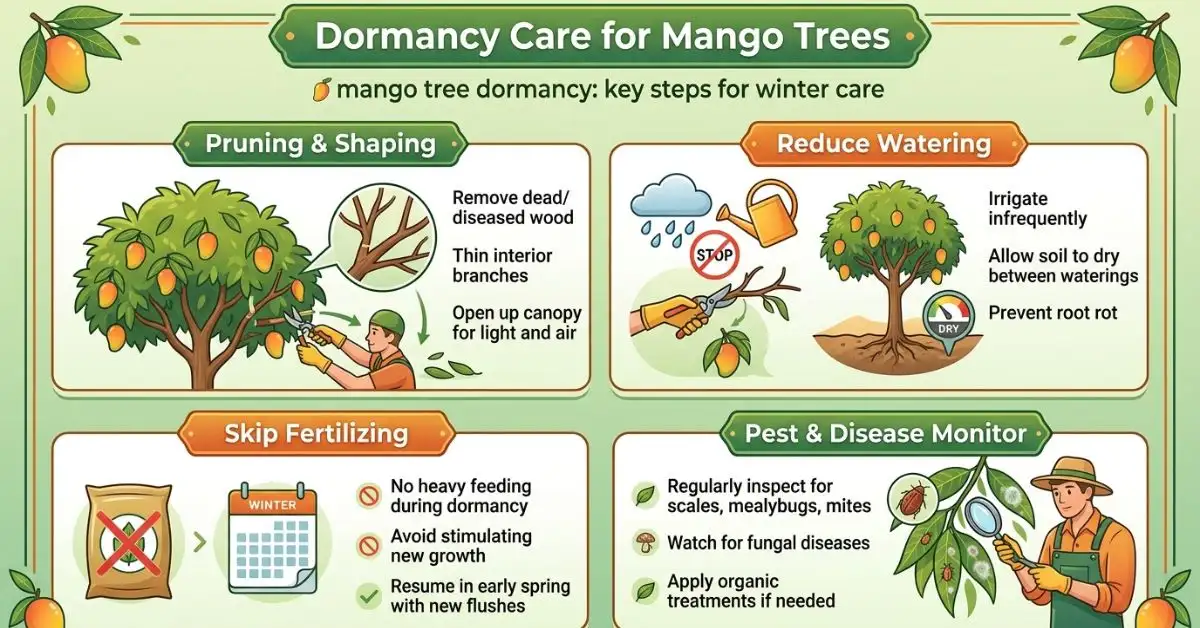
How to Water a Dormant Mango Tree
This is where most people go wrong. The instinct says: the tree looks stressed, give it water. But during dormancy, the opposite is true.
The dry period IS the point. It’s one of the primary triggers for flower bud development. Root activity drops by 60 to 80 percent during dormancy — the tree literally cannot use summer-level water.
Overwatering during dormancy does three bad things: it prevents flower bud formation, it promotes root rot in cold wet soil, and it triggers vegetative growth that replaces flower buds with leaf buds.
In-Ground Trees
Rely on natural rainfall. If it hasn’t rained in 3 to 4 weeks, give one light watering — 5 to 10 gallons depending on tree size. Not a deep soak. Just enough to keep the roots from completely drying out. Then let the soil dry again.
No more than once every 3 to 4 weeks during dormancy. Resume normal watering only after you see flower panicles emerge in late winter or early spring.
Container Trees
Containers dry out faster, so they need a bit more attention. Water very lightly every 2 to 3 weeks. Stick your finger 2 to 3 inches into the soil — water only if it’s completely bone dry. Use room-temperature water. Let all excess drain out. Never let the pot sit in standing water.
If you see new leaf growth popping out during winter, you’re watering too much. If the soil smells bad or mold appears on the surface, cut back immediately.
Fertilizing During Dormancy: Don’t
This is a hard rule. Zero fertilizer from late September or October through early spring when panicles emerge.
Nitrogen — the growth-promoting nutrient — stimulates leaf production. During dormancy, the tree is trying to convert terminal buds from vegetative to reproductive. A dose of nitrogen during this window reprograms those buds back to leaf mode.
ICAR research found that nitrogen applied during the pre-flowering rest period reduced flower panicle production by 40 to 70 percent. One bag of fertilizer at the wrong time can cost you your entire crop.
What about compost or mulch? Surface-applied compost or organic mulch is fine — it sits on top and breaks down slowly. It won’t trigger a growth response the way synthetic fertilizer or fresh manure will. Just don’t dig in anything nitrogen-rich.
What if you already fertilized? Stop adding more. For container trees, flush the pot with two to three rounds of heavy water to leach out excess nutrients, then let the soil dry completely. Flowering may be reduced this season, but the tree will recover for next year. Set a calendar reminder for next September: “Last fertilizer — no more until spring.”
Pruning During Dormancy: Almost Never
Every terminal bud on your mango tree has the potential to become a flower panicle — a cluster that can hold 500 to 10,000 flowers. Cut that terminal bud off and you’ve removed that entire panicle’s worth of fruit.
The pruning window closed in late September. Between October and spring, leave the pruning tools in the shed.
Exceptions: Remove clearly dead branches, storm-damaged limbs, branches with active disease, and rootstock suckers growing below the graft union on grafted trees. These can be taken off any time. But healthy living terminals? Don’t touch them.
If the tree’s shape bothers you, make a note and handle it next August after harvest. Cosmetic concerns can wait. Developing flower buds cannot.
Frost Protection: Dormant Doesn’t Mean Frost-Proof
A dormant mango tree can handle cool weather. It actually needs it — nights between 40 and 60°F are ideal for flower bud development. But mango trees are still tropical plants. They cannot handle freezing.
Below 32°F, leaves burn, young branches die, and developing flower buds can be killed. Below 25°F, you’re looking at trunk damage that can be fatal.
Keep frost cloth, incandescent Christmas lights (not LEDs — they don’t generate heat), and extra mulch ready to deploy on short notice. Water the soil 24 hours before a predicted freeze — moist soil holds and radiates more heat than dry soil.
If your tree takes frost damage, don’t prune the damaged wood immediately. Wait 4 to 8 weeks and then do the bark scratch test. What looks dead on the outside may still be alive underneath. Give it time.
Indoor Dormancy for Container Trees
If you overwinter your mango tree indoors, the biggest challenge is creating the right conditions. Most heated homes are too warm, too dry, and too dark for proper dormancy.
Temperature is the priority. You want cool nights — 50 to 62°F. That’s the range that drives flower bud development. A heated living room at 72°F all winter keeps the tree comfortable but prevents it from ever entering real dormancy. It’ll grow leaves in spring instead of flowers.
The best indoor spots are an unheated but frost-free sunroom, a bright spare bedroom with the heat turned low, or an attached garage with a window and a supplemental grow light.
Light matters too, but not the way you think. The tree needs some light to stay healthy — 8 to 10 hours a day with a grow light supplementing natural window light. But don’t run the lights 14 to 16 hours a day trying to simulate summer. That long photoperiod confuses the dormancy signal. Keep it to 8 to 10 hours on, 14 to 16 hours off. The long dark period supports the rest the tree needs.
Watch for spider mites — they thrive in dry indoor air. A humidifier or pebble tray helps keep humidity around 40 to 60 percent, which also prevents those brown leaf tips you see on overwintered trees.
Waking Up in Spring
When dormancy is ending, you’ll see the signs. Terminal buds get fatter and rounder. Tiny pointed structures — panicle tips — push out from the branch ends. That’s the moment you’ve been waiting for. Proof that your dormancy care worked.
Once you see panicles forming, resume light watering. Apply a low-nitrogen, high-potassium fertilizer. Start preventive fungicide. Begin attracting pollinators.
If the tree pushes leaves instead of flowers, the dormancy wasn’t long enough, wasn’t dry enough, or wasn’t cool enough. It’s disappointing but not harmful. The tree is still healthy. Adjust your approach next fall — longer dry period, cooler room — and try again.
For indoor container trees moving back outside, harden them off over two to three weeks. Start with a couple hours of morning sun, increasing each day. Don’t move them to full sun all at once — leaves acclimated to indoor light will burn badly.
Final Thought
Kevin figured it out the following year. He stopped watering in November. He moved his container tree to an unheated enclosed porch instead of his warm living room. He kept his hands off the fertilizer and the pruning shears.
In February, panicle tips appeared on almost every branch. By May, he had his first real harvest — over 30 Glenn mangoes from a tree he’d nearly killed with kindness the year before.
The hardest part of dormancy care is trusting the process. Your tree looks like it needs help. It doesn’t. It needs rest, dry soil, cool nights, and for you to walk away. Do that, and it will reward you with flowers.