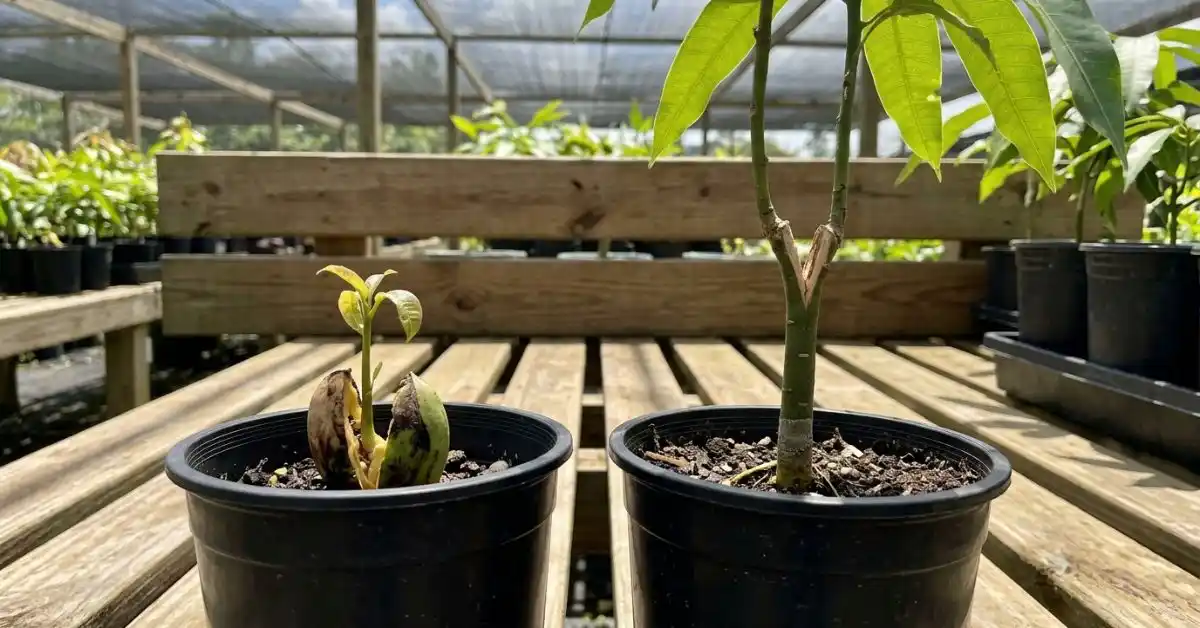
A guy named Ravi in a gardening group I follow once grew a mango from a seed he pulled out of a grocery store Alphonso. He babied that tree for eight years. Watered it perfectly. Fed it. Protected it from cold every winter. When it finally fruited, he bit into the first mango expecting that rich, creamy Alphonso flavor.
It tasted nothing like an Alphonso. Mildly sweet, a bit fibrous, totally different fruit.
Ravi didn’t do anything wrong. He just didn’t know something that would have saved him eight years of waiting: Alphonso is a monoembryonic variety. That means a seed-grown tree produces a random genetic mix — not a copy of the parent. His tree was basically a dice roll.
If he’d grafted instead, he would have had an exact clone producing real Alphonso mangoes in two to three years.
That’s the story of mango propagation in a nutshell. The method you choose decides how long you wait, what fruit you get, and whether the whole thing was worth the effort. Let me break down every option so you can pick the right one.
The Basics: What You Need to Know First
Propagation just means creating a new plant from an existing one. With mango trees, you have two paths:
Sexual propagation — growing from seed. The seed contains a new genetic combination. The tree you get might produce great fruit, bad fruit, or something completely unexpected.
Asexual propagation — grafting, air layering, budding, or cuttings. These methods create an exact genetic clone of the parent tree. Same fruit, same flavor, same everything.
Polyembryonic vs. Monoembryonic Seeds
This is the one concept most guides skip, and it’s the most important one for seed growers.
Monoembryonic seeds have one embryo inside. That embryo is a genetic hybrid — a mix of the mother and father tree. The fruit you get from this seedling is unpredictable. Most Indian varieties fall in this category: Alphonso, Dasheri, Langra, Kesar.
Polyembryonic seeds have multiple embryos. One is a genetic hybrid, but the rest are clones of the mother tree. If you pick the most vigorous sprout (usually the biggest one), you’ll likely get a tree that produces fruit identical to the parent. Most Southeast Asian and Floridian varieties are polyembryonic: Turpentine, Manila, Carabao, Kensington Pride.
How can you tell? When the seed sprouts, monoembryonic gives you one shoot. Polyembryonic gives you two to five shoots from the same seed.
How Long Until You Get Fruit?
This is where your method choice really matters.
| Method | Time to Fruit | True to Parent? | Difficulty |
|---|---|---|---|
| Seed (monoembryonic) | 5–10+ years | No | Easy |
| Seed (polyembryonic) | 4–8 years | Mostly yes | Easy |
| Grafting | 2–3 years | Yes | Moderate |
| Air layering | 1–2 years | Yes | Moderate |
| Cuttings | 3–5 years | Yes | Hard (low success) |
If speed matters, air layering gets you fruit fastest. If you want the standard professional approach, grafting is the way. If you just want to try something fun and don’t mind waiting, seeds are the easiest starting point.
How to Grow a Mango Tree From Seed
This is where most people start, and it’s a perfectly fine way to go — as long as your expectations are set right.
Picking and Preparing the Seed
Use a seed from a fully ripe mango. The fresher, the better. Mango seed viability drops fast once the seed dries out, so plant within one to two weeks of eating the fruit.
The hard, flat shell you see after eating the mango is the husk — not the seed. The actual seed is inside. Here’s how to get it out:
- Scrub off all the fruit flesh and let the husk dry for a day or two.
- Carefully pry open the husk along the edge with a butter knife or scissors.
- Pull out the inner seed — it’s bean-shaped, tan or light purple.
- Check it: plump and firm is good. Shriveled, brown, or moldy means toss it.
A common beginner mistake is planting the whole husk. That delays germination by weeks and lowers your success rate. Always crack it open.
The Paper Towel Method (Best for Beginners)
This is the method I recommend because you can watch the whole process.
- Wrap the prepared seed in a damp paper towel — moist, not soaking.
- Put it in a zip-lock bag. Leave the bag slightly open for airflow.
- Set it somewhere warm — 75 to 90°F. Top of the fridge works.
- Check every two to three days. Re-moisten the towel if it’s drying out.
- In 7 to 14 days, you’ll see a root emerge, then a shoot.
- Once the root is 2 to 3 inches long, plant it in a pot.
Success rate with fresh seeds: 80 to 95 percent.
You can also plant the seed directly in a pot — lay it flat about half an inch deep in well-draining mix. Or suspend it in water like an avocado pit. Both work, but the paper towel method gives you the most control and visibility.
Early Seedling Care
Once your seedling has a few true leaves, move it to a 3 to 5 gallon pot with good drainage. Start in bright indirect light, then gradually move to full sun over a couple weeks. Water when the top inch of soil is dry. Wait until you see six or more leaves before giving any fertilizer, and even then, use it at quarter strength.
Keep it warm. Mango seedlings are very frost-sensitive — don’t let temperatures drop below 60°F.
How to Graft a Mango Tree
Grafting is how the pros do it. Over 90 percent of commercial mango trees worldwide are grafted. You join two plant parts together: the rootstock (a sturdy seedling that provides the root system) and the scion (a cutting from the variety you want to grow). The result is a tree that combines the best of both — strong roots with great fruit.
Growing Rootstock
Start with a polyembryonic seed. Turpentine is the most widely used rootstock variety in the world — vigorous, disease-resistant, and uniform. Grow it in a small pot until the trunk is pencil-thick, about half to three-quarters of an inch in diameter. That usually takes 12 to 18 months.
Getting Scion Wood
You need a cutting from the variety you want. Pick a healthy, mature terminal shoot that’s hardened off — not soft new growth and not old woody growth. It should be pencil-thick, 4 to 6 inches long, with two to three dormant buds. Use it within 24 hours of cutting, or wrap it in a damp paper towel in a plastic bag in the fridge for up to a week.
Local tropical fruit societies are great places to find scion wood. The Tropical Fruit Society of South Florida and California Rare Fruit Growers both hold scion wood exchanges. Online forums and Facebook mango groups are another option, but verify the variety — mislabeling is common.
Veneer Graft (The Most Common Method)
This is the standard technique and the one I’d recommend starting with. Success rate: 75 to 90 percent.
- On the rootstock, make a shallow downward cut about 1.5 to 2 inches long on one side, 4 to 6 inches above soil level. Cut through the bark into the cambium, angling slightly inward. Make a short inward cut at the bottom to create a small lip.
- On the scion, make a matching long tapered cut on one side. Make a shorter cut on the opposite side to create a wedge at the base.
- Slide the scion into the rootstock cut. Align the cambium layers — the thin green layer just under the bark. This is the make-or-break step. If the cambium doesn’t touch, the graft won’t take.
- Wrap tightly with parafilm grafting tape. Seal everything. Cover the scion tip with a small plastic bag or parafilm cap.
- Keep the grafted tree in warm shade for 3 to 6 weeks. Don’t remove the wrapping until you see new growth pushing from the scion buds.
- Once the scion is actively growing, gradually cut back the rootstock above the graft over two to three sessions.
Three things matter most: razor-sharp knife (dull cuts fail), cambium alignment, and speed — don’t let the cut surfaces dry out.
After the graft takes, remove any shoots growing from below the graft union. Those are rootstock growth, not your desired variety. If you leave them, they’ll take over.
How to Air Layer a Mango Tree
Air layering — also called marcotting — is the fastest way to get a fruiting mango clone. You force a branch on an existing tree to grow roots while it’s still attached. Then you cut it off and plant it as its own tree. Because the branch is already mature wood, it can fruit in as little as one to two years.
- Pick a healthy branch, pencil to thumb thick, 12 to 24 inches from the tip.
- Make two parallel cuts around the branch about an inch apart. Cut through the bark down to the white wood. Peel off that ring of bark and scrape the exposed area clean.
- Dust the upper edge of the wound with rooting hormone (IBA, 3000 to 5000 ppm).
- Wrap a softball-sized ball of damp sphagnum moss around the wound.
- Cover the moss with plastic wrap. Seal both ends tight with string or tape. No air should get in.
- Wait 4 to 12 weeks. Check every couple weeks — add water with a syringe if the moss is drying out.
- When you see healthy white roots through the plastic, cut the branch below the moss ball.
- Plant immediately in a 3 to 5 gallon pot. Keep in indirect light for two to four weeks before moving to full sun.
Cut the leaves in half to reduce stress on the new roots. Mist daily for the first couple weeks.
One thing to know: air-layered trees don’t develop a deep taproot. They grow lateral roots only. Stake the tree for the first two to three years and protect it from strong winds.
Can You Grow a Mango From a Cutting?
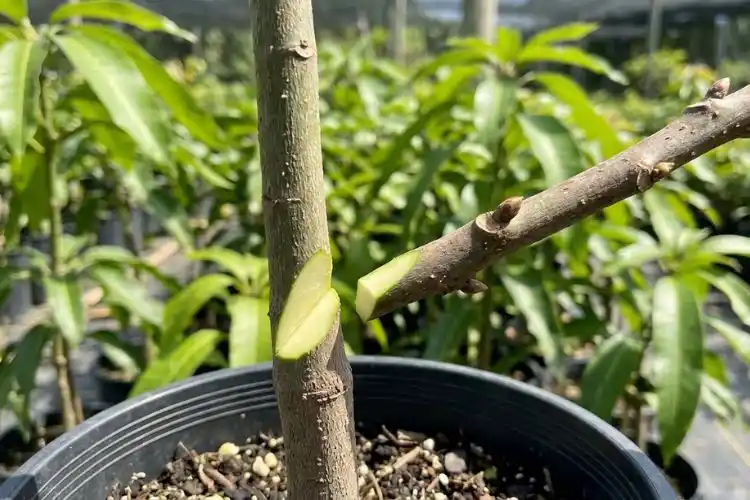
Honestly? You can try, but keep your expectations low. Mango cuttings are hard to root. Home grower success rates run about 10 to 25 percent. Even with professional equipment, it tops out around 40 to 60 percent.
If you want to try: use semi-hardwood cuttings, 6 to 12 inches long. Dip in high-concentration rooting hormone (3000 to 8000 ppm IBA — regular garden-center rooting powder is too weak). Plant in a sterile perlite and peat mix. Create a humidity dome with a clear plastic bag. Keep it warm (75 to 90°F) in bright indirect light. Check for roots after 4 to 8 weeks.
Take at least 10 cuttings. Expect most to fail. The ones that make it will be worth it — but grafting and air layering are much more reliable paths.
Common Mistakes That Kill New Trees
A few things I see go wrong repeatedly:
Planting a dried-out seed. If the seed has been sitting around for weeks, it’s probably dead. Use it fresh.
Expecting seed-grown trees to match the parent fruit. Unless it’s a polyembryonic variety, it won’t. Graft if you want a specific flavor.
Removing graft tape too early. Wait until new growth has hardened — usually 4 to 8 weeks minimum. Pulling the tape off early exposes the union before it’s healed.
Ignoring rootstock suckers. Any growth from below the graft union is rootstock, not your grafted variety. Remove it the moment you see it, for the entire life of the tree.
Overwatering newly propagated trees. Fresh grafts, new air layers, and rooted cuttings all have limited root systems. Keep the soil moist, not wet. Soggy soil means root rot.
Where to Go From Here
If you’re just starting out, grow a seed. It’s easy, it’s free, and you’ll learn a lot about how mango trees work. Use that seedling as rootstock in a year or two.
When you’re ready for exact variety replication and faster fruit, try a veneer graft or an air layer. Both are learnable skills that any home grower can pick up with a little practice.
Ravi — the guy who waited eight years for mystery fruit — eventually learned to graft. He ordered Alphonso scion wood from a collector in South Florida, grafted it onto his original seedling as rootstock, and had real Alphonso mangoes two years later. Same tree, different outcome. He just needed the right method.