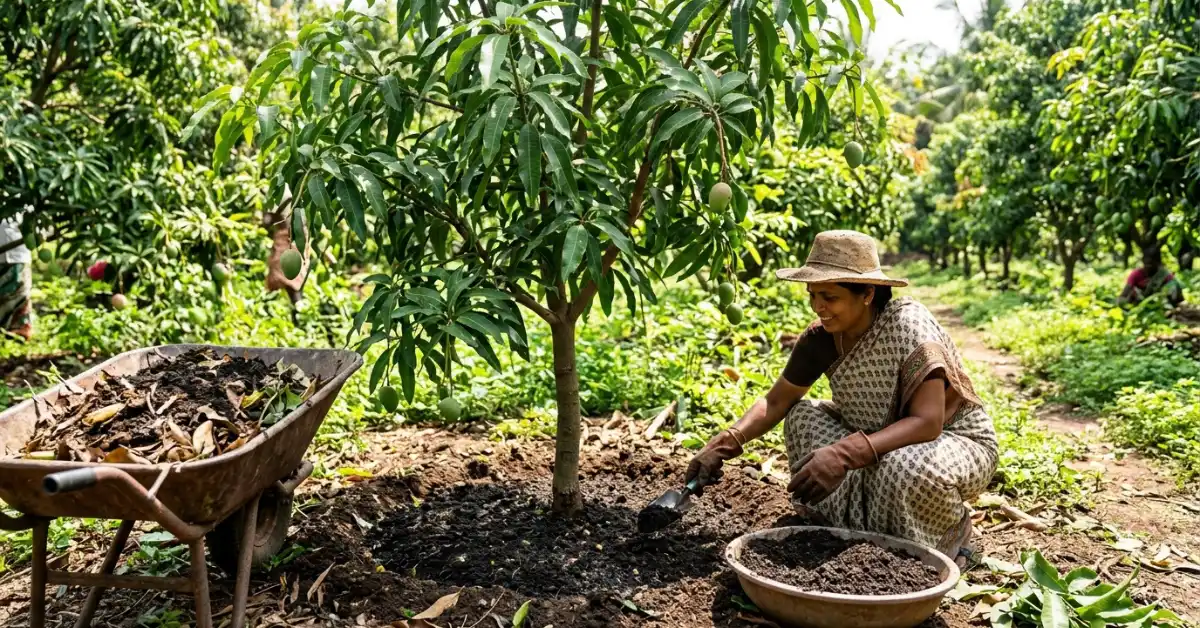
A grower I follow online named Patricia shared something a few years ago that stuck with me. She had two mango trees in her yard near Fort Myers, Florida — same variety, same age, planted the same year, about 30 feet apart. One got synthetic fertilizer three times a year. The other got regular compost top-dressing and mulch.
After five years, the difference was hard to ignore. The composted tree had a thicker trunk, darker green leaves, and produced about 40 percent more fruit. The fertilizer-only tree looked fine, but the soil around it was hard, pale, and lifeless. When Patricia dug into the ground near each tree, the composted side was crawling with earthworms. The other side had none.
That’s the thing about compost. Fertilizer feeds the tree. Compost feeds the soil. And healthy soil feeds the tree better than any bag of chemicals ever will.
Why Compost Matters So Much for Mango Trees
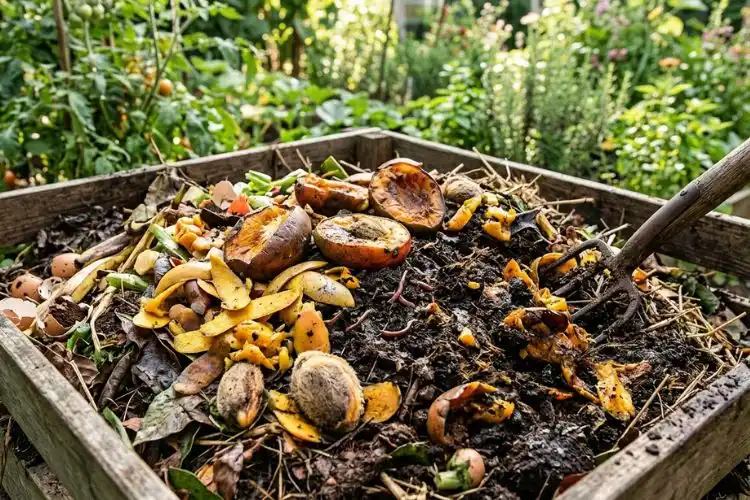
Compost is decomposed organic matter — kitchen scraps, leaves, manure, and yard waste that have been broken down by billions of tiny organisms into a dark, crumbly, earthy-smelling material. When you add it to the soil around your mango tree, it does a lot more than just add nutrients.
It improves soil structure. Clay soil loosens up. Sandy soil holds more water. It can increase your soil’s water-holding capacity by 20 to 30 percent — a big deal if you’re growing in the fast-draining sandy soils common across South Florida or coastal areas.
Compost feeds the bacteria, fungi, and other microorganisms that make soil alive. Those microbes break down nutrients into forms your mango tree can actually absorb. They also fight off soil-borne diseases like Phytophthora — the root rot fungus that kills more mango trees than just about anything else.
And here’s something that really matters for fruit quality: trees growing in compost-rich soil tend to produce sweeter mangoes with better color. The slow, steady nutrient release from compost gives the tree exactly what it needs, when it needs it. ICAR research shows composted mango orchards have 30 to 50 percent more microbial life in the soil than orchards that rely only on synthetic fertilizer.
Compost vs. Synthetic Fertilizer
Synthetic fertilizer gives your tree a quick nutrient hit. It’s fast, but it fades fast too. It does nothing for soil structure, water retention, or microbial life. Over time, it can actually make your soil worse — salt buildup, compaction, and declining organic matter.
Compost works slower, but it builds on itself year after year. It’s almost impossible to over-apply. And it creates a soil that increasingly takes care of itself.
My opinion? Use compost as the foundation. Add targeted fertilizer only when a soil test shows a specific deficiency. That’s the approach most experienced tropical fruit growers I’ve talked to have landed on.
Best Types of Compost for Mango Trees
Not all compost is created equal. Here’s what works best.
Vermicompost (worm castings) is the gold standard. Red wiggler worms eat organic waste and produce castings packed with beneficial microbes, plant growth hormones, and balanced nutrients. Studies show vermicompost can increase fruit tree yields by 15 to 40 percent compared to regular compost alone. It’s gentle enough that you can apply it right to the root zone without any risk of burning. If you only use one type, make it this one.
Hot compost is the classic method. You pile up green materials (grass clippings, kitchen scraps, fresh manure) and brown materials (dried leaves, straw, cardboard) in a 1:3 ratio. The pile heats up to 130 to 160°F, killing weed seeds and pathogens. Turn it every week, and you’ll have finished compost in 6 to 8 weeks.
Composted cow manure has been the go-to mango tree amendment in India for thousands of years. It’s mild, balanced, and widely available. Just make sure it’s fully aged — at least 6 months. Fresh manure burns roots and carries harmful bacteria.
Composted chicken manure is higher in nitrogen and works great for the post-harvest recovery period. But again — it must be fully composted. Fresh chicken manure is extremely hot and will damage feeder roots fast.
Bokashi is a Japanese fermentation method that works well for container mango growers. You can process meat, dairy, and cooked food scraps that regular compost piles can’t handle. Ferment in a sealed bucket for two weeks, then bury in soil for another two to four weeks before the roots contact it.
Mushroom compost — use this one carefully. It tends to run alkaline (pH 7.5 to 8.5) and can be high in salts. Only use it if your soil pH is already below 6.5 and you need to bring it up. Keep it under 15 percent of your total amendment.
| Type | Quality | Speed | Best For | Watch Out |
|---|---|---|---|---|
| Vermicompost | Excellent | 2–4 months | All growers | None — safest option |
| Hot Compost | Good | 6–8 weeks | General use | Must be fully finished |
| Cow Manure | Good | 6+ months aging | In-ground trees | Must be composted, not fresh |
| Chicken Manure | High nitrogen | 6+ months aging | Post-harvest boost | Burns roots if fresh |
| Bokashi | Good | 4–6 weeks | Containers, small spaces | Must cure in soil before use |
| Mushroom Compost | Moderate | Ready-made | Acidic soils only | Alkaline, salty |
How to Make Compost for Mango Tree
Here’s a straightforward recipe that works.
Standard Hot Compost
- Gather your materials: 3 parts brown (dried leaves, straw, shredded cardboard) to 1 part green (grass clippings, kitchen scraps, fresh plant trimmings).
- Build the pile in layers — 3 to 4 inches of brown, then green, then a thin layer of composted manure or garden soil. Repeat.
- Moisten each layer. The pile should feel like a wrung-out sponge — damp but not dripping.
- Make the pile at least 3 feet by 3 feet by 3 feet. That size is needed for the pile to generate heat.
- Turn with a pitchfork every 5 to 7 days.
- It should heat up to 130 to 160°F within a few days. A compost thermometer helps here.
- It’s done when it’s dark, crumbly, smells like earth, and you can’t recognize any of the original materials. Usually 6 to 8 weeks.
Pro tip: Chop or shred everything before adding it. Smaller pieces break down 2 to 3 times faster.
Using Your Own Mango Leaves
Your tree drops leaves every year — use them. Mango leaves decompose slowly because of their waxy coating and tannin content, but shredding them with a mower speeds things up dramatically. Mix 2 parts shredded mango leaves with 1 part green material and some composted manure. Ready in 8 to 12 weeks.
There’s something satisfying about feeding your mango tree its own composted leaves. You’re recycling the exact micronutrients — manganese, zinc, iron — that the tree pulled from the soil in the first place. A perfect closed loop.
How to Apply Compost for Mango Tree
Top-Dressing (The Main Method)
This is simple and effective. Spread 2 to 4 inches of finished compost in a ring around the tree, starting about 12 inches from the trunk and extending out to the drip line — the outer edge of the canopy.
Never pile compost against the trunk. That creates constant moisture against the bark, which leads to collar rot, fungal decay, and pest problems. Think donut, not volcano.
Water it in after applying. The nutrients will start working their way down to the feeder roots in the top 12 to 24 inches of soil.
At Planting Time
When planting a new mango tree, mix 30 percent finished compost with 70 percent native soil for your backfill. Don’t fill the hole with pure compost — roots need to grow into the surrounding native soil, not stay trapped in an amended pocket.
Compost Tea
Compost tea is a liquid brew that delivers beneficial microbes and soluble nutrients fast. Put a pound or two of vermicompost in a mesh bag, suspend it in a 5-gallon bucket of dechlorinated water, add a tablespoon of unsulfured molasses, and aerate with a small aquarium pump for 24 to 48 hours. Use it within a few hours of brewing.
Pour it around the drip line as a soil drench, or spray it on leaves early in the morning. Foliar compost tea has been shown to reduce anthracnose — the worst mango fungal disease — by colonizing leaf surfaces with beneficial microbes that crowd out the bad ones.
How Much Compost Per Tree?
| Tree Size | Amount Per Application | Frequency |
|---|---|---|
| Newly planted | 5–10 lbs mixed in + 2-inch top-dress | At planting |
| Young (1–3 years) | 25–50 lbs | 2–3x per year |
| Established (3–7 years) | 50–100 lbs | 2–3x per year |
| Mature (7+ years) | 100–200+ lbs | 2x per year |
| Container tree | 2–4 inch top-dress | 2–3x per year |
When to Apply Compost (Seasonal Timing)
Timing matters because mango trees have distinct seasonal needs.
Early spring (February–March): Apply a 2 to 3 inch top-dressing before flowering. This feeds the root flush that supports blooms and the coming growing season. Avoid heavy nitrogen-rich composts right now — you don’t want to push leaf growth at the expense of flowers.
Late spring/early summer (May–June): After fruit has set, add another 2-inch layer plus fresh mulch on top. The tree is working hard to grow fruit. This is the best time for vermicompost — gentle, nutrient-dense support for developing mangoes.
Post-harvest (August–October): This is the heaviest application of the year. Hit it with 3 to 4 inches. The tree just spent a massive amount of energy producing fruit and needs to replenish. High-nitrogen composted manure works well here because you want to support the fall growth flush that becomes next year’s fruiting wood.
Winter (November–January): Don’t apply compost. The tree needs to rest. Heavy nitrogen now triggers new leaf growth that can prevent flowering. Let the existing compost and mulch layer do their work quietly. A light compost tea spray every few weeks is fine if you want to keep leaf surfaces healthy.
Common Composting Mistakes
A few things I see go wrong regularly:
Applying unfinished compost. If it still smells sour, has recognizable food scraps, or feels warm, it’s not done. Half-finished compost robs nitrogen from the soil as it continues breaking down. Let it cure for another 2 to 4 weeks before using.
Piling compost against the trunk. I mentioned this already, but it’s worth repeating because I see it constantly. Leave a 12-inch gap between the compost and the trunk. Always.
Using compost from unknown sources. Compost made from grass treated with persistent herbicides like aminopyralid can survive the composting process and damage your tree. If you’re buying compost, ask about the source materials. Better yet, make your own. A simple test: plant a few bean seeds in a sample. If they grow normally, the compost is safe.
Adding fresh manure. Every year someone in a gardening group asks why their mango tree’s leaves are burning after they spread “organic fertilizer” around it. Turns out they used fresh chicken manure straight from the coop. That stuff is way too hot. Age it for at least 6 months first.
Heavy compost right before flowering season. Nitrogen-rich applications in November through January will push your tree to grow leaves instead of flowers. Save the heavy feeding for after harvest.
Final Thought
Patricia told me recently that she stopped using synthetic fertilizer on both her trees about two years ago. Now they both get compost. The one that was fertilizer-only took a season to adjust, but the soil is slowly coming back to life. She’s finding earthworms there now too.
Compost isn’t a quick fix. It’s a long game. But it’s the one input that makes everything else — watering, fertilizing, disease prevention — work better. Start with whatever you have. Kitchen scraps and yard waste in a pile. A small worm bin. Even a bag of composted cow manure from the garden center spread around the drip line.
Your mango tree will thank you for it. And you’ll taste the difference in the fruit.