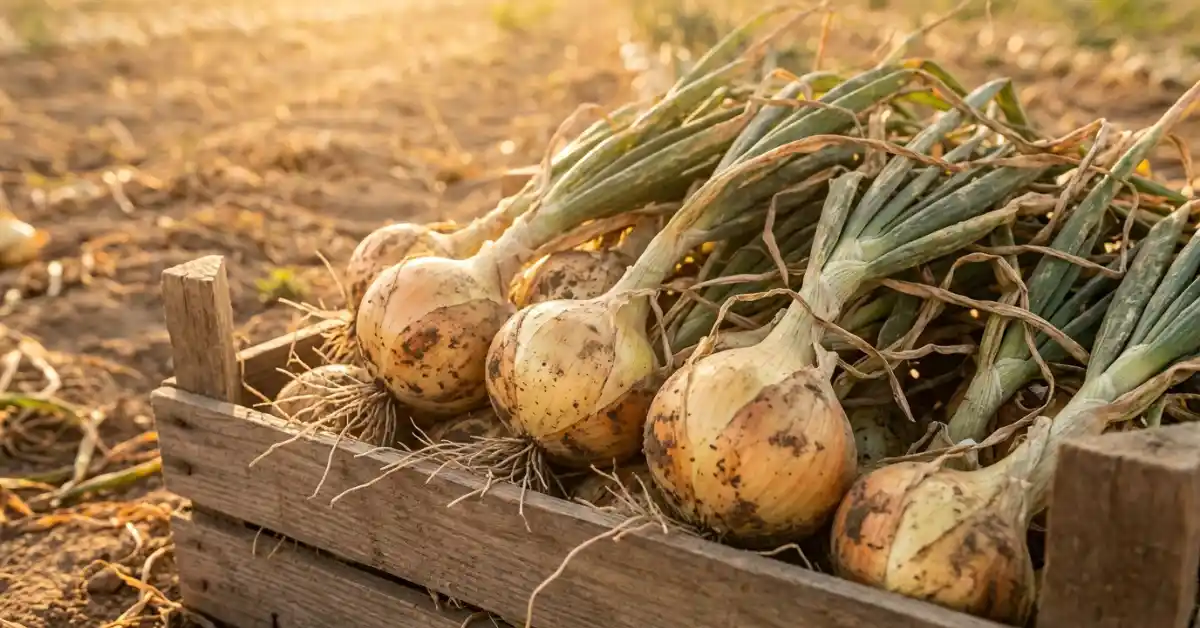
My neighbor Doug — the same guy who stood in his yard holding a bag of onion sets with no clue what to do — called me over in July. He was grinning ear to ear. “I pulled them up!” he shouted, pointing at a pile of fat yellow onions sitting in the grass. Right in the blazing afternoon sun.
“Doug, get them into the shade!” I yelled back as I jogged across the yard.
He looked at me like I was crazy. “But don’t they need to dry out?”
This is where so many home growers get tripped up. You spend months watering, weeding, and watching your onions grow. You pull them out of the ground and feel like a champion. And then — if you skip the curing step or do it wrong — you’ve got a pile of soft, mushy, sprouting onions by October.
That’s exactly what happened to my aunt in southern Indiana a few years ago. She grew the most gorgeous red onions I’ve ever seen. Pulled up about 50 of them. Left them in a cardboard box in her garage without any airflow. Three weeks later, half of them were rotten. She almost cried.
The thing is, curing onions isn’t hard. It just takes a little patience and the right setup. Let me show you how to cure onions the right way so they last for months — maybe even through winter.
What Is Curing, Anyway?
Curing sounds like a medical term, but it’s really just drying. That’s all it is.
Curing is the process of drying the outer skins and sealing the neck of an onion to prevent moisture loss and bacterial rot during storage.
When you pull an onion from the ground, the outer layers are still moist. The neck — that spot where the green leaves meet the top of the bulb — is soft and open. Moisture and bacteria can sneak right inside.
Curing dries out those outer layers. The skin turns papery and tight. The neck shrinks and seals shut. This creates a natural barrier that keeps the onion fresh and firm during storage.
Think of it like sealing a jar of jam. If you don’t get that lid on tight, air gets in and the jam goes bad. Curing is nature’s way of putting a lid on your onion.
Without proper curing, onions go soft. They sprout. They rot from the inside out. And all that work you put into growing them? Gone.
The Step-by-Step Curing Process
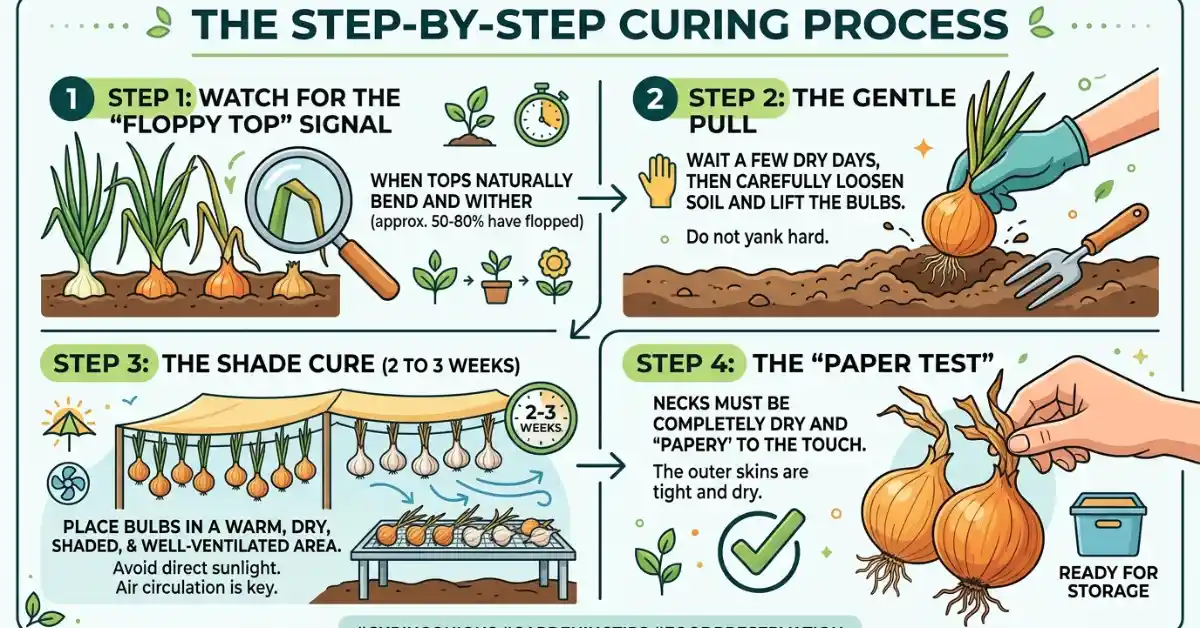
Here’s how to cure onions from start to finish. No special equipment needed. Just time, shade, and air.
Step 1: Watch for the “Floppy Top” Signal
Your onions will tell you when they’re ready to come out of the ground. You don’t have to guess.
As the bulbs finish growing, the green tops start to turn yellow. Then they bend over and flop down — like the plant just gave up standing. This is called “necking down” or “lodging,” and it’s completely normal.
When about 50% to 75% of your onion tops have fallen over, it’s harvest time.
Don’t wait until every single top has flopped. If you wait too long, the onions can start taking on water again or even re-root in wet soil. I made this mistake during a rainy August in central Ohio. I kept waiting for that last stubborn row to fall over. By the time I pulled them, a few had started growing new roots and the skins were splitting. Lesson learned.
On the other hand, don’t pull them too early. If the tops are still green and standing straight up, the bulb isn’t done filling out. Give it more time.
A gardening buddy of mine in East Tennessee told me he marks his calendar when the first tops start flopping. About 10 to 14 days later, he harvests the whole patch. That system has worked well for him for over a decade.
Step 2: The Gentle Pull
This part matters more than people realize. Onions have what growers call “shoulders” — the rounded top of the bulb that sits right at the soil line. If you grab the top and yank hard, you can bruise or crack those shoulders. A bruised onion won’t store. It’ll rot right at the damage point.
Here’s what I do instead:
Take a garden fork — not a shovel — and push it into the soil about 4 to 6 inches away from the bulb. Gently lever the soil up to loosen things. Then reach down and lift the onion out by the base of the leaves, right above the bulb.
If the soil is loose and sandy, you can often just pull them by hand. But if you’re dealing with heavy clay — and I know a lot of growers in the Midwest and Southeast fight this every season — use the fork. It’s worth the extra 10 seconds per onion.
Shake off loose dirt but don’t wash them. Water is the enemy right now. You want these onions dry from this point forward.
If you do nick or cut an onion during harvest, set it aside. Use it in the kitchen this week. It won’t store well, but it’s still perfectly good to eat.
Step 3: The Shade Cure (2 to 3 Weeks)
Here’s where Doug went wrong — and where a lot of people go wrong.
Do not cure onions in direct sunlight.
I know it seems logical. Sun equals dry, right? But onions can get sunscald. It’s basically a sunburn on the outer flesh. The damaged area turns soft, then green, then mushy. And once rot starts, it spreads fast.
Instead, move your onions to a dry, shaded spot with good airflow. Here are some places that work great:
- A covered porch. This is my go-to. The roof blocks the sun. The open sides let air move through.
- A garage with the door cracked open. Works well as long as it doesn’t get too hot. In places like Phoenix or the Texas Hill Country, a closed-up garage in July can hit 120°F. That’s too hot.
- A garden shed with windows. Open the windows for cross-ventilation.
- Under a shade tree on a table or rack. Just make sure they’re off the ground so air circulates underneath.
Lay the onions in a single layer. Don’t stack them. Don’t pile them. Every onion needs air touching its skin on all sides. I use old window screens propped up on cinder blocks. Some people use wire shelving from an old bookcase or baker’s rack. Anything that lets air flow under and around the bulbs.
Leave the tops attached during curing. The green leaves are still feeding energy back into the bulb during the first few days. Let them dry naturally. They’ll shrivel up and turn brown on their own.
Curing takes about 2 to 3 weeks, depending on humidity. If you live somewhere dry — like Colorado or New Mexico — it might only take 10 days. If you’re in a humid area — like coastal Virginia or the Gulf Coast — it can take the full 3 weeks or even a little longer.
Check on them every few days. If you see any soft spots or mold, pull those onions out right away. One bad onion can spread problems to the ones next to it.
Step 4: The “Paper Test”
How do you know when curing is done? Three simple checks:
1. The roots are dry and brittle. Pick up an onion and look at the bottom. The roots should snap off easily. If they’re still flexible or moist, keep curing.
2. The skin sounds papery. Run your fingers over the outer skin. You should hear a dry “shish-shish” sound — like rustling tissue paper. If the skin still feels damp or thick, it needs more time.
3. The neck is tight and hard. Squeeze the neck gently between your thumb and finger. It should feel firm and completely dry. If it’s soft, spongy, or still has any green color, the onion isn’t sealed yet. Put it back.
Once your onions pass all three checks, they’re ready for storage.
At this point, you can trim the tops down to about 1 inch above the bulb. Trim the roots off too. Brush away any loose dirt, but again — don’t wash them.
If you want to braid your onions for hanging storage (more on that below), leave the tops long. You’ll need that extra length for braiding.
Quick Storage Comparison Table
Once your onions are cured, you’ve got a few storage options. Here’s a quick breakdown:
| Storage Method | Shelf Life | Best For… |
|---|---|---|
| Mesh Bags or Crates | 6 to 8 Months | Standard storage in a cool, dark pantry. |
| Braiding (Tops On) | 4 to 6 Months | Soft-neck onion varieties and kitchen decor. |
| Fridge (Whole) | 1 to 2 Months | Not recommended — too humid, promotes sprouting. |
| Chopped and Frozen | 8 to 12 Months | Soups and stews. They lose their crunch but keep their flavor. |
My personal favorite is mesh bags hung in a cool, dark closet. I have a coat closet near my back door that stays around 50 to 60°F in winter. I hang three or four mesh bags of onions in there, and they last well into February.
A woman I met at a farmers’ market in western Kentucky told me she stores her cured onions in old pantyhose. She drops one onion in, ties a knot, drops another, ties another knot — all the way up the leg. Then she hangs the whole thing from a nail in her basement. When she needs an onion, she cuts below the bottom knot. It sounds funny, but she said her onions last all winter that way. The nylon lets air circulate around each bulb perfectly.
The Golden Rule of Onion Storage
I tell this to every new grower I meet:
Never store onions near potatoes.
I know it’s tempting. They’re both pantry staples. You want them in the same bin or the same shelf. Don’t do it.
Potatoes release moisture and ethylene gas as they sit in storage. That gas triggers onions to sprout. And the extra moisture speeds up rot. Put them together and you’ll lose both crops faster.
Keep your potatoes in a separate spot — ideally in a dark, cool area with its own airflow. A different shelf, a different closet, a different corner of the basement. Whatever works. Just keep distance between them.
I learned this from personal disaster. My first big onion harvest — about 40 bulbs — went into a wooden crate right next to a 10-pound bag of russet potatoes in my pantry. Within a month, the onions were sprouting and the potatoes had gone soft. I lost most of both. That won’t happen twice.
Which Onions Store Best?
Not all onions are built for long storage. This trips people up too.
Pungent, firm varieties store the longest. Yellow storage onions like Copra, Patterson, and Stuttgarter are bred for long shelf life. They have tight skins, strong flavor, and low water content.
Sweet onions store the worst. Vidalia, Walla Walla, and Texas Sweet onions taste amazing fresh. But their high sugar and water content means they go soft much faster — usually within a month or two, even with good curing.
If you grow sweet onions, plan to eat them first. Save the strong, pungent ones for long-term storage.
Common Curing Mistakes (and How to Avoid Them)
Here’s a quick list of things I’ve seen go wrong — either in my own garden or from other growers I’ve talked to:
- Curing in a damp basement. Humidity is the enemy. If your basement feels clammy, it’s not the right spot. Use a fan if you have to, but pick a drier location if possible.
- Stacking onions during curing. Every onion needs airflow on all sides. Stacking traps moisture between bulbs.
- Putting uncured onions in plastic bags. Plastic holds moisture in. Always use mesh, burlap, or open crates.
- Skipping the inspection. Check your stored onions every couple of weeks. Pull out any that are going soft. One bad onion really can ruin the whole batch.
- Curing in a hot, closed space. You need airflow. A closed-up shed in 95°F heat with no ventilation will cook your onions, not cure them.
From Garden to Pantry — It’s Worth the Wait
Curing onions takes patience. Two to three weeks of waiting while they sit there drying doesn’t feel productive. But it’s the difference between eating your own onions in December and throwing them in the compost in September.
Doug ended up curing his onions on his covered back porch — right after I pulled them out of the sun. He laid them on an old screen door balanced across two sawhorses. Three weeks later, the skins were crackling like parchment paper. He stored them in mesh bags in his hall closet.
Last time I talked to him, he still had six or seven left. In January. From a July harvest. That’s six months of homegrown onions from about 20 minutes of curing setup.
Not a bad return for something so simple.