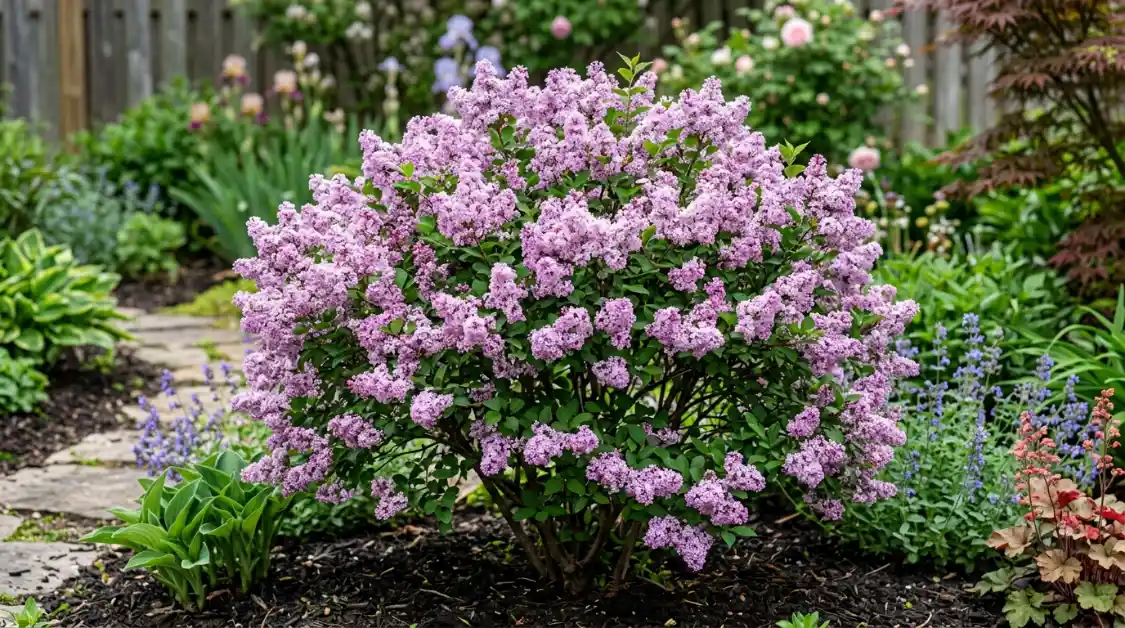
Three years ago, my neighbor Janet knocked on my door holding a garden catalog, practically vibrating with excitement. “Look at this!” she said, pointing to a photo of a shrub covered in purple flowers. “I want one, but my yard is tiny. Will it take over everything like my old lilac did?”
She was talking about the monster French lilac her dad had planted in the 1980s—a beautiful plant that eventually grew 15 feet tall and swallowed half her side yard. I told her about dwarf Korean lilacs, and she planted two that spring. Now they frame her front walkway, covered in fragrant blooms every May, and they’ve never gotten bigger than her kitchen table. She stops by every spring to thank me.
If you’ve ever loved lilacs but didn’t have room for a full-sized one, or if you’re tired of wrestling with an overgrown shrub, the dwarf Korean lilac might be exactly what you need.
What is a Dwarf Korean Lilac Tree?
Let’s clear something up right away: dwarf Korean lilac is technically a shrub, not a tree, though some people train it to a single stem and call it a tree. Either way works. The botanical name is Syringa meyeri ‘Palibin’, and it’s one of the best compact flowering shrubs you can grow.
Botanical Overview (Syringa meyeri ‘Palibin’)
This plant comes from northern China and Korea, where it grows in mountainous areas. It’s part of the olive family (Oleaceae), same as regular lilacs, but it was bred specifically to stay small. The ‘Palibin’ cultivar—sometimes sold as ‘Miss Kim’—is the most common variety you’ll find at nurseries.
It’s hardy in USDA zones 3 through 7, which means it can handle seriously cold winters (down to -40°F in zone 3) and reasonably warm summers. If you live in zone 8 or warmer, it probably won’t do well because it needs winter chill to set buds properly.
Key Characteristics and Features
A mature dwarf Korean lilac grows about 4 to 5 feet tall and 4 to 5 feet wide. That’s it. It won’t suddenly shoot up to 12 feet when your back is turned. The growth is slow and steady, maybe 6 inches a year once it’s established.
The plant has a naturally rounded, compact shape. You don’t need to prune it constantly to keep it looking good—it just grows that way on its own. The leaves are small, dark green, and oval-shaped, maybe 1 to 2 inches long. In fall, they sometimes turn a nice burgundy or reddish-purple before dropping.
But the real show happens in late spring, usually May or early June depending on where you live. The plant gets covered in clusters of purple-pink flowers that smell amazing. We’re talking stop-you-in-your-tracks fragrance, the kind that makes you want to sit on your porch with a book and just breathe. Sometimes you’ll get a smaller second bloom in fall, though it’s not guaranteed.
Dwarf Korean Lilac vs. Traditional Lilac: Key Differences
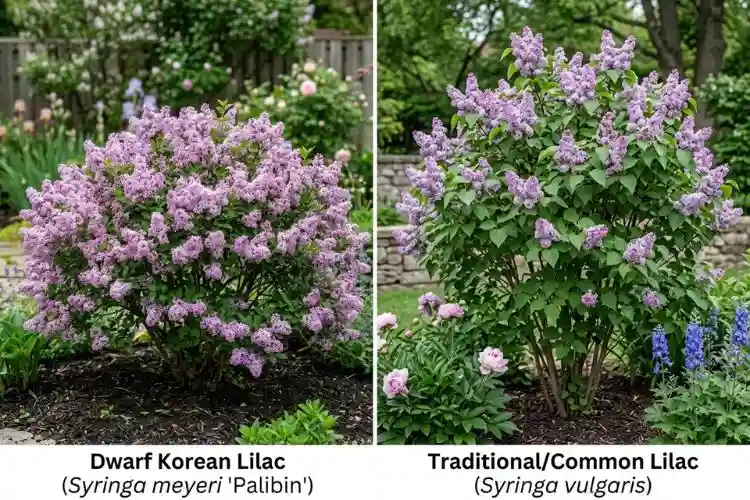
Here’s a quick breakdown of how dwarf Korean lilac stacks up against the common French lilac (Syringa vulgaris) that most people think of when they hear “lilac”:
| Feature | Dwarf Korean Lilac | Traditional French Lilac |
|---|---|---|
| Mature height | 4-5 feet | 8-15 feet |
| Mature width | 4-5 feet | 6-12 feet |
| Growth rate | Slow | Moderate to fast |
| Flower size | Smaller clusters | Large, showy clusters |
| Fragrance | Intense, sweet | Strong, classic lilac scent |
| Bloom time | Late spring | Mid to late spring |
| Suckering habit | Minimal to none | Heavy (can spread) |
| Powdery mildew resistance | Better | More susceptible |
The biggest difference that matters to most home gardeners: dwarf Korean lilac doesn’t sucker. French lilacs send up shoots from the roots all over the place, and you end up spending half your summer cutting them back. Dwarf Korean lilac stays put.
I know a guy who planted French lilacs along his fence line thinking they’d make a nice hedge. Five years later, he was pulling up shoots 10 feet away from the original plants. He ripped them all out and replanted with dwarf Korean lilacs. Problem solved.
Dwarf Korean Lilac Tree Characteristics
Let’s dig into what makes this plant special and whether it’ll work in your yard.
Size and Growth Habit
As I mentioned, you’re looking at 4 to 5 feet in both height and width. Some plants stay a bit smaller, maybe 3 feet. I’ve never seen one get much bigger than 6 feet, even after 20 years.
The shape is naturally round and dense. The branches grow evenly in all directions, creating a neat mound. You don’t need to stake it or train it unless you specifically want a tree form (more on that later). Just plant it and let it do its thing.
Growth is slow, especially the first couple of years. Don’t expect much the first season—the plant is busy growing roots. By year two or three, you’ll start seeing decent growth, but we’re still talking inches, not feet.
Flowers and Fragrance
This is why you plant dwarf Korean lilac. The flowers are pale purple to reddish-purple, grouped in small, dense clusters at the ends of the branches. Each flower is tiny, maybe half an inch across, but when you’ve got hundreds of them covering the plant, the effect is stunning.
The fragrance is strong and sweet, similar to common lilac but maybe a bit more intense because the flowers are so densely packed. One plant can perfume a whole corner of your yard.
Bloom time is late spring, usually two to three weeks after common lilacs finish. Where I live (zone 5), that’s typically the last week of May into early June. In warmer zones, it might be late April or early May. The flowers last about two weeks, sometimes a bit longer if the weather stays cool.
Some years, you’ll get a light rebloom in late summer or early fall. It’s never as heavy as the spring show, but it’s a nice bonus. I’ve noticed this happens more often after a cool, wet summer.
Foliage and Seasonal Interest
The leaves are small, dark green, and kind of leathery. They’re attractive but not showy. The plant doesn’t have interesting bark or winter structure, so once the leaves drop, it’s just a tangle of small branches.
But in fall, if you’re lucky, the leaves turn burgundy or purplish before they drop. This doesn’t happen every year—it seems to depend on weather and how much stress the plant had over the summer. When it does happen, it’s pretty.
Hardiness and Climate Requirements
Zones 3 through 7 are the sweet spot. In zone 3 and 4, where winters are brutal, this plant sails through without any protection. I’ve seen them in northern Minnesota and the Upper Peninsula of Michigan, buried under snow for months, and they come back fine every spring.
In zones 6 and 7, they still do well but might struggle a bit in hot, humid summers. They don’t love heat and humidity the way southern shrubs do. If you’re in zone 7, plant them where they’ll get afternoon shade and make sure they have good air circulation.
Zone 8 and warmer? Skip it. The plant won’t get enough winter chill, and it’ll sulk. You’re better off with a southern-friendly flowering shrub like vitex or crape myrtle.
How to Plant a Dwarf Korean Lilac Tree
Getting the planting right makes all the difference between a plant that thrives and one that just sits there looking sad.
Choosing the Right Location
Dwarf Korean lilac needs full sun. That means at least 6 hours of direct sunlight daily. More is better. In partial shade, it’ll survive, but you’ll get fewer flowers and the plant will be more prone to powdery mildew.
Good air circulation is also key. Don’t cram it into a tight corner or plant it right up against the house. Give it space so air can move around the branches. This helps prevent disease and keeps the plant healthier.
Avoid wet spots. If you have an area that stays soggy after rain, don’t plant there. Dwarf Korean lilac can’t stand wet feet. It needs well-draining soil.
Soil Preparation and Requirements
The soil doesn’t need to be perfect, but it does need to drain well. Dwarf Korean lilac grows best in loamy soil—that mix of sand, silt, and clay that’s the holy grail of gardening. But it’ll tolerate clay soil as long as it’s not constantly wet, and it’ll grow in sandy soil if you add some organic matter.
pH should be slightly acidic to neutral, around 6.5 to 7.0. A little above or below is fine. If your soil is really acidic (below 6.0), add some lime when you plant. If it’s really alkaline (above 7.5), work in some sulfur or peat moss.
Before you plant, dig a hole and fill it with water. Come back an hour later. If the water is still sitting there, you have a drainage problem. You’ll need to either amend the soil heavily with compost and sand, or choose a different spot.
Best Time to Plant
Spring and fall are both good. I prefer fall, especially in zones 5 and colder, because the plant has all winter to settle in and start growing roots before it has to deal with summer heat and blooming.
Spring planting works fine too, just get it in the ground early—as soon as the soil is workable. Avoid planting in late spring or summer. The plant will be stressed trying to establish roots while also dealing with heat.
Step-by-Step Planting Instructions
Here’s how I plant dwarf Korean lilac:
- Dig the hole. Make it twice as wide as the root ball but only as deep. You want the top of the root ball to sit level with or slightly above the surrounding soil. Planting too deep is one of the biggest mistakes people make.
- Loosen the roots. If the plant is root-bound (roots circling around the pot), gently tease them apart. If they’re really tight, make a few shallow cuts with a knife to encourage them to grow outward.
- Set the plant in the hole. Make sure it’s straight and at the right depth. Lay a shovel handle across the hole to check—the top of the root ball should be level with the handle.
- Backfill with the soil you dug out. Don’t add fertilizer or special soil mixes to the hole. Just use the native soil. As you backfill, gently tamp it down to eliminate air pockets, but don’t pack it like concrete.
- Water thoroughly. Fill the hole with water and let it soak in. This settles the soil around the roots.
- Add mulch. Spread 2 to 3 inches of mulch around the plant, keeping it a few inches away from the stems. This helps retain moisture and suppress weeds.
- Water again. Give it another good soak. For the first few weeks, water deeply once or twice a week if it doesn’t rain.
Spacing Guidelines
If you’re planting just one as a specimen plant, give it at least 4 to 5 feet of space in all directions. This lets it develop its natural shape without crowding.
If you’re planting a row or hedge, space them 3 to 4 feet apart, center to center. They’ll eventually grow together into a continuous hedge, but each plant will still have room to breathe.
Don’t plant closer than 2 to 3 feet from a walkway or building. You need to leave room for the mature width plus a little extra for maintenance.
Dwarf Korean Lilac Tree Care Guide
Once your plant is in the ground and established, care is pretty straightforward. This is not a high-maintenance shrub.
Watering Requirements
For the first year, water regularly to help the plant establish. That means a deep soak once or twice a week if you don’t get rain. “Deep soak” means watering slowly until the soil is wet 8 to 10 inches down. A quick sprinkle doesn’t cut it.
After the first year, dwarf Korean lilac is pretty drought-tolerant. It’ll appreciate water during long dry spells, but it doesn’t need constant babying. I water mine maybe once every two weeks in summer if we’re not getting rain, and that’s it.
Don’t overwater. This plant would rather be a little dry than too wet. Soggy soil leads to root rot and a whole host of problems.
Fertilizing Schedule
Dwarf Korean lilac doesn’t need much fertilizer. In fact, too much nitrogen will give you lots of leaves and few flowers.
I feed mine once a year in early spring with a balanced, slow-release fertilizer like 10-10-10. Sprinkle it around the base of the plant (not touching the stems) and water it in. That’s it.
If your soil is decent, you might not need to fertilize at all. A layer of compost around the plant each spring can provide all the nutrients it needs.
If you’re getting lots of leaf growth but no flowers, cut back on nitrogen. Switch to a bloom-booster fertilizer with more phosphorus (the middle number), like 5-10-5.
Pruning and Maintenance
Here’s the best part: you barely need to prune dwarf Korean lilac. It maintains its shape naturally.
Light pruning should happen right after blooming finishes, usually early to mid-summer. This is when you:
- Remove any dead, damaged, or crossing branches
- Shape the plant lightly if needed
- Deadhead spent flowers if you want (optional—doesn’t really affect next year’s blooms)
Don’t prune in fall, winter, or early spring. The plant sets its flower buds in summer for next year’s bloom, so if you prune after mid-summer, you’re cutting off next spring’s flowers.
Every few years, you can do a light rejuvenation by cutting out the oldest, thickest stems at ground level. This encourages new growth from the base and keeps the plant vigorous. I do this on my oldest dwarf Korean lilac every three or four years, removing maybe one or two of the oldest stems.
A guy I know got overzealous and cut his dwarf Korean lilac back hard in March, thinking he was doing spring cleanup. No flowers that year. The plant came back fine the next spring, but he learned his lesson about timing.
Mulching Best Practices
Keep 2 to 3 inches of mulch around the plant year-round. Use wood chips, shredded bark, or leaf compost. This:
- Keeps the soil cool and moist in summer
- Suppresses weeds
- Adds organic matter as it breaks down
- Protects roots in winter
Keep the mulch a few inches away from the stems. Mulch piled against the bark can cause rot and attract pests.
Refresh the mulch once a year, usually in spring. You don’t need to remove the old stuff—just add a new layer on top.
Winter Care and Protection
In zones 3 through 6, you don’t need to do anything special. Dwarf Korean lilac is tough.
In zone 7, especially if you get sudden cold snaps, a layer of mulch will help protect the roots. But the plant itself doesn’t need wrapping or covering.
If you get heavy, wet snow, you might want to gently brush it off the branches to prevent breakage. But honestly, I’ve never had a problem with this.
Common Problems and Solutions
Dwarf Korean lilac is generally trouble-free, but a few issues can pop up.
Pest Issues (Scale, Borers, Spider Mites)
Scale insects look like small bumps on the stems. They suck sap and can weaken the plant over time. If you catch them early, scrape them off with your fingernail or a soft brush. For heavier infestations, spray with horticultural oil in early spring before the leaves emerge.
Lilac borers are the larvae of a clearwing moth. They tunnel into stems, causing dieback. You’ll see holes in the bark, sometimes with sawdust around them. The best defense is keeping the plant healthy—stressed plants are more susceptible. If you see borer damage, prune out and destroy affected stems.
Spider mites show up in hot, dry weather. You’ll see fine webbing on leaves and stippled, yellowing foliage. Spray the plant with a strong stream of water to knock them off, and keep the plant well-watered during dry spells.
Disease Prevention (Powdery Mildew, Bacterial Blight)
Powdery mildew is the most common disease. It shows up as white, powdery spots on leaves, usually in late summer. It’s more of a cosmetic problem than a health issue, but it’s ugly.
Prevention:
- Plant in full sun with good air circulation
- Don’t overcrowd plants
- Avoid overhead watering
- Water in the morning so leaves dry quickly
If you get powdery mildew, you can spray with neem oil or a fungicide, but honestly, I usually just ignore it. It doesn’t kill the plant, and by the time it shows up, the blooming season is over anyway.
Bacterial blight causes brown, withered shoots and blackened, dying flowers. It’s less common but more serious. If you see it, prune out affected branches (sterilize your pruners between cuts) and destroy the cuttings. Avoid overhead watering and improve air circulation.
Environmental Stress
Yellowing leaves in summer usually mean the plant is stressed from heat and drought. Water deeply and add mulch.
Leaf scorch—brown, crispy leaf edges—happens in hot, dry, windy conditions. Not much you can do except water and wait for cooler weather.
Leaf drop in mid-summer can be normal, especially on the interior of the plant where there’s less light. If the whole plant is dropping leaves, check for pests, disease, or watering problems.
Troubleshooting Poor Blooming
If your plant isn’t blooming well, here are the usual suspects:
- Not enough sun. Needs at least 6 hours. Move it if you can, or prune back anything shading it.
- Pruned at the wrong time. Only prune right after blooming. Pruning later removes next year’s flower buds.
- Too much nitrogen fertilizer. Gives you leaves, not flowers. Cut back on feeding or switch to a low-nitrogen fertilizer.
- Plant is too young. New plants sometimes take a couple of years to settle in and start blooming heavily. Be patient.
- Late spring frost. Can kill flower buds. Not much you can do about this—just hope for better weather next year.
Yellowing Leaves and Nutrient Deficiencies
Yellow leaves with green veins usually indicate iron deficiency, which happens in alkaline soil. Add sulfur to lower the pH, or spray with chelated iron.
Overall yellowing and weak growth might mean the plant needs fertilizer. Give it a light feeding with balanced fertilizer in early spring.
Purple or reddish leaves can indicate phosphorus deficiency, though this is rare. Add bone meal or a phosphorus-rich fertilizer.
Landscape Design Ideas with Dwarf Korean Lilac
This is where dwarf Korean lilac really shines. It’s so versatile.
Foundation Planting Applications
Dwarf Korean lilac is perfect under windows or along the front of a house. It stays short enough that it won’t block windows, and the flowers and fragrance right by your door or porch are wonderful.
I’ve seen beautiful foundation plantings where dwarf Korean lilac is paired with evergreens like boxwood or dwarf spruce. The lilac provides spring color and fragrance, and the evergreens give year-round structure.
Just make sure you plant at least 2 to 3 feet away from the foundation so the plant has room to spread and air can circulate.
Companion Plants and Pairings
Dwarf Korean lilac looks great with spring-blooming perennials like peonies, catmint, salvia, and baptisia. The bloom times overlap, and the colors complement each other.
For later color, try pairing with daylilies, coneflowers, or black-eyed Susans. The lilac blooms first, then the perennials take over for summer.
Low groundcovers like creeping phlox, thyme, or ajuga work well planted around the base. They fill in the space and help suppress weeds.
Other shrubs that pair well: weigela, spirea, potentilla, hydrangea. Just make sure everything has similar sun and water needs.
Container Growing Possibilities
You can grow dwarf Korean lilac in a large container—at least 18 to 24 inches wide and deep. Use a good-quality potting mix and make sure the pot has drainage holes.
Container plants dry out faster, so you’ll need to water more often, especially in summer. Feed lightly a couple of times during the growing season.
In zones 5 and colder, you’ll need to protect the container in winter. Either move it to an unheated garage or shed, or insulate it with bubble wrap and mulch. Roots in containers are more exposed to cold than roots in the ground.
Hedge and Border Uses
Plant dwarf Korean lilacs 3 to 4 feet apart to create a low, flowering hedge. They’ll grow together into a continuous mass while still keeping good air circulation between plants.
This makes a beautiful border along a driveway, property line, or garden bed. The flowers and fragrance in spring are amazing, and the compact size means minimal maintenance.
Small Space Garden Solutions
If you have a tiny yard, a balcony, or a small urban garden, dwarf Korean lilac is one of the best flowering shrubs you can grow. It gives you the beauty and fragrance of a full-sized lilac in a fraction of the space.
One plant in a corner, flanked by a few perennials, can be the backbone of a small garden. Or plant one in a container on a patio or deck.
Varieties and Cultivars of Dwarf Korean Lilac
‘Palibin’ (Miss Kim) – The Classic
This is the standard, the one you’ll find at most nurseries. It grows 4 to 5 feet tall and wide, with purple-pink flowers in late spring. The fragrance is intense and sweet.
‘Miss Kim’ is actually a slightly different cultivar, but it’s so similar to ‘Palibin’ that they’re often sold interchangeably. ‘Miss Kim’ might have slightly darker buds and blooms a bit later.
Both are rock-solid performers in zones 3 through 7.
Other Compact Lilac Varieties
If you can’t find Syringa meyeri ‘Palibin’, here are some other compact lilacs worth considering:
- ‘Bloomerang’ series (purple, pink, white): Reblooms heavily in summer and fall. Slightly larger than ‘Palibin’, about 4 to 6 feet tall. Zones 3-7.
- ‘Tinkerbelle’: Wine-red buds open to pink flowers. Compact growth, 5 to 6 feet. Zones 3-7.
- Syringa pubescens subsp. patula ‘Miss Kim’: Very similar to ‘Palibin’, with icy pink flowers and good fall color. 6 to 8 feet, so slightly larger.
Choosing the Right Variety for Your Zone
In zones 3 and 4, stick with ‘Palibin’ or ‘Miss Kim’. They’re the toughest.
In zones 5 and 6, you can try any of the varieties listed above.
In zone 7, go with ‘Palibin’ or ‘Bloomerang’, which handles heat a bit better than some others.
Buying and Planting Tips
Where to Buy Dwarf Korean Lilac Trees
You can find dwarf Korean lilac at most garden centers and nurseries in spring. Big-box stores sometimes carry them too, though selection and quality can be hit-or-miss.
For the best selection and healthiest plants, buy from a local nursery. The staff can give you advice specific to your area, and the plants are usually grown or acclimated locally.
Online nurseries like Spring Hill, Breck’s, and Nature Hills also sell them. Plants usually arrive bare-root or in small pots. Quality is generally good, though you’re taking a bit of a gamble ordering plants sight unseen.
What to Look for When Purchasing
Inspect the plant before you buy:
- Leaves should be green and healthy, no yellowing or brown spots
- Stems should be firm, not soft or shriveled
- Roots (if you can see them) should be white or tan, not black or mushy
- The plant should have multiple stems coming from the base
- Avoid plants that look wilted, even if the soil is moist
If you’re buying online, check reviews and make sure the company has a good guarantee. Most reputable nurseries will replace plants that arrive damaged or don’t survive the first year.
Container vs. Bare Root vs. Balled-and-Burlapped
Container plants are the easiest to plant and establish. They’re available spring through fall and can be planted anytime the ground isn’t frozen. You pay a bit more, but the convenience is worth it.
Bare-root plants are cheaper and lighter to ship. They’re usually only available in early spring. They need to be planted as soon as possible after you receive them. Soak the roots in water for a few hours before planting.
Balled-and-burlapped (B&B) plants are dug from the field with a ball of soil around the roots, which is wrapped in burlap. They’re usually larger and more expensive. Plant them as soon as possible. When you plant, remove any twine, wire, or synthetic burlap from the top of the root ball. Natural burlap can be left in place—it’ll rot.
Pricing Guide
Prices vary by size and where you buy:
- Small container plant (1-gallon pot): $15 to $25
- Medium container plant (2 to 3-gallon pot): $25 to $40
- Larger container or B&B plant (3 to 5 feet tall): $40 to $80
Bare-root plants from online nurseries: $10 to $30
Sales happen in late spring and early fall when nurseries are clearing out seasonal stock. You can sometimes get great deals, but selection is limited.
Transplanting Established Plants
Dwarf Korean lilac can be moved, but it’s stressful for the plant. Do it in early spring or fall when the plant is dormant or semi-dormant.
Dig a wide circle around the plant, at least 12 to 18 inches from the base. Try to get as much of the root ball as possible. Lift the plant carefully and move it to the new hole (which you should have already dug). Plant at the same depth it was growing before.
Water thoroughly and keep it well-watered for the first few weeks. The plant might sulk for a season, but it should recover.
Propagation Methods
If you want more plants for free (or just enjoy the challenge), you can propagate dwarf Korean lilac.
Propagating from Cuttings
This is the most common method. Take softwood cuttings in late spring or early summer, right after the plant finishes blooming.
- Cut 4 to 6-inch pieces from the tips of healthy stems. Make the cut just below a leaf node.
- Remove the lower leaves, leaving just two or three sets at the top.
- Dip the cut end in rooting hormone (optional but helpful).
- Stick the cuttings in a pot filled with moistened perlite, vermiculite, or a mix of peat and sand.
- Cover the pot with a plastic bag to keep humidity high.
- Place in bright, indirect light. Keep the medium moist but not soggy.
- Cuttings should root in 4 to 8 weeks. You’ll know they’ve rooted when you see new growth or when you gently tug and feel resistance.
- Once rooted, transplant into individual pots with potting soil and grow for a season before planting outside.
Success rate is maybe 50 to 70 percent, depending on conditions and timing.
Layering Techniques
Layering is easier and more reliable than cuttings, but it takes longer.
- In early spring, choose a low, flexible branch.
- Bend it down to the ground and bury a section of it (still attached to the plant) under 2 to 3 inches of soil. You can wound the buried section lightly by scraping the bark to encourage rooting.
- Weight it down with a rock or pin it with a landscape staple.
- Keep the soil moist.
- By the following spring, the buried section should have roots. Cut it free from the mother plant and transplant it.
Division (If Applicable)
Dwarf Korean lilac doesn’t divide easily like perennials, but if you have a multi-stemmed plant with stems that have rooted separately, you can dig up the plant and separate the rooted sections. This is risky and stressful for the plant. I’ve only done it once, and I wouldn’t recommend it unless you’re desperate.
Success Rates and Timeline
Cuttings: 50 to 70 percent success, 4 to 8 weeks to root, one full season to grow before transplanting.
Layering: 80 to 90 percent success, one full year to root.
Division: Variable, risky, only attempt if the plant has clearly separate rooted stems.
Here’s the bottom line: if you want a beautiful, fragrant, low-maintenance flowering shrub that won’t take over your yard, dwarf Korean lilac is hard to beat. It’s tough, reliable, and fits into spaces where bigger shrubs would be a nightmare.
Plant it in full sun with good drainage, give it a little water and food, and mostly just leave it alone. That’s all it needs. In return, you’ll get weeks of gorgeous blooms and fragrance every spring, and a neat, compact plant that looks good year-round.
I’ve recommended dwarf Korean lilac to dozens of people over the years, and I’ve never had anyone come back disappointed. It just works.