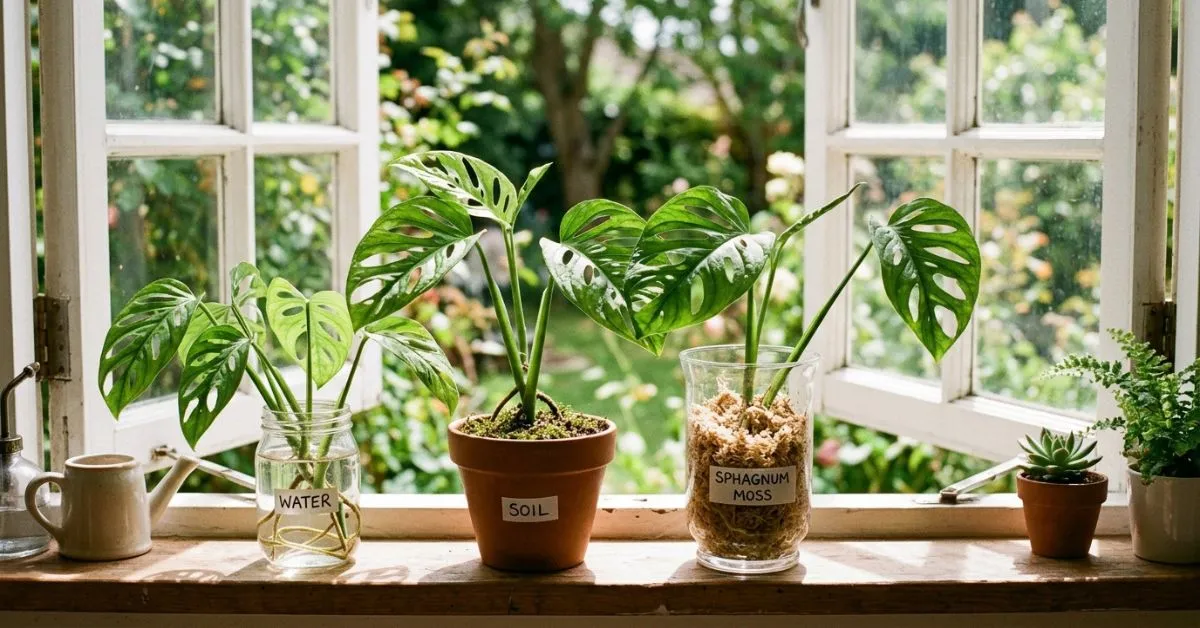
My friend Sarah called me last spring in a panic. Her Swiss Cheese Plant — a gorgeous Monstera she’d been growing for three years — had gotten so leggy it was practically crawling across her living room floor. She wanted to cut it back but couldn’t stomach the idea of tossing those healthy vines in the trash.
“Can I just… make more plants from it?” she asked.
Yes. Yes, you absolutely can. And it’s way easier than most people think.
I walked her through the steps over the phone. Six weeks later, she had four new baby Monsteras rooting on her kitchen windowsill. She’s given two away as gifts and kept the rest. Her mother plant? It grew back bushier than ever.
If you want to learn how to propagate Swiss Cheese Plant, you’re in the right place. I’m going to break down five methods — from super beginner-friendly to advanced — so you can pick the one that fits your comfort level.
But first, you need to know where to cut. Because cutting in the wrong spot is the number one reason propagation fails.
Understanding Swiss Cheese Plant Anatomy — Nodes, Aerial Roots, and Where to Cut
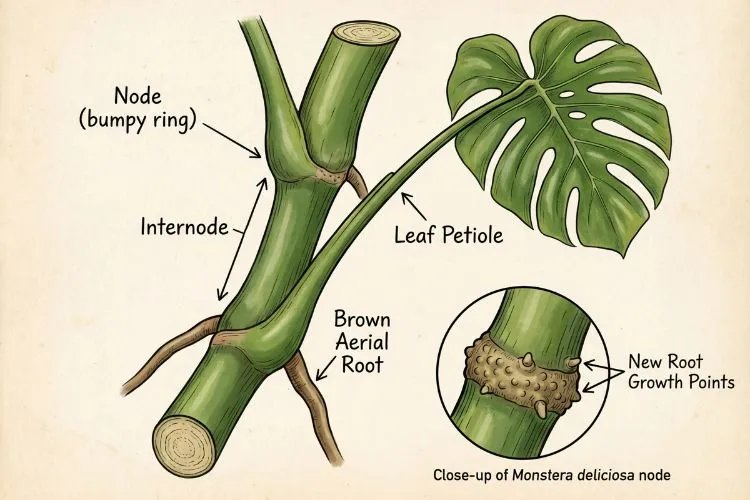
What Is a Node (and Why It Matters More Than Anything)
Here’s the single most important thing in this whole article: your cutting must include a node.
A node is that small bumpy ring on the stem where a leaf, branch, or aerial root grows out. It’s usually a slightly thicker spot — sometimes brown, sometimes green. Each leaf on your Monstera has one.
Nodes contain special cells that can turn into roots, stems, or leaves. Without a node, a cutting physically cannot grow roots or new leaves. It just can’t. A leaf sitting in a jar of water might look pretty for a few weeks, but it will never become a new plant.
As Dr. Bodie Pennisi, a horticulture professor at the University of Georgia, puts it: “The node is the command center for new growth. If your cutting doesn’t include at least one healthy node, propagation is biologically impossible.”
Aerial Roots — Helpful but Not Required
Those long, brown, stringy things growing off your Monstera’s stem? Those are aerial roots. In the wild, Monsteras use them to climb trees and soak up moisture from humid air.
During propagation, aerial roots give you a head start. Cuttings that already have them tend to root two to three weeks faster. But you do NOT need them. They’re a nice bonus — not a deal-breaker.
Where Exactly to Cut
Here’s your simple cutting checklist:
- Clean your scissors or pruning shears with rubbing alcohol
- Find a healthy node on the stem (look for the bump or ring)
- Cut about 1 to 2 inches below the node at a 45-degree angle
- Make sure at least one leaf is attached
- Include an aerial root if one is there — but don’t stress if there isn’t one
- Never cut between nodes with no node on the cutting — it won’t root
If your plant has several nodes close together, you can take a longer cutting with two or three nodes. That’ll give you a bushier new plant. Or you can separate them into single-node cuttings to get more plants.
What Happens to the Mother Plant
Don’t worry — your mother plant won’t die from a proper cut. New growth will pop up from the node right above where you cut. A lot of plant owners actually propagate on purpose just to make their Monstera grow back fuller.
Let the cut wound air dry for about 30 to 60 minutes. It’ll seal itself over. No wound paste needed.
Research from the Royal Horticultural Society shows that pruning aroids like Monstera triggers new growth points at the remaining nodes. So you’re not just getting a new plant — you’re making the old one better, too.
When Is the Best Time to Propagate Swiss Cheese Plant?
Spring and Early Summer Win Every Time
March through June is your sweet spot. This is when your Monstera is actively growing. Cell division is humming along. Growth hormones are flowing. Daylight hours are long.
Cuttings taken during this window can root 40 to 60 percent faster than ones taken in colder months. You’re working with the plant’s natural rhythm instead of fighting against it.
Can You Propagate in Fall or Winter?
You can, but it’s slower. Winter propagation might take 6 to 10 weeks to show roots, compared to 2 to 4 weeks in spring. If you’re going to try it, help your cutting out with a grow light (12 to 14 hours a day), a heat mat under the container, and a clear plastic bag over the cutting to hold in humidity.
Signs Your Plant Is Ready
Before you grab those shears, check a few things:
- The plant is healthy and has pushed out a new leaf in the last month or so
- It has at least 5 or 6 mature leaves (don’t propagate a small plant)
- There are visible nodes or aerial roots
- No yellowing, browning, or pest problems
- You haven’t just repotted or bought it — give new plants at least 3 to 4 weeks to settle in
| Season | Rooting Time | Success Rate | Worth It? |
|---|---|---|---|
| Spring (Mar–May) | 2–3 weeks | 90–95% | Best time |
| Summer (Jun–Aug) | 2–4 weeks | 85–90% | Great |
| Fall (Sep–Nov) | 4–6 weeks | 70–80% | Slower but doable |
| Winter (Dec–Feb) | 6–10 weeks | 50–65% | Use grow light and heat mat |
Method 1 — How to Propagate Swiss Cheese Plant in Water
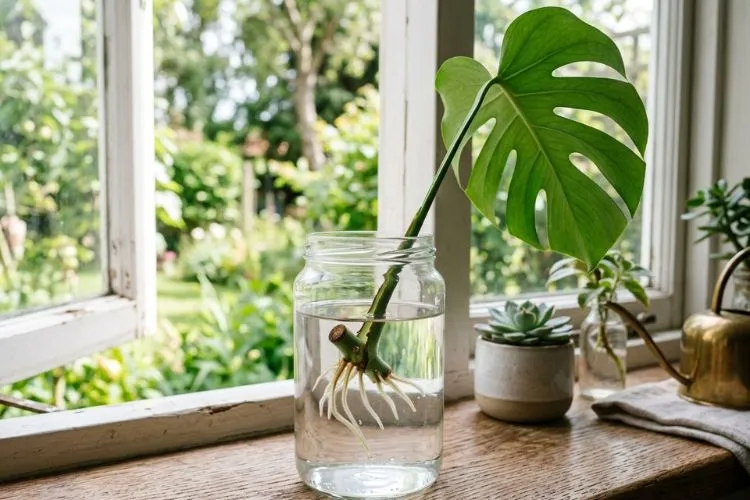
This is the most popular method, and the one I recommend to anyone doing this for the first time. You get to watch the roots grow in real time. It’s honestly pretty satisfying.
What you need: Sharp sterilized scissors, a clear glass jar, room-temperature filtered water, a healthy cutting with a node and leaf, and optionally some rooting hormone.
Step-by-Step Instructions
- Take your cutting. Cut 1 to 2 inches below a healthy node at a 45-degree angle.
- Remove lower leaves. Any leaf that would sit underwater needs to go. Submerged leaves rot fast and introduce bacteria.
- Apply rooting hormone (optional). Dip the cut end and node area in rooting hormone. This can speed things up by 20 to 30 percent.
- Place in water. Fill your jar, submerge the node and any aerial roots, but keep the leaves above the waterline.
- Find the right light. Bright, indirect sunlight. No direct sun — it heats the water and grows algae.
- Change water every 3 to 5 days. Fresh water means fresh oxygen. If it gets cloudy or smelly, change it right away. A small piece of activated charcoal in the jar helps keep things clean.
- Wait. Root nubs usually show up within 1 to 3 weeks. Let them grow to at least 2 to 3 inches before moving to soil — usually 4 to 6 weeks total.
- Transplant to soil. Once roots are long enough, plant in a well-draining aroid mix. Water well and keep humidity up for the first two weeks.
Use a clear jar so you can see what’s happening. If something goes wrong — rot, stagnation — you’ll catch it early.
| Pros | Cons |
|---|---|
| Beginner-friendly | Roots must adjust when moving to soil |
| You can see root growth | Need regular water changes |
| High success rate | Risk of algae in warm spots |
| Minimal supplies needed | Water roots are more fragile |
Method 2 — How to Propagate Swiss Cheese Plant in Soil
If you want roots that are strong and soil-ready from the start, skip the water and go straight to dirt.
Recommended aroid soil mix: 40% potting soil, 30% perlite, 20% orchid bark, 10% horticultural charcoal. This mimics the loose, airy forest floor where Monsteras grow naturally. Regular potting soil alone holds too much water and invites rot.
Step-by-Step Instructions
- Take your cutting and let the cut end dry for 30 to 60 minutes to form a light callous.
- Dip in rooting hormone. This matters more here since you can’t watch root growth.
- Fill a 4- to 6-inch pot (with drainage holes) with pre-moistened aroid mix.
- Plant the cutting with the node buried 1 to 2 inches below the surface.
- Create a humidity chamber — loosely cover with a clear plastic bag or dome. Open it daily for 10 to 15 minutes for air flow.
- Mist the soil every 2 to 3 days. Keep it damp like a wrung-out sponge — not soaked.
- Bright, indirect light. Same rules as water propagation.
- Check for roots after 3 to 4 weeks by giving the cutting a very gentle tug. If it resists, roots are growing.
A study in HortScience found that aroid cuttings rooted in soil developed 35% thicker root systems than water-rooted ones. The soil gives roots something to push against, which makes them grow stronger.
Method 3 — Sphagnum Moss Propagation
This is what serious plant people use for rare or expensive cuttings. Sphagnum moss has natural antifungal properties, holds moisture without drowning roots, and produces strong root growth. If you use a clear container, you get the visual monitoring benefit of water propagation combined with the root quality of soil.
How to do it: Soak dried sphagnum moss for 15 to 20 minutes, squeeze out excess water, wrap it around the node of your cutting, place it in a clear container, and seal loosely. Check moisture every few days. Expect visible roots in 2 to 4 weeks. Transplant to soil when roots hit 2 to 3 inches.
Method 4 — Air Layering (The Zero-Risk Method)
Here’s the one I recommend when someone tells me, “I’m terrified of killing my plant.”
Air layering lets you grow roots on the vine while it’s still attached to the mother plant. You wrap moist sphagnum moss around a node, cover it with plastic wrap, and wait. The cutting keeps getting water and food from the mother plant the whole time. You only make the cut after roots are already growing.
Success rate is close to 95 to 100 percent. Transplant shock is almost nonexistent.
A buddy of mine in our local plant swap group used this method on a variegated Monstera he’d paid over $200 for. “No way I was cutting that thing without roots already there,” he told me. Smart move. It worked perfectly.
Method 5 — Division (For Big, Bushy Plants)
If your Monstera has multiple stems coming out of the same pot — which is common in mature plants or nursery pots that had several cuttings planted together — you can separate them at the root ball.
Water the plant 24 hours before. Slide the whole thing out of the pot. Gently tease the root systems apart with your fingers. Only cut tangled roots you absolutely can’t separate by hand. Pot each division in fresh aroid mix and keep humidity higher for two weeks.
This gives you an instant full-sized plant. No waiting for a tiny cutting to grow up.
Which Method Should You Pick?
| Factor | Water | Soil | Moss | Air Layering | Division |
|---|---|---|---|---|---|
| Difficulty | Beginner | Intermediate | Intermediate | Advanced | Intermediate |
| Rooting Time | 3–6 weeks | 3–6 weeks | 2–5 weeks | 3–6 weeks | Instant |
| Success Rate | 85–90% | 80–85% | 88–93% | 95–100% | 90–95% |
| Best For | First-timers | Stronger roots | Rare cuttings | Risk-averse growers | Mature plants |
There’s no single “best” answer. Pick based on your comfort level and your plant’s situation. All five methods work when done right.
Week-by-Week Rooting Timeline
- Week 1: Nothing visible yet. The cutting is forming a callous and signaling internally. This is normal.
- Weeks 2–3: Tiny white bumps or nubs start showing at the node. In water, you’ll see pale root tips poking out. Don’t disturb the cutting.
- Weeks 3–5: Roots are growing and branching. Healthy roots look white or light tan — not brown, black, or slimy.
- Weeks 5–8: Roots reach 2 to 3 inches. You might see a new leaf unfurling. Time to transplant if you used water or moss.
The hardest part is this waiting phase. If your cutting isn’t mushy, smelly, or turning black, it’s probably doing fine. Trust it.
Troubleshooting Common Problems
No roots growing? Check that your cutting actually has a node. Warm up the water if it’s cold. Add more light. Try rooting hormone.
Leaves turning yellow? Cut back on watering (soil method) or move away from direct sun. Sometimes a cutting drops an older leaf to send energy toward root growth — that’s normal if only one leaf yellows.
Mushy, brown, or smelly roots? That’s rot. Cut away everything that’s brown or slimy with clean scissors. Let it dry for an hour. Restart in fresh water or fresh moss. A pinch of cinnamon on the cut ends works as a natural antifungal.
Wilting or drooping? Humidity is probably too low. Mist daily or cover with a clear bag. Mild drooping in the first 48 hours after cutting is common and usually fixes itself.
Mold on moss or soil? Open your humidity dome more often for air flow. Reduce moisture levels. Sprinkle cinnamon on the moldy spots.
Frequently Asked Questions
Can you propagate a Swiss Cheese Plant from a single leaf?
No. A leaf alone cannot grow roots or new growth. You need a section of stem with at least one node.
How long does it take for a cutting to root?
In spring or summer with good light: 2 to 3 weeks for first root nubs, 4 to 6 weeks to reach transplant length. Winter can take 6 to 10 weeks.
Can I keep my Monstera in water forever?
Technically yes, but growth will be much slower and the plant won’t reach its full potential. It’ll need hydroponic nutrients to avoid deficiencies over time.
Do I need rooting hormone?
No. Monsteras root well on their own. But rooting hormone speeds things up by about 20 to 30 percent and helps root density, especially with soil and moss methods.
When will the new plant get holes in its leaves?
Not right away. The first few leaves from a propagated cutting are usually smaller and without fenestrations. Those signature holes and splits show up as the plant matures — usually 6 to 12 months later, depending on how much light it gets.
How many cuttings can I take from one plant?
Count the nodes. Each cutting needs at least one node and one leaf. A mature Monstera with a 3-foot vine might give you 3 to 5 cuttings. Always leave at least 3 to 4 leaves on the mother plant so it can recover.
Final Thought
Propagating a Swiss Cheese Plant is one of those gardening skills that feels intimidating until you actually do it. Then you realize the plant wants to grow. It wants to root. You’re just giving it the right conditions to do what it already knows how to do.
Pick a method, make your cut, and give it time. Six weeks from now, you might be the one handing out baby Monsteras to your friends.