
I’ll never forget the first time I saw a durian in person. A grower named Heng in Homestead, Florida, had been nursing his durian tree for over a decade. He invited me over when his tree finally dropped its first fruit. The thing was the size of a football, covered in spikes that looked like medieval weaponry, and it hit the ground with a thud you could feel through your shoes.
Then he cracked it open. The smell hit me like a wall. My eyes watered. My brain told me to run. But Heng just grinned, scooped out a golden pod of flesh, and held it out to me. “Try it,” he said. “Trust me.”
That bite changed everything I thought I knew about fruit.
Whether you’re growing durian, thinking about planting a tree, or just curious about why millions of people across Southeast Asia worship this spiky giant — this guide covers everything you need to know about durian fruit.
What Is Durian Fruit? — Origin, Botany, and the “King of Fruits” Title
Durian at a Glance
Here’s a quick look at what we’re dealing with:
| Attribute | Details |
|---|---|
| Scientific name | Durio zibethinus (most common species) |
| Family | Malvaceae (same family as hibiscus, cacao, and okra) |
| Native region | Borneo and Sumatra (Indonesia/Malaysia) |
| Fruit size | 15–30 cm long; 1–5 kg (some reach 7+ kg) |
| Edible parts | Flesh (arils) and seeds (when cooked) |
| Taste | Rich, creamy, sweet — like custard with almond and vanilla |
| Smell | Extremely strong; sulfurous; people either love it or hate it |
| Main season | June through August (varies by region) |
| Tree height | 25–50 meters (80–160 feet) at maturity |
| Time to fruit | 4–8 years from grafted sapling; 7–15 years from seed |
| Productive lifespan | Can fruit for 80–150+ years |
That last number isn’t a typo. Old-growth durian trees can produce fruit for over a century. In Malaysia, century-old trees are treated almost like landmarks. Families pass them down through generations.
The Botanical Story
The name “durian” comes from the Malay word “duri,” which means thorn. One look at the fruit and you’ll understand why.
There are at least 30 species in the Durio genus, but only 9 produce fruit you can eat. The one you’ll find at stores and markets is almost always Durio zibethinus. Other edible species like D. graveolens and D. kutejensis are eaten locally in Borneo but rarely show up anywhere else.
Durian trees are huge. We’re talking 80 to 160 feet tall at maturity with big buttress roots. If you’re growing one in South Florida or Hawaii, give it serious space.
Here’s a fun fact for growers: durian flowers open at night. They’re pollinated mainly by bats, with some help from moths and beetles. The flowers give off a strong scent after dark to attract their pollinators. If you’re growing a durian tree and wondering why it flowers but doesn’t set fruit, pollination access might be your issue.
Why Is It Called the “King of Fruits”?
This title has been used across Southeast Asia for at least 400 years. It’s not a marketing gimmick. Here’s why it stuck:
Taste. People who love durian consider its flavor unmatched by any other fruit on the planet. Nothing else tastes like it.
Size and presence. A ripe durian is big, heavy, and covered in a crown of thorns. It demands attention.
Cultural weight. Durian season is an event in Malaysia, Thailand, and Indonesia. Families gather. Prices spike. People line up. It’s treated with the same excitement that apple harvest gets in New England — but turned up to ten.
Price. Premium varieties like Musang King sell for serious money. In parts of Asia, gifting someone a high-quality durian is a status symbol.
The traditional pairing? Mangosteen — the “Queen of Fruits.” The two are often eaten together. The mangosteen’s cool, tart flavor balances the rich heaviness of durian.
What Does Durian Fruit Look Like? — Anatomy and Physical Features
The Outside
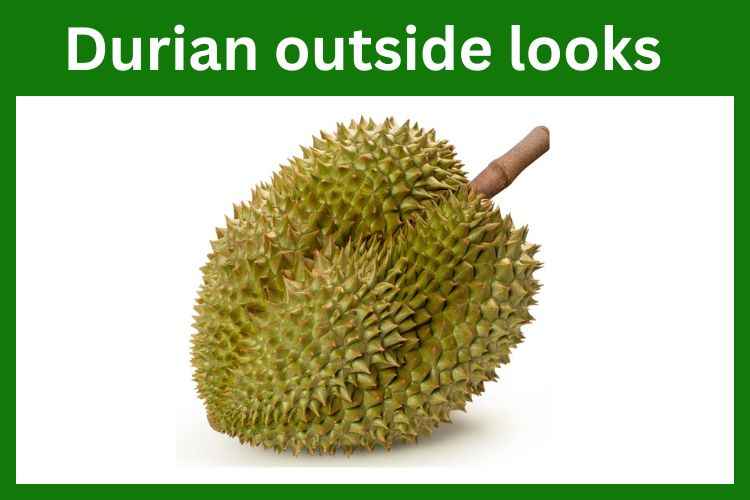
A durian looks like something that belongs in a fantasy novel, not on a fruit stand. It’s oval or egg-shaped, about the size of a football, and covered in hard, pyramidal thorns about an inch long. The husk starts green and shifts to yellow-green or brown as it ripens.
If you look closely, you can spot 5 faint seam lines running from top to bottom. These mark where the internal segments divide — and they’re your guide for opening the fruit later.
Average weight is 2 to 3 kg (around 5 to 7 pounds), but some varieties can push past 7 kg. Heng’s first fruit was about 4 kg, and catching it when it dropped from the tree was not something you’d want to do barehanded.
The Inside
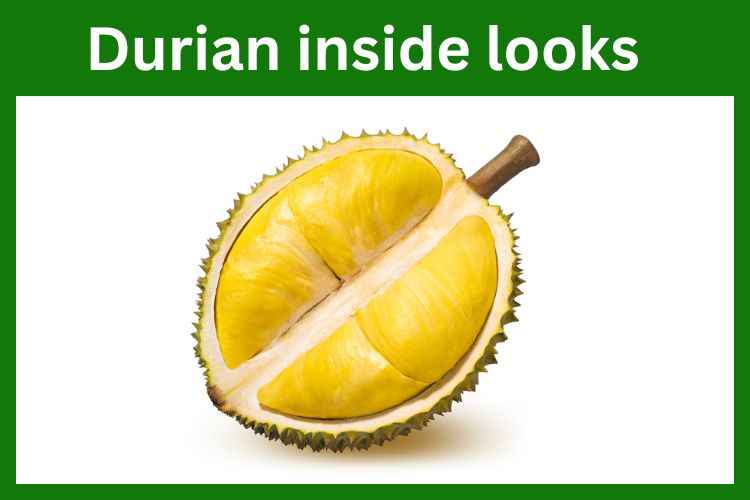
Crack open a durian along those seam lines and you’ll find 5 chambers (called locules). Inside each chamber sit pods of creamy, custard-like flesh — these are called arils. Each aril wraps around a large seed about the size of a chestnut.
The arils are what you eat. They range from pale yellow to deep gold depending on the variety. The texture is soft, sticky, and almost mousse-like when fully ripe.
The seeds are edible too, but only when cooked. Boiled or roasted durian seeds taste a lot like chestnuts or potatoes. More on that later.
Flesh Color by Variety
Different durian varieties look different inside:
| Variety | Flesh Color | Texture |
|---|---|---|
| Musang King (D197) | Deep golden yellow | Thick, creamy, sticky |
| D24 | Pale to golden yellow | Smooth, creamy |
| Monthong | Pale yellow | Thick, firm |
| Red Prawn (D175) | Reddish-orange | Creamy, slightly fibrous |
| Black Thorn (D200) | Deep orange-gold | Very creamy, dense |
If you ever get the chance to try Red Prawn, the color alone is worth it. That reddish tint is unlike any other fruit I’ve seen.
What Does Durian Fruit Smell Like?
Let’s talk about the elephant in the room. Or more accurately, the smell that follows you out of the room.
The Smell That Divides People
Durian’s smell is the single most talked-about thing about the fruit. Hotels across Southeast Asia ban it. Airlines won’t allow it in the cabin. Some taxi drivers charge extra if you bring one in their car.
Here’s the range of what people say it smells like:
People who hate it say: Rotting onions. Gym socks. Turpentine. Rotten eggs. Natural gas leak. Decomposing flesh.
People who love it say: Sweet custard. Butterscotch. Caramel. Honey. Almond cream.
Honest first-timers say: “Sweet garbage.” “Onion ice cream.” “Heaven and hell at the same time.”
You might like: What Does Durian Fruit Smell Like? The Honest Truth About the World’s Smelliest Fruit
What Does Durian Fruit Taste Like? — Beyond the Smell
The Great Paradox
This is the part that surprises everyone. The taste is almost nothing like the smell.
While the smell is dominated by sulfur compounds, the taste is driven by sweet esters, natural fats, and sugars. Here’s what people commonly say it tastes like:
- Rich vanilla custard
- Crème brûlée with almond
- Butterscotch pudding
- Sweet cheesecake with tropical undertones
- Whipped cream and caramel with a hint of savory
Why the disconnect? When you sniff durian from the outside, sulfur compounds hit your nose full-force. But when you chew it, the aroma travels from the back of your mouth up to your nose through a different pathway (retronasal olfaction). Through that route, the sweet compounds dominate. Your brain combines taste, texture, and retronasal smell into one experience — and that experience is overwhelmingly positive for most people.
It’s the same reason parmesan cheese can smell like vomit but taste incredible.
Taste by Variety
If you’re trying durian for the first time, variety matters a lot:
Monthong (Thai) — Sweet, mild, gentle. Very beginner-friendly. Least intense smell.
D24 (Malaysian) — Sweet and smooth with a nice custard quality. Another great starter.
Musang King (Malaysian) — Intense, bittersweet, rich. The one serious fans rave about. Stronger smell. Save this for after you’ve built up some experience.
XO (Malaysian) — Fermented, almost alcoholic taste. This is expert territory.
Black Thorn (Malaysian) — Bittersweet with caramel and roasted notes. Complex and highly sought after.
The Texture
Ripe durian flesh has a texture unlike any other fruit. It’s creamy like mousse. It almost dissolves on your tongue. Some people compare it to thick custard or soft ice cream. Slightly underripe durian is firmer and more fibrous. Overripe durian gets very soft and starts tasting fermented.
Many fans prefer durian slightly chilled. Cold temperatures suppress the sulfur volatiles and bring out the sweet, creamy side. Frozen durian tastes like the richest ice cream you’ve ever had.
How to Select, Open, and Eat Durian Fruit
How to Pick a Good One
If you’re at an Asian market staring at a pile of spiky green-brown fruits, here’s what to look for:
Shake it. Hold it near your ear and give it a gentle shake. If you feel/hear the seeds shift slightly inside, it’s ripe. If it feels solid with no movement, it needs more time.
Smell the bottom. A sweet, fragrant smell at the stem end means it’s ripe. No smell means underripe. An overwhelming, boozy, fermented smell means overripe.
Check the stem. A fresh, moist, green stem means it was recently harvested. A dry, brittle stem means it’s been sitting a while.
Tap it. Knock on the husk with your knuckle. A hollow sound means the flesh has developed. A dense thud means it’s not ready.
Look at the seams. If you can see the 5 seam lines starting to separate slightly, it’s ready to open.
How to Open a Durian
You’ll need thick gloves (or a folded towel), a sturdy knife, and a cutting board.
- Set the durian stem-side up on a stable surface.
- Find one of the 5 natural seam lines running top to bottom.
- Insert your knife tip into a seam near the bottom — only an inch or two deep.
- Pry the seam open by twisting the knife sideways. The husk should crack along the line.
- Pull the husk apart with gloved hands. It opens like a book.
- Scoop out the flesh pods with your fingers or a spoon.
- Remove the seed from each pod.
- Repeat for all 5 segments.
Do NOT try to hack through it with brute force. Work with the natural seam lines. Those thorns will puncture skin fast.
How to Eat It
Eat it fresh, within hours of opening. The flavor drops off fast once the flesh hits air.
Use your hands — that’s the traditional way. Start with small pieces and let your palate adjust. If the smell is overwhelming, try breathing through your mouth for the first bite so the taste hits before the aroma.
The classic pairing is durian with mangosteen. The mangosteen’s cool tartness cuts through the richness perfectly.
One rule: don’t combine durian with alcohol. There’s a traditional belief — and some emerging science — suggesting the combination can cause serious discomfort.
How to Store It
| Form | Method | How Long |
|---|---|---|
| Whole, unopened | Room temperature | 2–3 days |
| Whole, unopened | Refrigerator | 4–5 days |
| Opened flesh | Airtight container in fridge (wrap in plastic first) | 1–2 days |
| Frozen flesh | Zip-lock bag in freezer | 2–6 months |
Frozen durian is one of the best ways to enjoy it, especially if you’re new to it. Freezing cuts the sulfur smell way down while keeping the creamy texture. It’s like nature’s ice cream. Most Asian supermarkets sell pre-packaged frozen durian flesh — that’s the easiest and least messy way to try it for the first time.
Final Thought
Back to Heng and his backyard durian tree in Homestead. That tree now produces a couple dozen fruits each summer. He eats some fresh, freezes some, and gives the rest to neighbors — though he says not all the neighbors appreciate the gift equally.
His advice to anyone thinking about growing a durian tree: “Be patient. Give it space. And warn your neighbors before harvest season.”
Solid advice for any grower taking on the King of Fruits.