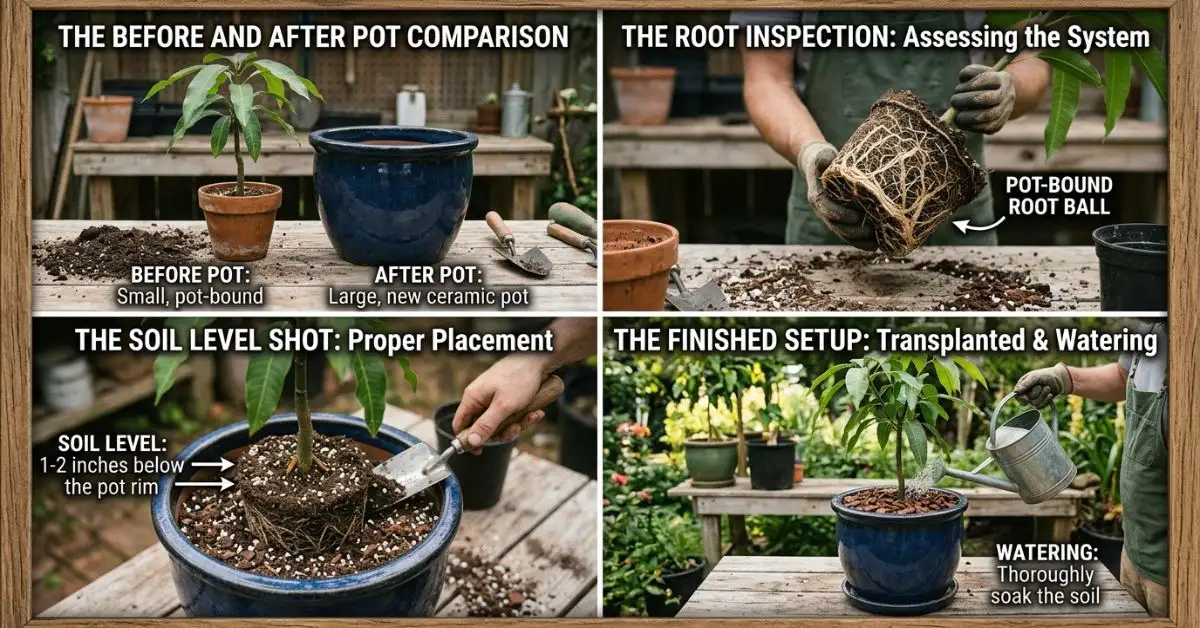
Last summer, my neighbor Carlos knocked on my door holding a potted mango tree that looked rough. Yellow leaves. Barely any new growth. He’d been feeding it, watering it, giving it full sun — doing everything “right.” But when we tipped it out of the pot, the answer was obvious. The roots had formed a tight, tangled ball with nowhere left to go. That tree was suffocating in its own container. One repot later, and by fall it had pushed out a full flush of dark green leaves. That’s the power of giving a mango tree room to breathe.
If your potted mango tree looks tired, sluggish, or just off, there’s a good chance it needs a new home. Let me walk you through everything — from when to do it, to what soil to use, to the exact steps so you don’t mess it up.
Why Repotting Mango Tree Is Essential
What Happens When a Mango Tree Becomes Root Bound
When a mango tree outgrows its pot, the roots start circling the inside walls. Over time, they wrap around themselves tighter and tighter. It’s like wearing shoes two sizes too small — nothing works right anymore.
Here’s what you’ll see when this happens:
- Roots strangle each other inside the pot
- The tree can’t pull nutrients from the soil like it used to
- Water runs straight through the pot or pools on top without soaking in
- Growth slows down or stops completely
- Leaves turn yellow, curl up, or fall off early
The Direct Impact on Fruit Production
A root-bound mango tree puts all its energy into just staying alive. Fruiting takes a back seat. Research from the University of Florida IFAS Extension shows that container mango trees with enough root space can produce up to 40% more fruit than cramped ones. That’s a huge difference from something as simple as a bigger pot and fresh soil.
On top of that, old compacted soil loses the microbial activity your tree depends on to break down nutrients. The soil basically goes dead.
Root Health = Tree Health — The Science Behind It
There’s a direct link between what’s happening underground and what you see above. Healthy mango trees maintain a balanced root-to-canopy ratio. When roots get cramped, the top of the tree suffers too.
Fresh soil brings back depleted micronutrients. It also reintroduces beneficial mycorrhizal fungi — tiny organisms that attach to mango roots and help them absorb water and nutrients way more efficiently. Think of them as a support crew working underground.
According to the Journal of Tropical Agriculture, root-bound trees show a 30–50% drop in new growth. And the USDA Soil Science Division found that compacted soil can cut oxygen to roots by up to 60%.
“A mango tree confined to an undersized pot is like an athlete training in a closet — it simply can’t reach its potential.” — Dr. Jonathan Crane, Tropical Fruit Crop Specialist, University of Florida
When to Repot a Mango Tree — Timing Is Everything
Signs Your Mango Tree Needs Repotting
Here’s a quick checklist. If you see two or more of these, it’s time:
- ✅ Roots poking out of the drainage holes
- ✅ Roots visible on the soil surface
- ✅ Water sits on top and barely drains — or runs right through
- ✅ The tree tips over because it’s top-heavy
- ✅ New growth has stalled even though you’re fertilizing
- ✅ Leaves turning yellow or dropping with no signs of pests
- ✅ Soil dries out within 24 hours of watering
- ✅ It’s been more than 2 years since the last repot
Best Season to Repot Mango Trees
The sweet spot is late winter to early spring — February through April for most growers. This is when the tree is waking up and entering its active growth phase. Roots recover fastest during this window.
Avoid repotting when:
- The tree is flowering or fruiting (it pulls energy away from fruit)
- It’s the middle of a hot summer (transplant shock risk goes way up)
- The tree is dormant in winter (roots heal slowly)
Can You Repot a Mango Tree in Summer or Fall?
Summer repotting is doable, but I’d only do it in an emergency — like if you discover root rot or the pot cracks. If you have no choice, repot early in the morning or in the evening. Keep the tree in full shade for 7 to 14 days after. Water more often than usual.
Fall repotting can work if you’re growing in tropical or subtropical areas (USDA zones 10b–12), where the warm season stretches longer.
Repotting Frequency by Tree Age
| Tree Age | How Often | Why |
|---|---|---|
| Seedling (0–1 year) | Every 6–12 months | Fast root growth |
| Young tree (1–3 years) | Every 12–18 months | Still building its root system |
| Mature tree (3–7 years) | Every 2–3 years | Growth slows, bigger pots needed |
| Established tree (7+ years) | Every 3–5 years or top-dress | Root pruning can replace full repotting |
“Timing your repot to coincide with the tree’s natural growth surge in spring gives roots the best chance to colonize the new soil quickly.” — Dr. Noris Ledesma, Curator of Tropical Fruit, Fairchild Tropical Botanic Garden
Choosing the Right Pot for Your Mango Tree
Ideal Pot Size — The 2-Inch Rule
Go 2 inches bigger in diameter than the current pot. That’s it. Don’t jump to a massive pot thinking you’re doing the tree a favor. Too much extra soil holds too much water, and that leads to root rot.
For seedlings, start with at least a 5-gallon (12-inch) pot. Mature fruiting trees do best in 15 to 25-gallon containers.
Pot Size Guide by Tree Stage
| Tree Stage | Pot Size | Dimensions |
|---|---|---|
| Seedling | 3–5 gallons | 10–12″ diameter |
| Small tree (2–3 ft) | 7–10 gallons | 14–16″ diameter |
| Medium tree (3–5 ft) | 15–20 gallons | 18–22″ diameter |
| Large / fruiting tree | 25+ gallons | 24″+ diameter |
Best Pot Materials Compared
| Material | Pros | Cons | Rating |
|---|---|---|---|
| Fabric grow bags | Great drainage, air prunes roots, light | Dries out faster, not as pretty | ⭐⭐⭐⭐⭐ |
| Terracotta / clay | Breathable, heavy base keeps it stable | Heavy, breaks easy, dries fast | ⭐⭐⭐⭐ |
| Plastic | Lightweight, holds moisture, cheap | Poor airflow, can overheat in sun | ⭐⭐⭐ |
| Ceramic (glazed) | Looks nice, holds moisture | Heavy, pricey, less breathable | ⭐⭐⭐ |
| Wood (half barrels) | Natural look, breathable, insulates roots | Rots over time, heavy | ⭐⭐⭐⭐ |
Drainage — The Non-Negotiable Factor
Your pot needs at least 4 to 6 drainage holes in the bottom. Set it on pot feet or bricks so air can flow underneath. Never let it sit in a saucer full of standing water. If you’re using a plastic pot, grab a drill and add more holes. Mango roots do not forgive soggy conditions.
🌿 Pro Tip: Fabric grow bags are the top pick among professional container mango growers. They naturally “air prune” roots — stopping that circling pattern that causes root-bound problems in the first place.
Best Soil Mix for Repotting a Mango Tree
What Mango Trees Need From Their Soil
Mangoes want four things from their soil: fast drainage, slightly acidic pH (between 5.5 and 7.0), good organic matter, and plenty of air pockets. Soggy soil is a death sentence for mango roots.
The Perfect DIY Mango Tree Soil Recipe
Recipe #1 — Standard Mix (works great for most growers):
- 40% quality potting soil (peat or coco coir base)
- 30% perlite or pumice
- 20% aged compost or worm castings
- 10% coarse sand or pine bark fines
Recipe #2 — Premium Fast-Draining Mix:
- 30% coco coir
- 30% perlite
- 20% pine bark (small chips)
- 10% worm castings
- 10% coarse sand
- A handful of horticultural charcoal
I’ve used both. Recipe #2 is what I stick with now, especially here in Florida where summer rain can waterlog containers fast.
Pre-Mixed Soils — What to Buy and What to Skip
- ✅ Good picks: FoxFarm Ocean Forest (add extra perlite), Black Gold Natural & Organic
- ✅ Budget-friendly: Miracle-Gro Cactus/Palm/Citrus mix with added perlite
- ❌ Stay away from: Heavy garden soil, straight topsoil, moisture-control mixes, anything with water-retaining gels or crystals
Soil Amendments That Help
| Amendment | What It Does | How Much (per 5-gal pot) |
|---|---|---|
| Worm castings | Slow-release food, good microbes | 1–2 cups |
| Mycorrhizal inoculant | Boosts root nutrient uptake by up to 200% | Follow package directions |
| Horticultural charcoal | Improves drainage, filters toxins | ½ cup |
| Bone meal | Phosphorus for roots and flowers | 1 tablespoon |
| Epsom salt | Magnesium for greener leaves | 1 teaspoon |
Research published in Scientia Horticulturae found that mango trees grown with mycorrhizal inoculant developed 35% more root mass and absorbed 28% more nutrients compared to trees without it.
How to Repot a Mango Tree — Step by Step
A friend of mine in Miami lost a beautiful Glenn mango because she yanked it out by the trunk and ripped half the roots off. Don’t be like her. Here’s how to do it right.
What You’ll Need
- New pot (2 inches larger)
- Fresh soil mix (dampened ahead of time)
- Clean pruning shears (sterilized with rubbing alcohol)
- Trowel
- Watering can
- Mesh screen or coffee filter for drainage holes
- Tarp or newspaper to catch the mess
- Mycorrhizal inoculant (optional but worth it)
- Gloves
Step 1 — Prepare the New Pot
Cover the drainage holes with mesh screen so soil stays in but water flows out. Add 2 to 3 inches of your fresh soil mix to the bottom. Moisten it lightly.
Step 2 — Remove the Tree From Its Current Pot
Water the tree well 24 hours before you plan to repot. This loosens the root ball and reduces shock. On repotting day, squeeze or flex the sides of the pot. Tip it sideways and slide the root ball out gently. Do not pull by the trunk. If it’s stuck, run a butter knife around the inside edge.
Step 3 — Inspect and Prune the Roots
Shake off about 30 to 50% of the old soil. Look closely at the roots. Healthy roots are white or tan. Rotting roots are brown, mushy, and smell bad.
Trim away any dead, rotting, or circling roots. Make 3 to 4 shallow vertical cuts on the outside of the root ball to encourage new outward growth. Dust the cuts with cinnamon — it’s a natural antifungal.
Step 4 — Place the Tree in the New Pot
Set the tree in the center. The root flare — that spot where the trunk meets the roots — should sit about 1 inch below the rim. Don’t bury the trunk any deeper than it was before. Add or remove base soil until it sits right.
Step 5 — Fill With Fresh Soil
Pack soil around the root ball in layers. Gently press down every few inches to remove air pockets, but don’t stomp it down. Leave about an inch of space between the soil surface and the rim for watering.
Step 6 — Water Deep
Water until it pours out the drainage holes. Wait five minutes. Water again. Add more soil if it settles. This is also a good time to mix in mycorrhizal inoculant with the water.
Step 7 — Find the Right Spot
Keep your tree in bright, indirect light for 7 to 14 days. No harsh afternoon sun. Slowly move it back to full sun over a week or two. Don’t add any fertilizer for at least 3 to 4 weeks. The fresh soil has enough nutrients, and fertilizer can burn stressed roots.
Common Mistakes When Repotting a Mango Tree
Mistake #1 — Going Too Big on the Pot
Extra soil means extra moisture. Extra moisture means root rot. Stick to the 2-inch rule.
Mistake #2 — Using Heavy Soil
Garden soil from your yard will compact and choke the roots. Always use a fast-draining mix made for containers.
Mistake #3 — Bad Timing
Repotting during bloom causes flowers to drop. Repotting in July heat makes transplant shock much worse.
Mistake #4 — Burying the Trunk Too Deep
This leads to stem rot and fungal problems. Keep the root flare at the same level it was before.
Mistake #5 — Feeding Too Soon
Wait at least 3 to 4 weeks. Damaged roots can’t handle strong fertilizer.
Mistake #6 — Skipping Root Work
If circling roots go into the new pot as-is, they’ll keep circling and strangling themselves.
Mistake #7 — Throwing It Straight Into Full Sun
Transplant shock plus blazing sun equals scorched leaves and major leaf drop. Ease it back into sunlight over 1 to 2 weeks.
⚠️ The #1 killer of freshly repotted mango trees is overwatering in the first 2 weeks. The roots are stressed and can’t drink at their normal rate. Water only when the top 2 inches of soil feel dry.
Aftercare — Helping Your Mango Tree Bounce Back
Watering After Repotting
- Weeks 1–2: Check daily. Water when the top 2 inches are dry.
- Weeks 3–4: Start shifting to your normal watering routine.
- Month 2 on: Deep water when the top 3 inches dry out.
- Pull back on watering during cooler months.
When to Start Fertilizing Again
Wait 3 to 4 weeks, then use a half-strength balanced fertilizer like 6-6-6 or 10-10-10. After 6 weeks, switch to a formula higher in potassium, like 6-2-12, which supports fruiting. A few solid options: Jobe’s Organics Fruit & Citrus, Espoma Citrus-tone, or Southern Ag Citrus Nutritional Spray.
Recognizing Transplant Shock
Some stress is normal. Here’s what to watch for:
Normal (goes away in 1–3 weeks):
- Mild leaf wilting
- A few lower leaves dropping
- Growth pausing for a bit
Red flags (act fast):
- Severe wilting that doesn’t improve overnight
- Losing more than 30% of leaves
- Black stems or a bad smell from the soil — that’s root rot
Recovery Timeline
| Timeframe | What You’ll See |
|---|---|
| Days 1–7 | Mild wilting, adjustment mode |
| Weeks 2–3 | Wilting fades, roots start anchoring |
| Weeks 4–6 | New root growth, maybe a flush of new leaves |
| Months 2–3 | Strong new growth, full recovery |
| Next spring | Possible flowering and fruit |
Repotting Mango Seedlings vs. Mature Trees — Key Differences
Seedlings (0–1 Year)
Do the first repot when your seedling is about 6 to 8 inches tall with at least 4 leaves. Move it from the starter cup to a 1 to 3-gallon pot. Be very gentle — seedling roots are fragile. Use a lighter, finer soil mix and keep it somewhere warm (70–85°F) with bright light.
Young Trees (1–3 Years)
Follow the same step-by-step process above. You can be a bit more hands-on with root pruning at this stage. Start hardening the tree off to outdoor conditions if it’s been inside.
Mature Trees (3+ Years)
Big trees in big pots can be a two-person job. If the tree is already in a 25-gallon container and you can’t go bigger, try root pruning instead. Remove the tree, shave about 2 inches off the root ball on all sides and the bottom, then put it back in the same pot with fresh soil.
For very large trees you can’t move, top-dressing works as a compromise. Scrape off the top 2 to 3 inches of old soil and replace it with fresh compost-rich mix. Add a layer of mulch on top.
| Factor | Seedling | Young Tree | Mature Tree |
|---|---|---|---|
| Pot size jump | 1–3 gal | 5–15 gal | 15–25+ gal or same pot |
| Root pruning | Minimal | Moderate | Aggressive is fine |
| Recovery time | 1–2 weeks | 2–3 weeks | 3–6 weeks |
| Shock risk | High (fragile roots) | Moderate | Lower, but heavier lifting |
| Best timing | Anytime during growing season | Early spring | Early spring only |
Final Thought
Repotting a mango tree isn’t complicated, but the details matter. Get the timing right, use the right soil, follow the steps, and give it time to recover. That’s really all there is to it. Carlos’s tree bounced back beautifully, and yours will too.