A grower named Dennis in a South Florida gardening group learned the hard way what happens when you treat a mango tree the same all year long. He fertilized every month. He watered on the same schedule January through December. He pruned whenever a branch looked messy.
His tree grew like crazy. Big, green, healthy-looking canopy. But in three years, it flowered exactly once — and that one time, it set only four fruit.
Someone in the group finally asked him, “Are you giving it a dry period before flowering season?” Dennis had no idea what that meant. He’d been watering his tree through winter like it was still July. The tree never got the signal to stop growing leaves and start making flowers.
That’s the thing about mango trees. They don’t care how much attention you give them. They care about when you give it. A well-timed dry spell in November does more for your harvest than all the fertilizer in the world dumped on in December.
Let me walk you through what your mango tree needs in every season — and just as importantly, when to leave it alone.
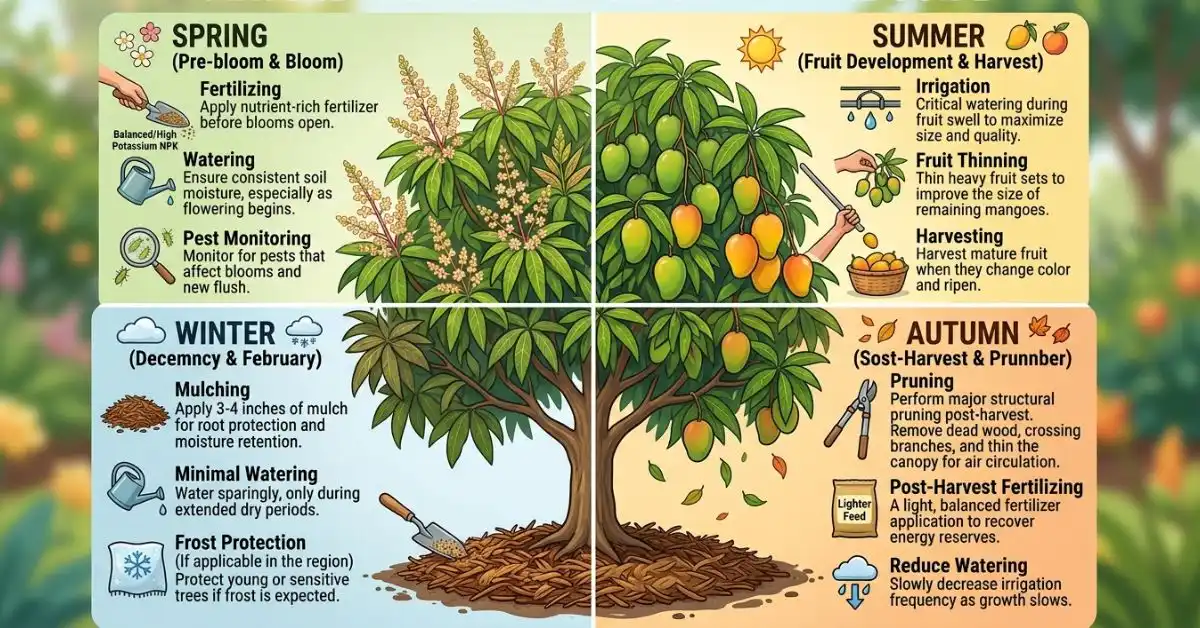
The Mango Tree’s Year: Four Phases
Mango trees run on a clock. Every year follows the same pattern, driven by temperature, moisture, and daylight:
Phase 1 — Rest (Late Fall through Early Winter). Growth stops. The tree goes quiet and conserves energy. Inside those terminal buds, flower buds are forming — you just can’t see them yet. This phase is triggered by cool temperatures and dry conditions.
Phase 2 — Flowering (Late Winter through Early Spring). Flower panicles push out from the branch tips. Blooming lasts two to four weeks. Pollinators do their work. Fruit set happens — or doesn’t — based on weather and insect activity.
Phase 3 — Fruiting and Growth (Spring through Summer). Fruit develops over three to five months. The tree also pushes new leaf growth. Water and nutrient demand hit their peak. Harvest happens late spring through late summer depending on your variety.
Phase 4 — Recovery (Late Summer through Fall). The tree recovers from fruiting. The last vegetative growth flush of the year produces the wood that will carry next year’s flowers. You start tapering off water and fertilizer to prepare the tree for rest.
Every care task you do should match the phase the tree is in. Working against this cycle is how you end up with a beautiful tree and no fruit.
Spring Care (March through May): Flowers, Pollination, and Fruit Set
Spring is when the whole year’s harvest is decided. Get this season right and the rest follows.
March — Protect Those Flowers
Flower panicles are emerging. This is the most vulnerable time.
Water lightly — once a week at the base. Never overhead. Wet flowers invite anthracnose and powdery mildew, the two worst mango flower diseases. Start a preventive fungicide spray (copper-based) as soon as you see panicle tips swelling.
Don’t fertilize with nitrogen. Excess nitrogen right now pushes leaf growth that competes with flowers. If you want to help, a light foliar spray of potassium and boron supports pollen health.
Don’t prune anything. Every branch tip could be holding a flower panicle. Even one cut removes potential fruit.
Attract pollinators. Place a small compost pile or some rotting fruit 10 to 20 feet from the tree. Flies — not bees — are the primary mango pollinators. They’re attracted to decomposing organic matter. Don’t spray any insecticides while flowers are open.
April — Peak Pollination
Flowers are fully open. Tiny fruitlets start appearing on successfully pollinated panicles.
Keep watering once a week. Water stress now causes flower and fruitlet drop. Continue the fungicide program. Monitor for mango hoppers on the panicles — they damage flowers and leave honeydew that grows sooty mold.
If your tree is indoors or on a screened patio, hand pollinate daily with a small paintbrush. Without pollinators, those flowers won’t become fruit.
May — Fruit Is Growing
Fruitlets are developing. The tree will naturally drop 60 to 90 percent of the fruit it set — that’s normal. It keeps only what it can support.
Increase watering to once or twice a week with deep soaking. Apply balanced fertilizer (6-6-6 or 10-10-10) and a 2 to 3 inch compost top-dressing. The tree is now under heavy nutrient demand. Switch from flower disease management to fruit pest management — set fruit fly traps if they’re a problem in your area.
Summer Care (June through August): Harvest and Peak Growth
Summer is the highest-activity season. Your tree needs the most water, the most nutrition, and the most attention right now.
June — Early Harvest Begins
Early-season varieties like Alphonso, Haden, and Dasheri start ripening. Fruit is ready when the shoulders fill out above the stem, the fruit gives slightly when squeezed, and you can smell sweetness at the stem end. Pick with an inch or two of stem attached to reduce sap burn.
Water is at peak demand. A mature fruiting tree can lose 15 to 25 gallons a day through transpiration in summer heat. Water one to two times a week with deep soaking. Increase volume during heat waves. Mulch — 3 to 4 inches — cuts evaporation by up to half.
Continue balanced fertilization and foliar micronutrient sprays. Potassium is especially important now for fruit sizing and sugar development.
July — Peak Harvest
Mid-season varieties like Kent, Glenn, Nam Doc Mai, and Langra are ripening. Harvest regularly — overripe fruit left on the tree attracts pests and disease.
Maintain your watering schedule. Don’t reduce water just because you’re picking fruit — there’s still fruit developing on the tree.
As each branch finishes its fruit, you can begin light tip-pruning on those harvested branches. This stimulates the next vegetative flush — which becomes next year’s fruiting wood.
August — Post-Harvest Recovery Begins
Late-season varieties like Keitt and Palmer are finishing up. Once the last fruit is picked, it’s time for the most important care tasks of the second half of the year.
Feed heavily. This is the biggest feeding of the year. Apply 3 to 4 inches of compost as a top-dressing. Hit it with balanced fertilizer including micronutrients. The tree just spent months producing fruit and is nutritionally depleted. It needs everything back.
Prune now. Right after the last harvest is the best window for major structural pruning. Remove dead and crossing branches. Open up the canopy center for light and airflow. Cut back excessive height. Apply copper fungicide to pruning wounds.
All pruning must be done by late September at the absolute latest. After that, terminal buds start forming into flower buds for next year. Cut them off and you cut off next year’s crop.
Clean up every fallen fruit and leaf from under the tree. Good sanitation reduces pest and disease carryover into next season.
Fall Care (September through November): Wind Down and Prepare
Fall is the most neglected season, but what you do — and don’t do — right now directly controls next year’s flowering.
September — Last Chance for Inputs
The final vegetative flush of the year is hardening. These branch tips will carry next year’s flowers.
Give the last fertilizer application of the year. After this — no more nitrogen until spring. This is one of the single most important timing decisions you’ll make. Late nitrogen is the number one cause of mango trees that grow leaves instead of flowers.
Complete any remaining pruning. After September, you’re done with the pruners until next August.
Reduce watering to every 7 to 10 days.
October — Stop Feeding, Start Drying
Growth is slowing down. The tree is hardening off.
No fertilizer. None. If you feel the urge to feed the tree, resist it. Any nitrogen now triggers a late vegetative flush that replaces developing flower buds with leaves — and that soft new growth is also vulnerable to frost.
Reduce watering to every 10 to 14 days. Refresh the mulch layer to 3 to 4 inches for root insulation heading into winter.
November — Begin the Dry Period
Growth has stopped. The tree is entering rest mode. Inside those terminal buds, flower development is starting — you just can’t see it.
Start the deliberate dry period. Water every two to three weeks at most, or stop entirely if natural rainfall is present. Container trees need just enough water to keep roots alive — very light watering every two to three weeks.
This dry stress, combined with cool nighttime temperatures, is the trigger that tells the tree to make flowers instead of leaves. Skip this step and you get Dennis’s result: a green tree with no fruit.
If you’re in Zone 9b to 10a, get your frost protection supplies ready. Frost cloth, incandescent Christmas lights, and extra mulch should be staged and accessible. For container trees, prepare the indoor winter location and move them inside before nights drop to 50°F.
Winter Care (December through February): The Art of Doing Nothing
Winter care for mango trees is mostly about restraint. The tree needs rest, and your job is to not interrupt it.
December and January — Deep Rest
No watering (or very minimal for containers). No fertilizer. No pruning. The tree looks dormant and inactive, but flower buds are developing inside those terminal shoots.
This feels like you’re neglecting the tree. You’re not. The restraint is the care.
Monitor weather in frost-prone zones. Have frost cloth ready to deploy within hours of a freeze warning. Water the soil 24 hours before a freeze — moist soil radiates more heat than dry. Cover the tree with frost cloth draped to the ground and secured. Incandescent lights (not LEDs) wrapped under the cloth generate heat. Remove everything as soon as the freeze passes.
By late January, watch for the terminal buds getting fatter and rounder. That’s the first sign that flower buds are forming inside. Your dry period strategy is working.
February — The Shift
When you see flower panicle tips emerging from the branch ends, resume light watering. Once a week, moderate volume. The panicles need moisture to develop.
The key is timing. Resume water after you see panicles — not before. Too early and the tree pushes leaves instead of flowers. Too late and the flowers dry out.
Apply a light dose of low-nitrogen, high-potassium fertilizer. Start the preventive fungicide program. And keep frost protection ready — a late February freeze that kills emerging panicles can wipe out the entire year’s crop in a single night.
The Mistakes That Cost You Fruit
Fertilizing with nitrogen in fall or winter. This is the number one seasonal mistake. It makes the tree grow leaves when it should be making flowers.
Watering through winter with no dry period. The tree never gets the signal to switch from vegetative growth to flowering.
Pruning during flower bud formation. Any cuts from October through March risk removing next year’s flowers.
Spraying insecticides during bloom. You kill the pollinators your tree depends on for fruit set.
Ignoring post-harvest care. The August feeding and pruning window is what sets up next year’s success.
Treating the tree the same all year. Mango trees need different things in different months. A constant, unchanging care schedule produces a lush tree with no fruit.
Final Thought
Dennis adjusted his approach the following year. He stopped fertilizing in October. He cut back watering in November. He let his tree sit dry and quiet through December and January. In February, panicle tips appeared on almost every branch.
He got over 60 mangoes that season. Same tree. Same yard. Same soil. The only thing that changed was the timing.