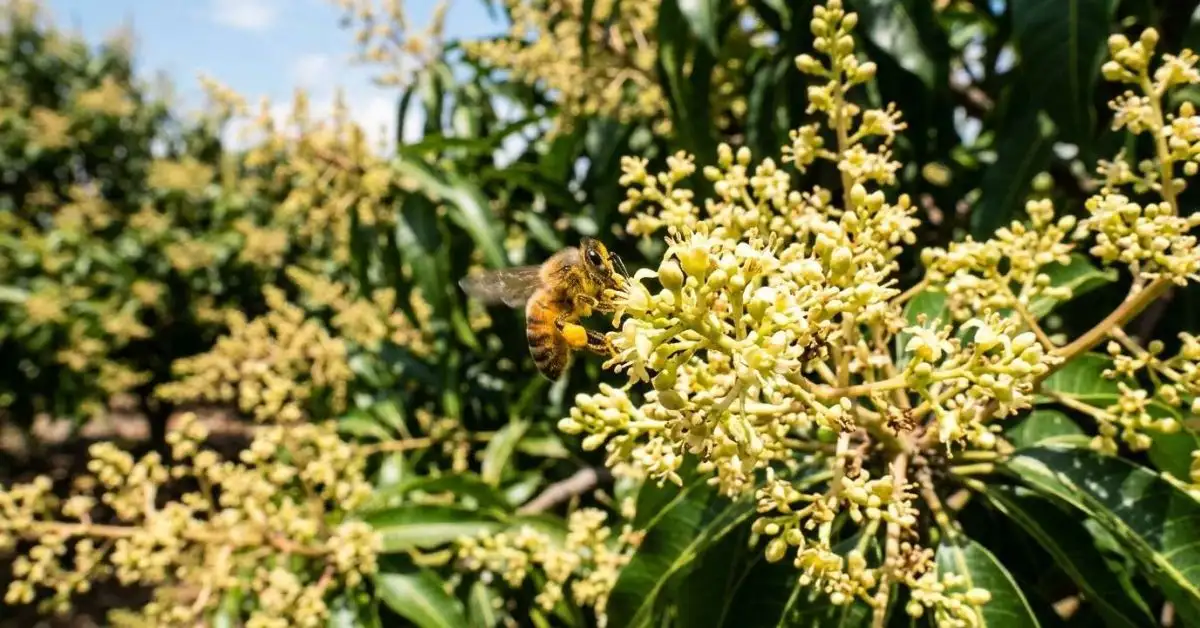
A grower named Angela sent a message to a gardening group I follow with a photo that told a familiar story. Her six-year-old mango tree was covered in flower panicles — hundreds of them. Beautiful. She was counting the mangoes in her head already.
Six weeks later, she posted again. Every single flower had dried up and fallen off. Not one fruit. The tree looked perfectly healthy. She’d watered it right, fertilized it on schedule, and gave it full sun. She couldn’t figure out what went wrong.
The answer was mango pollination — or more accurately, the lack of it. Angela’s tree was on a screened-in patio. The flowers bloomed perfectly. But no insects could get to them. Without pollinators, those thousands of flowers had zero chance of becoming mangoes.
Her story is one I hear over and over. People assume that if a mango tree flowers, fruit will follow. But flowering is only half the equation. The other half is what happens — or doesn’t happen — between those tiny flowers and the insects that visit them.
How Mango Flowers Actually Work
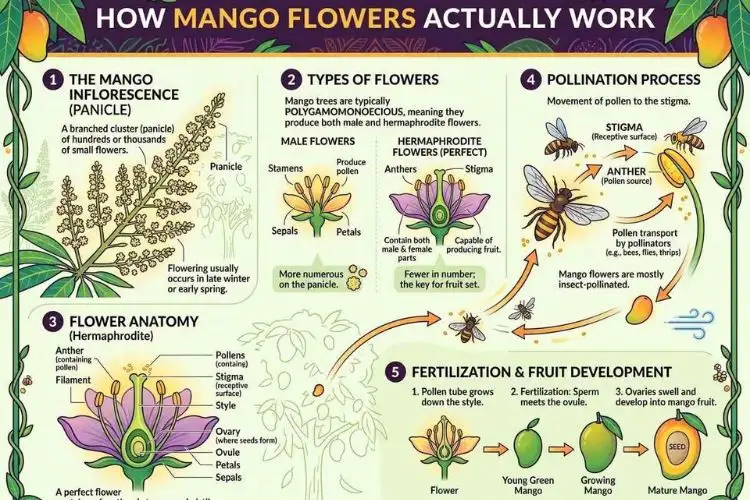
Before we talk about pollination, you need to understand what’s happening on those flower clusters. Most people don’t look closely at mango flowers because they’re tiny — each one is only about 5 to 10 millimeters across. But a lot is going on inside them.
Mango trees produce flowers in branched clusters called panicles. A single panicle can hold 500 to 10,000 individual flowers. A mature tree in full bloom might have hundreds of panicles, meaning millions of total flowers on the tree at once.
Here’s the part that surprises most growers: not all of those flowers can become fruit.
Every mango panicle carries two types of flowers at the same time:
Perfect flowers have both male and female parts. These are the only flowers that can turn into a mango.
Staminate flowers have only male parts. They produce pollen but can never become fruit. They exist only to provide pollen for the perfect flowers.
The ratio? Only about 25 to 50 percent of the flowers on any panicle are perfect. The rest are male-only. So right off the bat, half or more of your tree’s flowers are physically incapable of making fruit — no matter how good the pollination is.
And of the perfect flowers that do get successfully pollinated? Only about 0.1 to 2 percent will develop into mature fruit. The tree naturally drops the rest.
That sounds grim, but it’s completely normal. A healthy mature mango tree still produces 100 to 400 or more fruit per season even with those numbers. The tree makes millions of flowers because it knows most won’t make it.
The Pollination Process
When a mango flower opens, it’s only receptive for about one to two days. During that window, an insect needs to visit the flower, pick up sticky pollen from the stamens, carry it to a perfect flower on the same tree or a different tree, and deposit it on the stigma — the tip of the female part.
If all goes well, the pollen grain germinates, grows a tube down into the flower, and fertilization happens within 24 to 48 hours. The fertilized flower starts developing into a fruit. Unfertilized flowers dry up and drop.
The whole thing depends on two conditions being right at the same time: insects showing up, and the temperature being warm enough for pollen to work. If either one fails, you get Angela’s situation — beautiful flowers and zero fruit.
Do You Need Two Trees?
No. Mango trees are self-fertile. A single tree can pollinate its own flowers and produce fruit without another mango nearby. You don’t need a pollination partner like you do with some apple varieties.
That said, having two or more mango trees — even different varieties — can improve fruit set modestly through cross-pollination. But one tree is plenty.
The Real Mango Pollinators (It’s Not Bees)
Here’s something that most gardening guides get wrong: bees are not the main pollinators of mango trees. Flies are.
Blowflies, houseflies, flesh flies, and hoverflies do most of the work. Studies across India, Australia, and Florida have found that flies account for 60 to 90 percent of mango flower visits.
Why flies instead of bees? Mango flowers produce very little nectar — not enough to interest most bee species. The pollen is sticky and heavy, not the kind bees prefer to collect. And the flowers give off a subtle scent with light decomposition notes that attracts flies far more than bees.
Bees do visit mango flowers and help some, especially honeybees and stingless bees. But they’re secondary players. Flies are your MVP.
This matters because the things that attract flies to your yard are different from what attracts bees. More on that in a minute.
Wind does not pollinate mango trees. The pollen is too heavy and sticky for air transport. Without insects — primarily flies — pollination doesn’t happen.
Why Your Mango Tree Flowers But Doesn’t Fruit
If your tree blooms and nothing comes of it, here are the most common reasons:
No pollinators can reach the flowers. This is Angela’s problem. Trees on screened patios, in greenhouses, or indoors produce flowers but get zero insect visits. No pollination means no fruit. The fix is hand pollination.
Temperature is wrong. Pollen stops working below about 60°F and above 100°F. The sweet spot for pollination is 75 to 90°F during the day. In subtropical areas like Central Florida or Northern India, mango flowering often happens in late winter or early spring when cold snaps are still possible. One cold night can wreck a whole week of pollination.
Rain and humidity during bloom. Wet weather is a double hit. Rain physically washes pollen off the flowers. And high humidity above 80 percent promotes anthracnose and powdery mildew — fungal diseases that can destroy entire panicles. I’ve talked to growers in South Florida who lost their entire flower crop to anthracnose during a rainy February. A preventive copper fungicide spray at panicle emergence, before flowers open, is the standard defense.
Too much nitrogen. If you’ve been feeding the tree heavy nitrogen fertilizer heading into flowering season, the tree puts energy into growing leaves instead of setting fruit. Stop nitrogen two months before expected bloom. Switch to a potassium-heavy formula.
No dry period. Many mango varieties need a deliberate dry stretch of 4 to 8 weeks before flowering to trigger bud formation. Trees watered on a constant year-round schedule may grow green and leafy but never flower well.
Tree is too young. Seed-grown trees can take 5 to 10 years to flower. Grafted trees flower in 2 to 3 years, but first blooms often set poorly. First-year flowering with weak fruit set is normal and improves each season.
Alternate bearing. Some varieties — Alphonso, Langra, Dashehari — naturally produce heavily one year and lightly the next. It’s genetic. You can moderate it by thinning fruit during heavy years and keeping nutrition steady, but you can’t eliminate it completely.
How to Attract More Pollinators
Since flies are your primary pollinators, you want more flies near your tree during bloom. Here’s what works:
Place decomposing organic matter nearby. A small compost pile, a bucket of aging manure, or some rotting fruit placed 10 to 20 feet from the tree during flowering season will boost the fly population around your mango. It’s not glamorous, but it works. Remove it after flowering ends.
Plant companion flowers that bloom at the same time. Marigolds, zinnias, cosmos, and lantana attract a range of pollinators. Put them within 15 to 20 feet of your mango tree.
Don’t spray pesticides during bloom. This is the biggest self-inflicted wound I see growers make. Spraying any insecticide — even organic neem or pyrethrin — while flowers are open kills the flies and bees your tree depends on. If you need pest treatment, do it before or after flowering. Never during.
Set out a shallow water dish. A plate with pebbles and water gives pollinators a drinking spot. Flies and bees both need water, especially in dry or hot weather.
How to Hand Pollinate a Mango Tree
If your tree is indoors, on a screened patio, or in a greenhouse, hand pollination is your only option. It’s also worth doing as a supplement for outdoor trees during cold or rainy stretches when natural pollinators aren’t active.
Tools: A fine-tipped artist’s paintbrush (size 0 to 2 with natural bristles), a cotton swab, or even your fingertip.
Best time: Morning, between 8 and 11 AM, on a dry warm day above 68°F.
Step 1: Find the perfect flowers. Look for flowers with a small central structure (the pistil) rising above the stamens. These are the ones that can become fruit. Male-only flowers lack this central pistil.
Step 2: Touch your brush gently to the anthers of an open flower. You should see yellow pollen dust on the bristles. Collect from several flowers.
Step 3: Touch the pollen-loaded brush to the stigma (the tip of the pistil) on a different perfect flower. The stigma is slightly sticky when receptive — pollen will cling to it.
Step 4: Repeat on as many perfect flowers as you can find. Aim for 20 to 50 or more flowers per session.
Step 5: Come back and do it again every day or every other day throughout the entire bloom period — usually two to four weeks. New flowers open daily, and each one is only receptive for a day or two.
Studies show hand-pollinated mango trees can achieve 3 to 5 times higher fruit set compared to enclosed trees with no pollination. Even with good hand pollination, expect only 5 to 15 percent of pollinated flowers to develop into mature fruit. That’s normal. The tree drops the rest on purpose.
Fruit Drop After Pollination — Don’t Panic
Even after successful pollination, your tree will drop a lot of developing fruit. This freaks people out, but it’s the tree’s built-in quality control.
There are typically three waves of fruit drop. The first wave in the first week is unfertilized flowers falling off — expected. The second wave at weeks two to four is pea-sized fruit the tree can’t support nutritionally. The third wave at weeks four to eight is continued thinning of weaker fruit.
After wave three, what’s left usually stays on the tree through to harvest. Of the fruit that initially sets, the tree naturally drops 60 to 90 percent. It keeps only what it can fully support.
To reduce preventable drop beyond what’s natural: water consistently during fruit development, keep nutrition steady with potassium and micronutrients, and protect developing fruit from pests — especially fruit flies.
If all fruit drops, or near-mature fruit falls with visible damage, that’s not normal thinning. Check for drought stress, pest problems, disease, or root damage.
Final Thought
Angela’s fix was simple. She bought a $3 paintbrush and started hand-pollinating every morning during her tree’s next bloom. That season she got 14 mangoes from her screened-patio tree. Not a huge harvest, but 14 more than zero.
She told the group, “I spent two years blaming the tree. Turns out I just needed to play matchmaker.”
That’s pollination in a nutshell. Your tree does the hard work of making the flowers. Your job is making sure something — an insect or a paintbrush — connects the dots between them.