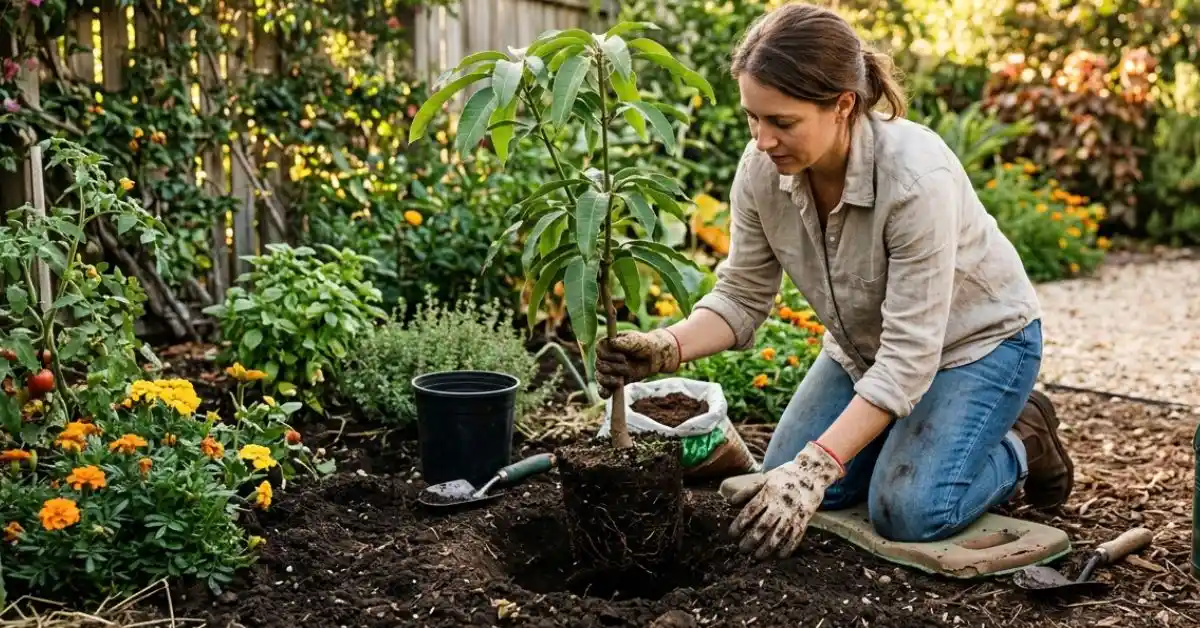
A woman named Sandra posted in a gardening group I follow last spring with a problem. Her landlord was about to pour a new driveway. Right where her seven-year-old Glenn mango tree was growing. She had two weeks to move it or lose it.
She panicked. She dug it up on a Saturday afternoon in July — peak Florida heat — with a root ball way too small for the trunk size. She didn’t prune the canopy. She didn’t root prune ahead of time. She dragged it across the yard by the trunk and dropped it in a hastily dug hole.
Within a week, every leaf was brown. By week three, the tree was completely bare. She was sure it was dead.
It wasn’t. But it took nine months to recover. Nine months of careful watering, shade cloth, and patience before new buds finally broke through. She got lucky. A lot of trees don’t survive that kind of move.
The thing is, transplanting a mango tree doesn’t have to be a gamble. With the right timing, preparation, and aftercare, survival rates run 85 to 95 percent for young trees. Even mature trees can be moved successfully. You just have to do it right.
When to Transplant a Mango Tree
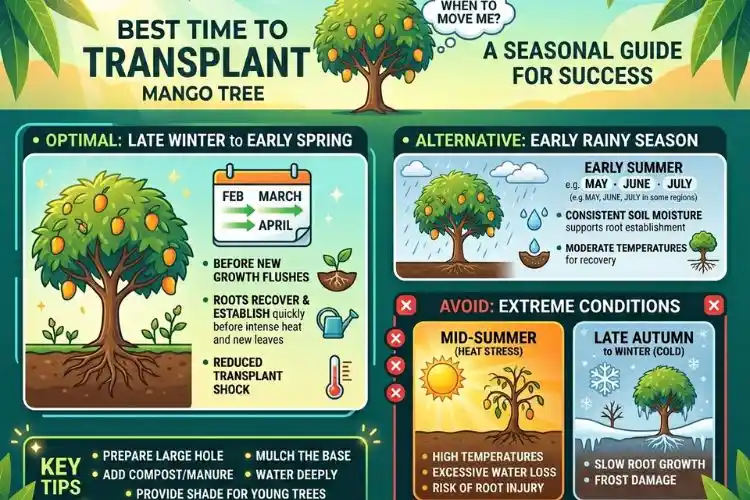
Timing is the single biggest factor in whether your transplant succeeds or fails.
Early spring is the best window. Late February through April in the Northern Hemisphere. The tree is coming out of its winter rest period with full energy reserves. Root growth is about to kick into high gear as the soil warms. And you’ve got the entire growing season ahead for recovery before the next winter.
ICAR research shows mango trees transplanted in early spring establish roots 30 to 40 percent faster than trees moved at other times.
In tropical climates with a distinct wet and dry season, the start of the rainy season also works well. Consistent rainfall reduces your watering burden and warm soil speeds up root growth.
Times to avoid:
- Mid-summer heat. Damaged roots can’t keep up with the water the tree loses through its leaves on a 95-degree day.
- During flowering or fruiting. The tree’s energy is tied up in reproduction. You’ll lose the crop and stress the tree badly.
- Late fall or winter. Root growth slows below 60°F and stops below 50°F. If a freeze follows the transplant, the tree may not make it.
The larger and older the tree, the narrower your timing window gets. A one-year-old seedling can be moved almost anytime it’s warm. A ten-year-old tree? Early spring only, with weeks of preparation beforehand.
| Tree Size | Best Timing | Recovery Time | Risk |
|---|---|---|---|
| Seedling (under 1 year) | Any warm season | 1–2 weeks | Very Low |
| Young (1–3 years) | Early spring | 2–4 weeks | Low |
| Established (3–7 years) | Early spring | 4–8 weeks | Moderate |
| Mature (7–15 years) | Early spring only | 2–6 months | High |
| Large mature (15+ years) | Early spring, hire a pro | 6–12 months | Very High |
Preparing Before the Move
What you do in the weeks before transplant day matters more than what you do on the day itself. A well-prepared tree has a 90 to 95 percent survival rate. An unprepared one drops to 60 to 70 percent.
Root Pruning (4 to 8 Weeks Before)
This is the step most people skip — and it’s the step that makes the biggest difference for in-ground trees.
Four to eight weeks before the move, take a sharp spade and cut straight down in a circle around the tree. This circle should match the root ball size you plan to dig on moving day. Cut 12 to 18 inches deep. Then stop. Leave the tree right where it is.
What happens next is the magic part. Those severed root tips grow dense clusters of new feeder roots over the next several weeks. When you finally dig the tree up, those new roots travel with the root ball. They’re the roots that will absorb water and nutrients at the new location.
Without root pruning, you’re moving a tree with almost no functional feeder roots. Think of root pruning as packing a suitcase of roots that the tree carries to its new home.
How Big Should the Root Ball Be?
Use the trunk diameter as your guide. For every inch of trunk thickness (measured 6 inches above the ground), you want 10 to 12 inches of root ball diameter.
A tree with a 2-inch trunk needs a root ball 20 to 24 inches across. A 4-inch trunk needs 40 to 48 inches. Undersized root balls are the second most common cause of transplant failure after bad timing.
Prune the Canopy
One to two weeks before the move, reduce the canopy to match the reduced root system. For established trees, remove 25 to 30 percent. For mature trees, take off 30 to 50 percent. Focus on lower branches, crossing branches, and heavy leaf clusters.
Don’t strip the tree bare — it still needs leaves for photosynthesis during recovery. But a full canopy on a damaged root system is like running the air conditioning full blast with the windows open. The roots can’t keep up.
Water Deeply Before Moving Day
Soak the root zone 24 to 48 hours before the transplant. Moist soil holds together around the root ball. Dry soil crumbles apart and exposes roots to air. Hydrated tissues also handle shock better than dehydrated ones.
Transplanting a Seedling or Potted Tree
This is the easiest type of transplant. If you’re moving a young mango from one pot to a bigger pot, or from a pot into the ground, the risk is low and the process is straightforward.
Pot to Bigger Pot
Water the tree the day before. Slide the root ball out by tipping the pot sideways and tapping the sides — don’t pull by the trunk. If roots are circling, tease them apart gently or make a few shallow vertical cuts along the sides of the root ball.
Put the tree in a pot that’s 2 to 4 inches larger in diameter. Don’t jump from a tiny pot to a huge one — too much soil around a small root system stays wet and causes rot. Fill with well-draining potting mix. Keep the soil line at the same level it was before. Water thoroughly. Give it indirect light for a few days before moving back to full sun.
Pot to Ground
Pick a spot with full sun, good drainage, and at least 20 to 25 feet from buildings and other large trees. Mango canopies can spread 30 to 60 feet at maturity — plan for the future, not just today.
Dig the hole three times wider than the root ball and the same depth. Not deeper. Mix the excavated soil with 20 percent aged compost and 10 percent perlite or coarse sand.
Place the tree so the root crown — where the trunk meets the roots — sits at or slightly above the surrounding soil level. If you have clay or slow-draining soil, build a raised mound 12 to 18 inches high and plant into that.
Backfill in layers, watering each layer to settle the soil and eliminate air pockets. Build a soil berm ring around the tree to hold water over the root zone. Spread 3 to 4 inches of mulch, keeping it 6 inches away from the trunk. Water deeply.
The number one mistake here is planting too deep. If the root crown gets buried, collar rot sets in and the tree slowly declines. When in doubt, plant a little high.
For grafted trees from a nursery, make sure the graft union — the bulge or scar on the lower trunk — stays above the soil line. Burying it defeats the purpose of the graft.
Moving an In-Ground Mango Tree
This is where the stakes get higher. Moving an established tree out of the ground and into a new location is a real operation. But it’s doable with the right approach.
Prepare the new hole before you dig up the tree. You want the root ball out of the ground for as little time as possible — ideally under 30 minutes. Every minute those roots sit in open air, fine feeder roots are drying and dying.
On moving day, dig around the root ball following the circle you cut during root pruning weeks earlier. Undercut beneath the root ball with the spade to sever the taproot. Tilt the tree gently and slide a tarp or burlap under the root ball. Wrap it tight to hold everything together.
Lift by the root ball. Never by the trunk. For small trees, two people can manage it. Medium trees need a hand truck or garden cart. Anything with a trunk over 6 inches? That root ball can weigh 500 to 1,000 pounds or more. You’ll need equipment or professional help. Tree moving services typically cost $500 to $3,000 depending on the size and distance.
Place the tree in the new hole at the same depth it was planted before — match the old soil line on the trunk. Backfill, water, mulch, and stake if the tree is leaning or exposed to wind.
Dealing with Transplant Shock
Every transplanted mango tree goes through some level of shock. It’s not a disease — it’s a stress response. The root system has been cut and disrupted, and the tree can’t absorb water at its normal rate.
You’ll see wilting within the first few days. Leaf drop over the next couple of weeks. Maybe some brown, crispy edges on the remaining leaves. Growth will stall completely for weeks or even months.
All of that is normal. Even complete leaf drop doesn’t mean the tree is dead. A bare mango tree with green bark under the surface is still alive and working on recovery underground.
Scratch a small patch of bark with your thumbnail. Green underneath? It’s alive. Keep watering. Keep waiting. Some trees take 8 to 12 weeks before new growth appears. Sandra’s took nine months. Don’t pull a tree out of the ground after three weeks of looking bad — you might be throwing away a tree that was about to come back.
How to Reduce Shock
- Provide 30 to 50 percent shade cloth for the first 2 to 4 weeks.
- Water consistently — every 1 to 2 days for the first two weeks, then gradually stretch to every 3 to 5 days.
- Apply mycorrhizal inoculant to the root zone at planting.
- Don’t fertilize for at least 4 to 6 weeks. Damaged roots can’t handle fertilizer salts.
- Don’t prune anything more after the move. The tree needs every leaf it has left.
Recovery Timeline
| Time | What to Expect | What to Do |
|---|---|---|
| Days 1–7 | Wilting, drooping | Water consistently, provide shade |
| Weeks 1–3 | Leaf drop, scorching | Stay the course, keep soil moist |
| Weeks 3–6 | Stabilizing, drop slows | Reduce shade gradually |
| Weeks 6–12 | First new buds appear | Begin diluted fertilizer |
| Months 3–6 | New leaf flushes, active growth | Resume normal care |
| Months 6–12 | Full canopy recovery | Standard mango care |
Emergency Transplants
Sometimes you don’t get 4 to 8 weeks to prepare. Construction, storm damage, or a property issue forces the move on short notice. Sandra’s situation.
If that’s you, here’s the emergency protocol: water the tree immediately and deeply. Prune the canopy by 40 to 50 percent — more aggressive than a planned move because you haven’t root pruned. Dig the biggest root ball you can manage. Wrap it. Move it fast. Plant it. Apply root stimulator. Cover with 50 percent shade cloth. Water daily for the first two to three weeks.
Accept that shock will be severe. Recovery will take longer. Success rates for emergency transplants run about 50 to 70 percent for established trees. Not great, but better than losing the tree to a bulldozer.
Common Mistakes That Kill Transplanted Trees
The ones I see most often:
Wrong timing. Moving a tree in July heat or during fruiting season. Wait for early spring.
Root ball too small. This is false economy. Take the extra time to dig wider.
Planting too deep. The root crown must be at or above the soil line. Every time.
Fertilizing too soon. Wait 4 to 6 weeks minimum. Start with compost tea or diluted seaweed extract.
Inconsistent watering. A big soak on day one followed by nothing for a week. Transplanted trees need reliable, steady moisture for weeks. Set a phone reminder if you have to.
Giving up too early. A leafless mango tree with green bark is a living tree. Wait three months before making any decisions.
Final Thought
Sandra’s Glenn mango is doing fine now. It took almost a full year, but it put out three strong growth flushes last summer and even produced a small cluster of flowers this spring. She didn’t get fruit from them — the tree wasn’t quite ready — but the fact that it flowered at all after what it went through is a good sign.
She told me if she had to do it again, she’d root prune ahead of time, cut the canopy back, and move it in March instead of July. “I’d have saved myself nine months of staring at a stick in the ground wondering if it was dead.”
That’s the lesson. A little planning up front saves a lot of worry on the back end. Your mango tree can handle the move. Just give it the right setup, the right timing, and a little patience.