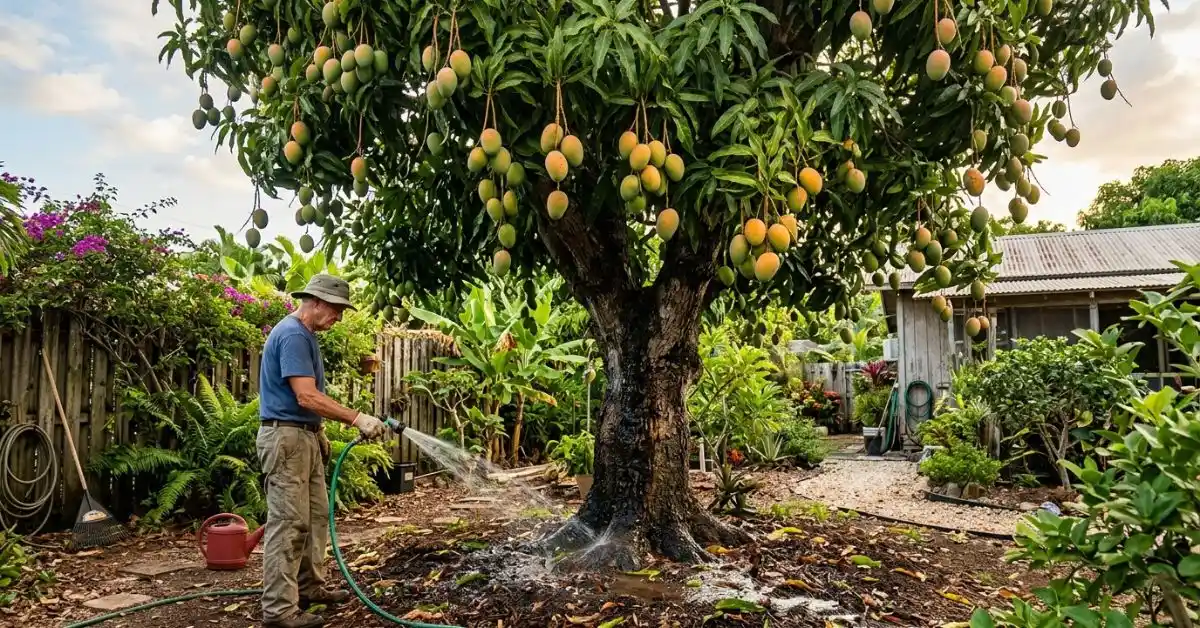
A grower named Theresa in a South Florida gardening group once posted a photo that broke my heart a little. Her mango tree — a five-year-old Glenn she’d babied since it was a nursery seedling — was dropping yellow leaves by the handful. The trunk base looked dark and wet. She thought it needed more water, so she’d been running the hose every single day.
The tree didn’t need more water. It was drowning.
By the time someone in the group told her to stop watering and check the roots, it was too late. Root rot had taken over. The roots were brown, mushy, and smelled like a swamp. She lost the tree.
Here’s the thing about mango trees: overwatering kills more of them than underwatering ever will. And the tricky part is that the symptoms of too much water can look a lot like not enough. Wilting, yellow leaves, dropping fruit — both problems can cause the same signs.
So let me walk you through exactly how to water a mango tree the right way — how much, how often, and when to stop.
How Mango Trees Use Water
Before we get into schedules and gallons, it helps to understand how water actually moves through a mango tree.
Water enters through the roots — mainly the fine feeder roots in the top 12 to 24 inches of soil. It travels up through the trunk and branches like liquid moving through a straw, carrying nutrients along with it. Then it exits through the leaves as vapor (that’s called transpiration). A mature mango tree can lose 50 to 100 gallons of water per week through its leaves during peak summer heat.
The root system spreads wide — usually as far out as the canopy reaches, sometimes wider. That means watering just at the trunk base misses most of the active roots. You need to water out at the drip line, where the canopy edge is.
Why Mango Trees Need Dry Periods
This is the part most people miss. Mango trees evolved in monsoon climates — places with a heavy wet season followed by months of dry weather. That dry period isn’t just something the tree tolerates. It actually needs it.
The dry spell, combined with cool nighttime temperatures, is what triggers the tree to stop growing leaves and start making flowers instead. No dry period means no flowers. No flowers means no fruit.
I’ve heard this story dozens of times: someone has a beautiful, lush, green mango tree that grows like crazy but never produces a single mango. They’re watering it perfectly — for a shade tree. But mango trees need that stress signal to shift into fruiting mode.
How Often to Water a Mango Tree

There’s no one-size-fits-all answer, but here are solid guidelines based on the tree’s age and growth stage.
Newly planted trees (first 2 weeks): Water every day for the first week, then every other day the second week. Use about 2 to 3 gallons each time. The goal is to keep the soil moist while roots settle in — but never soggy. If the ground is still wet from yesterday’s watering, skip today.
Young trees (0 to 3 years): Water 2 to 3 times per week during spring and summer. Cut back to once a week in fall. In winter, stretch it to every 10 to 14 days. Use 3 to 5 gallons per session. Let the top 2 to 3 inches of soil dry out between waterings. The finger test works great here — push your finger into the soil. Dry? Water. Still damp? Wait.
Established trees (3 to 5 years): Once or twice a week in summer, once a week in fall, and little to nothing in winter. Use 5 to 10 gallons per session, applied at the drip line. Your tree is getting tougher now and can handle some drought.
Mature fruiting trees (5+ years): This is where the seasonal rhythm really matters.
- Summer (fruit development): Once a week, deep soak, 10 to 20+ gallons depending on tree size.
- Fall (after harvest): Gradually reduce. Once a week, then every two weeks.
- Winter (pre-flowering): Stop watering or go very minimal for 4 to 8 weeks. This is the dry period that triggers flowering.
- Flowering and fruit set (late winter/spring): Resume light watering, once a week.
That winter dry period is the single most important watering decision you’ll make all year. A mature fruiting tree in South Florida or Southern California that gets watered through the winter like it’s still July will push out leaves instead of flowers — and you’ll get no fruit that season.
| Tree Stage | Spring/Summer | Fall | Winter | Gallons |
|---|---|---|---|---|
| Newly Planted | Daily → every other day | N/A | N/A | 2–3 |
| Young (0–3 yrs) | 2–3x per week | 1x per week | Every 10–14 days | 3–5 |
| Established (3–5 yrs) | 1–2x per week | 1x per week | Minimal | 5–10 |
| Mature (5+ yrs) | 1x per week deep | Reduce gradually | Stop for 4–8 weeks | 10–20+ |
How Much Water and How to Apply It
The golden rule: water deeply and less often. Short, frequent sprinkles create shallow roots. Deep, slow soaking pushes roots downward, making the tree more stable and more drought-resistant.
Lay your hose at the drip line — the outer edge of the canopy — on a slow trickle. Let it run for 20 to 45 minutes until water has soaked 12 to 18 inches deep. You can check depth with a long screwdriver or soil probe after watering. If it slides in easily to 12 inches or more, you’ve watered enough.
Never water at the trunk base. Most active roots aren’t there, and keeping the trunk wet invites collar rot and disease.
Your soil type changes everything. Sandy soil drains fast, so you may need to water more often with slightly less volume each time. Clay soil holds water much longer — water less often and give extra drying time between sessions. Sandy loam is the sweet spot where standard recommendations work well.
Watering a Mango Tree in a Pot
Container trees are a different game. Pots dry out much faster than the ground. There’s less soil to hold moisture, and the pot itself heats up in the sun, speeding evaporation.
During spring and summer, plan on watering your potted mango every 2 to 3 days. In extreme heat, it might need water daily. In fall, stretch to every 3 to 5 days. In winter, every 7 to 14 days — just enough to keep the soil from going bone dry.
Water slowly from the top until you see it flowing from the drainage holes. Let all the excess drain out completely. Never let your pot sit in a saucer of standing water. That’s a fast track to root rot.
Pot material matters too. Terra cotta is porous and dries out faster. Plastic holds moisture longer. Fabric grow bags drain the fastest of all — you’ll water these most often.
The best trick I’ve learned for container trees is the lift test. Pick up the pot (or try to) right after a good watering. Feel how heavy it is. Then check again in a few days. When it feels noticeably lighter, it’s time to water. After a while, you can tell at a glance just by tilting the pot.
Overwatering vs. Underwatering — How to Tell the Difference
Both cause wilting. Both cause yellow leaves. So how do you figure out which one is the problem?
Check the soil. Stick your finger in 2 to 4 inches deep.
- Soil is wet and tree is wilting? That’s overwatering. The roots are probably damaged.
- Soil is dry and tree is wilting? That’s underwatering. Give it a deep soak.
Other signs of overwatering: leaves turning yellow starting from the bottom of the tree, mushy or foul-smelling roots, fungal growth near the soil line, and leaves dropping even though they still look green.
Signs of underwatering: leaf edges turning brown and crispy, leaves curling inward, fruit dropping before it’s ready, and soil cracking or pulling away from the pot edges.
Here’s the good news: an underwatered mango tree usually bounces back within a day or two after a good drink. An overwatered tree with root rot? That’s much harder to save. If you catch it early — stop watering, trim away rotten roots, repot in fresh well-draining soil, and apply a phosphonate fungicide — you might pull it through. But if more than half the roots are gone, the odds aren’t great.
A $10 soil moisture meter from any garden center takes all the guesswork out of this. Stick it in, read the scale, and you know exactly where you stand.
Best Ways to Deliver Water
Drip irrigation is my top recommendation for most growers. It puts water right at the root zone, keeps leaves dry, wastes very little, and can run on a timer. Set up 2 to 4 emitters in a ring at the drip line. Run them for 30 to 60 minutes per session. A basic single-tree setup costs $30 to $100.
Soaker hoses are a solid budget option. Coil one around the drip line and let it seep for 30 to 45 minutes.
A garden hose on a slow trickle works fine if you only have a few trees and don’t mind standing there. Throw a $15 hose timer on it so you don’t forget and flood the yard.
Sprinklers? Skip them. Wet leaves invite anthracnose and powdery mildew — the two worst fungal diseases for mango trees. Sprinklers also waste a lot of water to evaporation and encourage shallow root growth.
If your mango tree is on the same zone as your lawn sprinklers, separate it. Lawns want short, daily watering. Mango trees want deep, infrequent soaking. Those two schedules are opposites.
Common Watering Mistakes
The biggest ones I see over and over:
Watering every day. Unless you just planted the tree this week, daily watering is too much. It keeps the soil saturated and kills roots.
Shallow watering. A quick spray with the hose wets the top inch and does nothing for roots 12 inches down.
Skipping the winter dry period. Your tree needs those dry weeks to trigger flowering. Keep watering through winter and you’ll get a leafy tree with zero fruit.
Not mulching. Bare soil around your mango tree loses moisture 2 to 3 times faster than mulched soil. A 3 to 4 inch layer of wood chips reduces how often you need to water by 25 to 50 percent. Keep the mulch 6 inches away from the trunk.
Ignoring your soil type. Watering advice online assumes average soil. If you have clay, you’re probably overwatering. If you have sand, you might be underwatering. Test your drainage and adjust.
Watering right after heavy rain. If you’re on an automated system, install a $15 rain sensor. It skips the cycle when it’s already rained. Seems simple, but I’ve seen plenty of trees sitting in puddles with the irrigation still running.
Final Thought
Theresa’s story didn’t have a happy ending. But she learned from it. She planted a new Glenn the following spring — this time on a raised mound with fast-draining sandy loam. She set up drip irrigation on a timer. She stopped watering in November and let the tree go dry through December and January.
That tree flowered its third year. She sent a photo of the first fruit to the group with the caption: “This time I let it get thirsty.”
That’s the thing about watering mango trees. Sometimes the best thing you can do is put the hose down.